赚钱效应

Search documents
投资者微观行为洞察手册3月第4期:市场高波动之下:外资比内资更积极
GUOTAI HAITONG SECURITIES· 2026-04-01 09:40
Group 1 - The report indicates a slight decrease in market trading activity, while the profitability effect is on the rise, with the average daily trading volume for the entire A-share market dropping to 2.1 trillion yuan and the proportion of stocks rising by 40.7% [8][10][11] - The report highlights that foreign capital has significantly flowed into the A-share market, with a net inflow of approximately 6.7 million USD as of March 25, while financing funds have seen a slight outflow [22][43][45] - The report notes that the issuance of new public equity funds has decreased to 16.9 billion yuan, indicating a decline in public fund activity [31][36] Group 2 - The report observes that the confidence index for private equity funds has decreased by 0.1% compared to the previous month, suggesting a decline in sentiment among private investors [41][47] - The report states that the net inflow of foreign capital into the A-share market has reached a historical percentile of 88.5%, indicating strong foreign interest [43][44] - The report mentions that the trading concentration in primary industries has decreased, while the concentration in secondary industries has increased, with seven industries maintaining a turnover rate above 90% historically [19][20] Group 3 - The report indicates that the electric power equipment sector has seen significant inflows from financing and ETF funds, while the electronics sector has experienced notable outflows [3][29][43] - The report highlights that the public utilities and coal sectors have shown a marked increase in trading activity, with public utilities seeing a 39.95% increase in trading volume [18][19] - The report notes that the top three industries on the trading leaderboard are public utilities, environmental protection, and electronics, reflecting current market trends [3][22] Group 4 - The report indicates that the southbound capital has significantly flowed into the Hong Kong stock market, with net purchases rising to 25.15 billion yuan, reflecting increased foreign investment in the region [4][24] - The report highlights that global foreign capital has marginally flowed into the Chinese market, with China being one of the top recipients of foreign investment [4][24][43] - The report mentions that the Nasdaq index has declined by 3.2%, with most global markets experiencing losses, particularly the South Korean composite index, which fell by 5.9% [4][24]
投资者微观行为洞察手册·2月第2期:外资延续流入,公募新发积极
GUOTAI HAITONG SECURITIES· 2026-02-24 10:05
Market Pricing Status: Trading Activity Slightly Decreased, Profitability Increased - The trading turnover rate has decreased, with the average daily trading volume for the entire A-share market dropping to 2.1 trillion yuan, and the average number of daily limit-up stocks decreasing to 60.8 [8][12] - The proportion of stocks that increased in value rose to 47.6%, while the median weekly return for A-share stocks increased to -0.1% [12][15] - The trading concentration in both primary and secondary industries has declined, with six industries having turnover rates in the historical top 90% [12][19] A-Share Liquidity Tracking: Foreign Capital Slightly Inflows, ETF Capital Slightly Outflows - Foreign capital inflow amounted to approximately 3.67 million USD, with the northbound trading volume accounting for 34.6% of total trading [29][46] - The new issuance scale of equity funds increased to 43.63 billion yuan, indicating a rise in overall stock positions of public funds [29][31] - ETF funds experienced a net outflow of 44.18 billion yuan, with the proportion of passive trading decreasing to 6.6% [29][25] A-Share Industry Allocation Tracking: Divergence in Movements of Foreign Capital, ETF Capital, and Financing Capital - Foreign capital saw net inflows in the non-ferrous metals (+39.1 million USD) and banking (+21.4 million USD) sectors [29][43] - Financing capital showed net inflows in the media (+2.88 billion yuan) and environmental protection (+0.24 billion yuan) sectors, while there were significant outflows in power equipment (-6.5 billion yuan) and non-bank financials (-4.56 billion yuan) [29][19] - The ETF sector experienced widespread outflows, particularly in electronics (-11.47 billion yuan) and power equipment (-4.94 billion yuan) [29][19] Hong Kong Stock and Global Liquidity Tracking: Slowing Inflows from Southbound Funds, Marginal Inflows of Global Foreign Capital into Developed Markets - Southbound fund inflows decreased to 27.8 billion yuan, representing the 76th percentile since 2022 [29][4] - The Hang Seng Index fell by 0.6%, while global markets showed mixed performance, with South Korea leading with a 5.5% increase [29][4] - Global foreign capital saw marginal inflows into developed markets, particularly in the US (+8.13 billion USD), Japan (+3.9 billion USD), and the UK (+2.11 billion USD) [29][4]
公募新发规模已创近四年新高!马年增量资金蓄势待发
Bei Jing Shang Bao· 2026-02-23 13:03
Core Insights - The A-share market is set to welcome the first trading day of the Year of the Horse with a significant number of new fund launches, indicating a strong market sentiment and potential for growth in 2026 [1][3]. Fund Issuance - On February 24, the first trading day, 18 new funds were launched, with a total of 35 new funds expected to debut in the first week [3]. - In the first two months of 2026, a total of 245 new public funds were issued, with a scale nearing 210 billion yuan, marking a record high for the same period in nearly four years [1][4]. - The structure of the new funds is predominantly equity-focused, with 24 out of 35 funds being equity funds, accounting for over 68% of the total [3]. Market Sentiment and Trends - Analysts express optimism for the market's performance in 2026, attributing it to a strong stock market and increased investor demand for equity funds due to favorable past performances [5][6]. - The growth in new fund issuance is seen as a reflection of a long-term trend of household savings shifting towards capital markets, which is expected to continue throughout the year [6]. Performance Expectations - The market is anticipated to maintain a positive trajectory, with predictions of the index remaining above 4,000 points, which would further attract outside capital [7]. - The A-share market is expected to benefit from a seasonal "spring offensive" following the Lunar New Year, supported by positive performances in overseas markets [7][8]. Sector Insights - Technology stocks are highlighted as a leading sector for the Year of the Horse, with potential for continued strong performance, particularly for companies with core technologies [8]. - Investors are advised to be cautious of high valuations in growth stocks and to focus on the premium levels of fund products when investing [8].


银行理财不香了?1月规模掉1000亿,投资者“倒戈”公募、基金新开户激增169%
Sou Hu Cai Jing· 2026-02-14 03:45
Core Insights - The banking wealth management sector experienced a significant contraction in January 2026, with a total market scale reduction of over 114.2 billion yuan, contrary to the usual "opening red" season [3][4] - In contrast, public funds saw a remarkable surge, with monthly issuance reaching a three-year high and the number of new accounts doubling, indicating a shift in investor sentiment [7][10] Banking Wealth Management - January typically marks a peak for bank wealth management, but this year saw a decline in scale, with a drop of 114.2 billion yuan, leading to a total of 33.18 trillion yuan by the end of the month [3][4] - The top 14 wealth management companies reported a combined management scale of 24.59 trillion yuan, down approximately 815 billion yuan, primarily due to significant reductions from state-owned banks [4] - Factors contributing to this decline include aggressive credit issuance leading to a "funds return" to banks, a decrease in deposit rates, and increased cash flow demands ahead of the Lunar New Year [5][6] Public Fund Market - The public fund market experienced a robust performance in January, with 169 new fund products issued, marking an increase of 87 products year-on-year, and total issuance reaching 161.12 billion units, up approximately 132% [7][10] - Mixed funds led the issuance with 66.2 billion units, followed by equity funds at 36.9 billion units and bond funds at 20.4 billion units [8][9] - The surge in public funds is attributed to a "profitability effect," as some funds achieved monthly returns exceeding 30%, with three funds surpassing 50%, highlighting a stark contrast to the low returns of bank wealth management products [11]

2026年首月A股新开492万户,高于2025所有月份
Feng Huang Wang· 2026-02-03 11:54
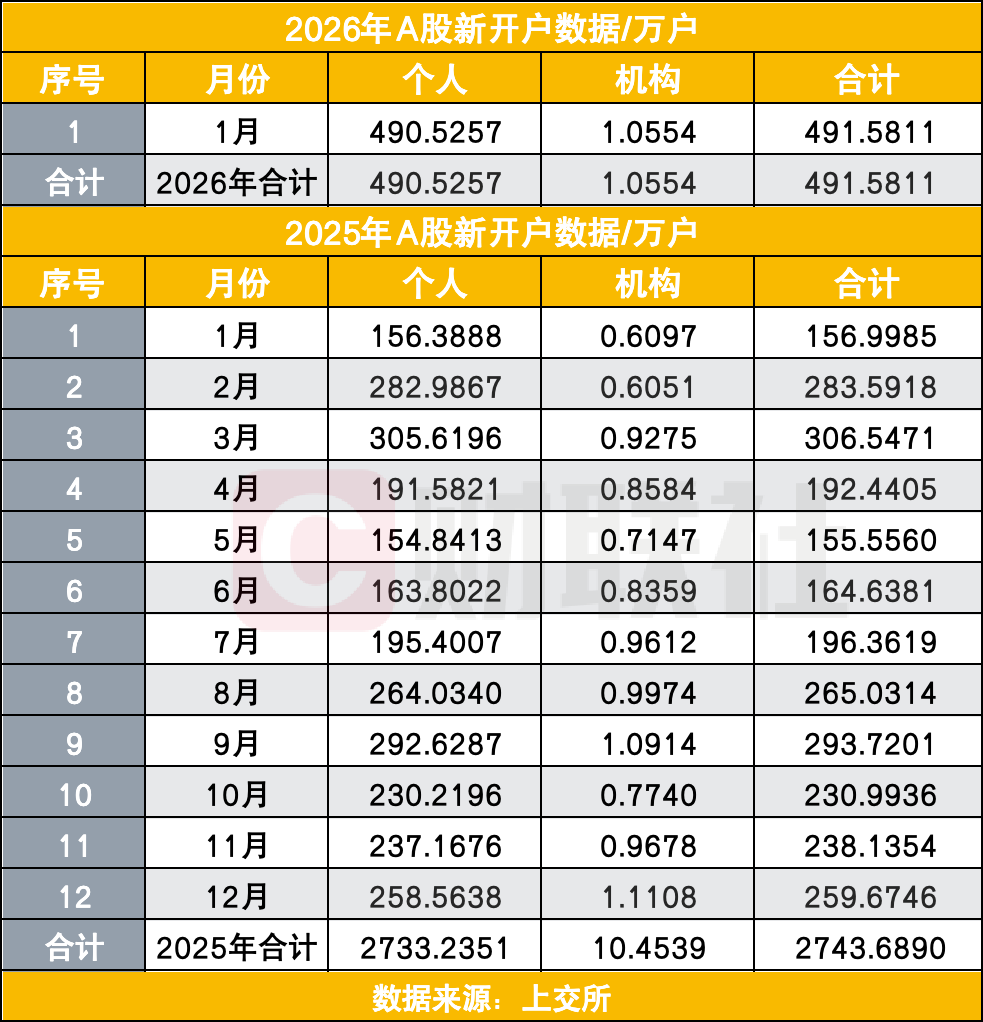
Core Insights - The A-share market saw a significant increase in new account openings in January 2026, with 4.92 million new accounts, marking a 213% year-on-year increase compared to January 2025 and an 89% increase from December 2025 [1][2] - The new account openings in January 2026 were the second highest in nearly a decade, only surpassed by four months in 2015 and one month in 2024 [1][2] - The current market conditions differ from the 2015 bull market, characterized by lower valuation levels, healthier funding structures, and more stable policy guidance, which may support a slow bull market [2] Monthly Account Opening Data - In January 2026, individual accounts accounted for approximately 490.53 thousand, while institutional accounts contributed about 1.06 thousand, totaling 491.58 thousand new accounts [2] - In comparison, January 2025 saw only 156.39 thousand individual accounts and 0.61 thousand institutional accounts, totaling 157.00 thousand [2] Market Performance - The A-share market achieved a strong start in January 2026, with all three major indices closing higher and trading volume reaching historical highs, despite a market correction towards the end of the month [3][4] - The Shanghai Composite Index closed at 4,117.95 points, up 3.76% for the month, while the Shenzhen Component and ChiNext indices rose by 5.03% and 4.47%, respectively [4] - The total trading volume for the month exceeded 70 trillion yuan, with an average daily trading volume of 3.33 trillion yuan, setting a new monthly record [4] Market Adjustments and Future Outlook - Towards the end of January, the market experienced a notable correction, influenced by factors such as increased margin requirements and seasonal tightening of funds ahead of the Spring Festival [5][6] - Analysts believe that the recent market adjustments are short-term fluctuations and do not alter the long-term upward trend of the A-share market [6][7] - The upcoming Spring Festival and the Two Sessions are expected to catalyze market activity, with policies aimed at boosting consumption and supporting emerging industries likely to accelerate post-holiday [7]
投资者微观行为洞察手册·1月第4期:融资资金开始回流
GUOTAI HAITONG SECURITIES· 2026-02-03 05:08
Market Pricing Status - The market transaction activity has slightly increased, but the profit effect has decreased. The average daily trading volume for the entire A-share market rose to 3.1 trillion yuan, while the proportion of stocks that increased in value dropped to 23.6% [6][8][15] - The median weekly return for all A-shares decreased to -3.4%, indicating a decline in profitability [6][8][15] A-Share Liquidity Tracking - Financing funds have seen a slight inflow, while ETF funds experienced a significant outflow. The new issuance scale of equity funds decreased to 35.09 billion yuan, and the overall stock position of public funds has declined [6][20][29] - Private equity confidence index increased by 0.5% compared to December, but the positions have marginally decreased [6][20][41] - Foreign capital inflow into A-shares was 4.13 million USD, with the northbound capital transaction proportion dropping to 0.1% [6][20][42][44] - The IPO fundraising was 5.55 billion yuan, and the scale of private placements was 4.55 billion yuan [6][20] - ETF funds saw a massive outflow of 319.37 billion yuan, with the passive trading proportion decreasing to 9.1% [6][20][28] A-Share Industry Allocation - Financing and ETF funds have both seen outflows from the electronics sector. In terms of foreign capital, net inflows were highest in non-ferrous metals (+119.5 million USD) and automobiles (+38.1 million USD), while transportation (-1.3 million USD) and public utilities (-1.1 million USD) saw net outflows [6][20][3.1] - Financing funds showed net inflows in non-ferrous metals (+13.45 billion yuan) and basic chemicals (+2.05 billion yuan), while defense and electronics sectors experienced net outflows of 2.82 billion yuan and 5.95 billion yuan, respectively [6][20][3.3] - The top sectors for net inflows in the ETF market included non-ferrous metals and chemical ETFs, while electronics, non-bank financials, and banks saw significant outflows [6][20][3.2] Hong Kong and Global Fund Flow - Southbound capital inflow has slowed down, while global foreign capital has marginally flowed into the US and Asian markets. The Hang Seng Index rose by 2.4% during this period [6][20][4.1] - The net buying amount of southbound capital decreased to 2.71 billion yuan, which is at the 15% percentile since 2022 [6][20][4.2] - In the global context, foreign capital inflows were highest in the US (+6.27 billion USD), South Korea (+2.83 billion USD), and China (+2.64 billion USD) [6][20][4.3]
量化择时周报:趋势指标进入边缘位置,由重仓位到重结构-20260201
ZHONGTAI SECURITIES· 2026-02-01 11:51
Quantitative Models and Construction Methods 1. Model Name: Timing System Signal - **Model Construction Idea**: The model uses the distance between the short-term and long-term moving averages of the WIND All A Index to determine the market trend. A significant positive distance indicates an upward trend, while a negative distance suggests a downward trend [2][7][13] - **Model Construction Process**: 1. Define the short-term moving average (20-day) and long-term moving average (120-day) of the WIND All A Index 2. Calculate the distance between the two moving averages: $ Distance = \frac{Short\text{-}term\ MA - Long\text{-}term\ MA}{Long\text{-}term\ MA} $ Where: - Short-term MA = 20-day moving average - Long-term MA = 120-day moving average 3. If the absolute value of the distance exceeds 3%, the market is considered to be in a trend (upward or downward depending on the sign of the distance) [2][7][13] - **Model Evaluation**: The model effectively captures market trends and provides a clear signal for timing decisions. However, it may be sensitive to short-term market fluctuations [2][7][13] 2. Model Name: Industry Trend Allocation Model - **Model Construction Idea**: This model identifies industry allocation opportunities based on medium-term reversal expectations and performance trends [6][8][14] - **Model Construction Process**: 1. Monitor industries with potential for medium-term reversal, such as real estate and liquor, and wait for reversal signals 2. Use the "TWO BETA" framework to recommend high-growth sectors like technology and commercial aerospace 3. Focus on performance trends in industries with high growth potential, such as computing power-related industries and upstream cyclical sectors like industrial metals and chemicals [6][8][14] - **Model Evaluation**: The model provides a structured approach to industry allocation, balancing medium-term reversal opportunities with high-growth sectors. However, its reliance on reversal signals may delay entry into emerging trends [6][8][14] 3. Model Name: Position Management Model - **Model Construction Idea**: This model determines the optimal equity allocation for absolute return products based on valuation and market trends [9] - **Model Construction Process**: 1. Assess the valuation of the WIND All A Index using PE and PB ratios 2. Combine valuation levels with short-term trend signals to recommend equity allocation levels 3. Current recommendation: 70% equity allocation for absolute return products, as the WIND All A Index PE is at the 90th percentile (high level) and PB is at the 50th percentile (medium level) [9] - **Model Evaluation**: The model provides a systematic approach to position management, balancing valuation and trend considerations. However, it may not fully account for sudden market shocks [9] --- Model Backtesting Results 1. Timing System Signal - Distance between 20-day and 120-day moving averages: 6.77% (absolute value significantly greater than 3%, indicating an upward trend) [2][7][13] 2. Industry Trend Allocation Model - No specific numerical backtesting results provided in the report [6][8][14] 3. Position Management Model - WIND All A Index PE: 90th percentile (high level) - WIND All A Index PB: 50th percentile (medium level) - Recommended equity allocation: 70% [9] --- Quantitative Factors and Construction Methods 1. Factor Name: Moving Average Distance Factor - **Factor Construction Idea**: Measures the distance between short-term and long-term moving averages to capture market trends [2][7][13] - **Factor Construction Process**: 1. Define short-term (20-day) and long-term (120-day) moving averages 2. Calculate the distance using the formula: $ Distance = \frac{Short\text{-}term\ MA - Long\text{-}term\ MA}{Long\text{-}term\ MA} $ 3. Use the absolute value of the distance to determine the trend strength [2][7][13] - **Factor Evaluation**: The factor is simple and intuitive, effectively capturing market trends. However, it may lag during rapid market reversals [2][7][13] --- Factor Backtesting Results 1. Moving Average Distance Factor - Distance: 6.77% (indicating a strong upward trend) [2][7][13]
投资者微观行为洞察手册・1月第4期:ETF 资金大幅流出,主动外资流入边际抬升
GUOTAI HAITONG SECURITIES· 2026-01-27 10:35
Market Overview - Market trading activity has decreased, with the average daily trading volume dropping to 2.8 trillion CNY, while the proportion of stocks rising has increased to 76.7%[4] - The median weekly return for all A-shares has risen to 2.7%[4] Fund Flows - Financing funds have seen a slight outflow of 68.9 billion CNY, with the proportion of financing transactions decreasing to 9.8%[4] - ETF funds have experienced a significant outflow of 3264.7 billion CNY, primarily due to state-owned enterprises selling ETFs to optimize their capital structure[4] - New issuance of equity mutual funds has increased to 261.2 billion CNY, indicating a rise in public fund activity[4] Foreign Investment - Foreign capital has flowed into A-shares, with a net inflow of 3.9 million USD as of January 21[4] - The proportion of northbound trading has increased to 18.0%, indicating stronger foreign participation in the market[4] Sector Performance - The top sectors for foreign inflows include non-ferrous metals (+27.3 million USD) and computers (+12.8 million USD), while banks (-35.1 million USD) and telecommunications (-20.8 million USD) saw outflows[4] - In terms of financing, electronics (+206.5 billion CNY) and telecommunications (+95.2 billion CNY) were the leading sectors for inflows, while beauty care (-0.2 billion CNY) and construction materials (-0.5 billion CNY) faced outflows[4] Risk Factors - There are potential risks related to data reporting discrepancies and measurement errors from third-party sources[4]
量化择时周报:牛市格局仍在延续,主题投资重回主线-20260125
ZHONGTAI SECURITIES· 2026-01-25 13:29
Quantitative Models and Construction Methods 1. **Model Name**: Timing System Model **Model Construction Idea**: The model uses the distance between the short-term moving average (20-day) and the long-term moving average (120-day) of the WIND All A Index to determine the market trend[2][7] **Model Construction Process**: - Define the short-term moving average (20-day) and long-term moving average (120-day) of the WIND All A Index - Calculate the difference between the two moving averages - If the short-term moving average is above the long-term moving average and the absolute difference exceeds 3%, the market is considered to be in an upward trend - Latest data: 20-day moving average = 6668, 120-day moving average = 6245, difference = 6.78%[2][7] **Model Evaluation**: The model effectively captures the market's upward trend and provides a clear signal for timing decisions[2][7] 2. **Model Name**: Industry Trend Allocation Model **Model Construction Idea**: This model identifies industry opportunities based on medium-term reversal expectations and performance trends[6][7] **Model Construction Process**: - Use medium-term reversal expectation signals to identify industries with potential recovery, such as innovative healthcare - Apply the TWO BETA model to recommend sectors like technology, commercial aerospace, space photovoltaics, and stablecoin concepts - Use performance trend signals to highlight opportunities in semiconductors, industrial metals, and chemicals[6][7] **Model Evaluation**: The model provides actionable insights into sector allocation, focusing on industries with strong growth potential or recovery signals[6][7] 3. **Model Name**: Position Management Model **Model Construction Idea**: This model determines the recommended equity allocation based on valuation levels and market trends[8] **Model Construction Process**: - Assess the valuation levels of the WIND All A Index using PE and PB ratios - Combine valuation levels with short-term trend signals to recommend an equity allocation - Current recommendation: 80% equity allocation for absolute return products based on the WIND All A Index[8] **Model Evaluation**: The model provides a systematic approach to managing equity exposure, balancing valuation and trend considerations[8] --- Model Backtesting Results 1. **Timing System Model**: - Moving average distance: 6.78% (absolute value > 3%, indicating an upward trend)[2][7] - Profitability effect: 2.7% (positive, supporting the upward trend)[2][7] 2. **Industry Trend Allocation Model**: - Recommended sectors: Innovative healthcare, technology, commercial aerospace, space photovoltaics, stablecoin concepts, semiconductors, industrial metals, and chemicals[6][7] 3. **Position Management Model**: - Recommended equity allocation: 80%[8] --- Quantitative Factors and Construction Methods No specific quantitative factors were explicitly mentioned in the report. The analysis primarily focuses on models rather than individual factors. --- Factor Backtesting Results No specific factor backtesting results were provided in the report. The focus remains on model-level performance and recommendations.
A股站上4100点新高,全球矿业股或迎超级周期,硬核成长互补发力
Sou Hu Cai Jing· 2026-01-25 12:19
Market Overview - The A-share market experienced a "steady rise" from January 19 to 23, with the Shanghai Composite Index increasing by 0.84% to reach 4100 points, marking a new high since 2015 [2] - The Shenzhen Component Index and the Sci-Tech Innovation 50 Index rose by 1.11% and 2.62%, respectively, indicating a trend of "moderate index growth and accelerated capital inflow" [2] - The core driving force behind this market rally is identified as a combination of "policy support, capital inflow, and industrial trends" [2] Sector Performance - Cyclical and technology stocks acted as "dual drivers," with sectors such as building materials, steel, and chemicals seeing gains of over 5% [2] - Commercial aerospace concept stocks led the market due to favorable industry developments, while banking and non-bank financial sectors experienced declines [2] Policy and Regulation - The China Securities Regulatory Commission and the Asset Management Association of China jointly released performance benchmark guidelines aimed at addressing issues like "style drift" and "fund blind boxes," marking the beginning of a reshaping of the public fund ecosystem [2] Investment Trends - Institutional research focused on three main areas: commercial aerospace, metal mining, and storage chips, with significant interest in companies like Daikin Heavy Industries and Naipu Mining [3] - The MSCI Metals and Mining Index has surged nearly 90% year-to-date, driven by soaring global metal demand and tightening supply of key minerals [3] - Gold prices are projected to rise further, with Goldman Sachs forecasting a price of $5,400 per ounce by the end of 2026, indicating an 8% upside from current levels [3] Commercial Aerospace Developments - The commercial aerospace sector saw a resurgence after a volatile January, with significant domestic and international positive developments [4] - The financing total for the industry is expected to reach 18.6 billion yuan in 2025, a 32% year-on-year increase, as multiple companies initiate their IPO processes [4] - The global satellite count exceeds 12,000, with China's commercial aerospace sector aiming to capture technological transformation opportunities through "new space infrastructure" [4] Market Outlook - Institutions generally expect a "slow bull" market to continue, although caution is advised regarding short-term valuation correction risks [4] - Analysts predict that the A-share market will maintain a trend of oscillating upward, with accelerated sector rotation focusing on cyclical recovery and hard technology growth [4]