
市场化经营机制

Search documents
国务院国资委:更大力度推进专职外部董事与现职领导人员双向交流
Zheng Quan Shi Bao Wang· 2026-01-16 01:13
Core Viewpoint - The State-owned Assets Supervision and Administration Commission (SASAC) emphasizes the need for deepening state-owned enterprise (SOE) reforms by 2026, focusing on modernizing corporate governance and enhancing market-oriented operational mechanisms [1] Group 1: SOE Reform Initiatives - By 2026, local SASACs are tasked with advancing SOE reforms and improving the modern enterprise system with Chinese characteristics [1] - Key tasks include broadening the sources of external directors and effectively utilizing the talent reserve for external directors in state-owned enterprises [1] - There will be a stronger push for two-way exchanges between full-time external directors and current leadership, alongside enhanced training for directors and accountability measures [1]
国企改革深化提升行动主体任务基本完成,116组战略性整合支撑实体发展
Hua Xia Shi Bao· 2026-01-13 12:57
Group 1: Core Insights - The core focus of the recent state-owned enterprise (SOE) reform is on restructuring and integration, aiming to strengthen and specialize the enterprises, with significant progress reported in the completion of key tasks [1][2] - The reform is characterized by a shift from scale expansion to a focus on core business and specialization, leading to the establishment of new central enterprises that serve as benchmarks for the reform [2][3] Group 2: Restructuring and Integration - The restructuring efforts have resulted in 116 strategic mergers involving 229 primary enterprises, concentrating on local pillar industries to enhance regional competitiveness [3][4] - New central enterprises, such as China Chang'an Automobile Group and China Yajiang Group, have emerged, focusing on specific industry tracks to optimize resource allocation and address issues of homogenization and resource dispersion [2][3] Group 3: Optimization and Efficiency - The optimization of the state-owned economy's layout is a critical aspect of the reform, with adjustments focusing on both traditional pillar industries and strategic emerging industries [4][5] - The central enterprises are projected to achieve over 11 trillion yuan in revenue from strategic emerging industries by November 2025, indicating strong growth momentum [4] Group 4: Innovation and R&D - The reform has led to increased R&D investment, with central enterprises' R&D expenditures growing at an annual rate of 6.5% since the 14th Five-Year Plan, and basic research funding increasing by 19% annually from 2022 to 2024 [5][6] - Central enterprises have established 134 external pilot verification platforms to accelerate the application of innovative results in the real economy [5][6] Group 5: Mechanism Reform - The reform emphasizes breaking down institutional barriers to activate the internal dynamics of enterprises, with market-oriented personnel selection and performance-based compensation mechanisms being implemented [6][7] - The introduction of a formal accountability system for violations in state-owned enterprises aims to enhance regulatory effectiveness and ensure compliance with operational standards [8][9]

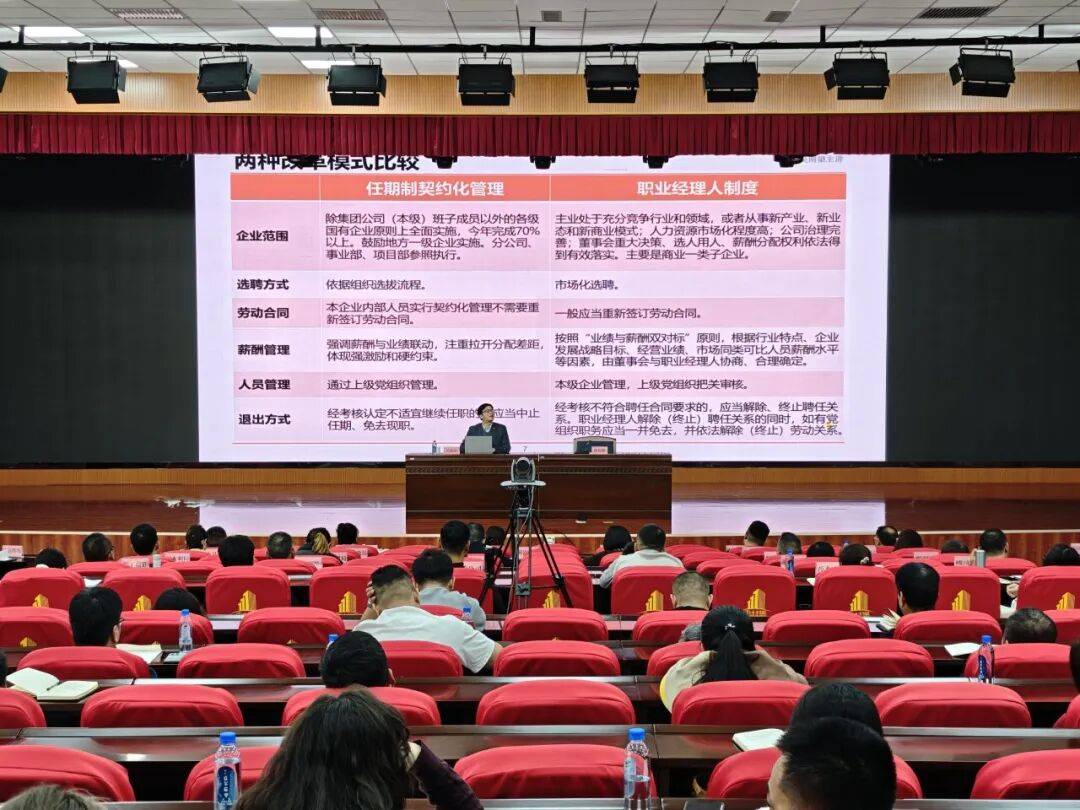
2025年第八期“博州干部大讲堂”开讲
Sou Hu Cai Jing· 2025-11-30 07:50
Core Viewpoint - The training session focused on constructing a new type of operating responsibility system to promote high-quality market-oriented operations of state-owned enterprises (SOEs) [1][3]. Group 1: New Operating Responsibility System - The lecture by Wu Gangliang provided an in-depth interpretation of the construction path for the new operating responsibility system, emphasizing clear rights and responsibilities [3]. - Key operational experiences shared included the professional manager system and contractual management system based on tenure, along with a comparison of the new and traditional operating responsibility systems [3]. - Wu's analysis included practical methods for implementing a market-oriented operating mechanism characterized by flexibility in personnel management, such as "can go up and down, can enter and exit, can increase and decrease" [3]. Group 2: Talent Acquisition Strategies - Wu addressed the core need for high-level technology talent in Bozhou's SOEs, proposing flexible talent acquisition methods such as consultant guidance, short-term part-time roles, and targeted support [5]. - The lecture highlighted advanced experiences, including the "dual-residence recruitment" model from China Resources Group's Jiangzhong Pharmaceutical, providing direction for attracting high-tech talent [5]. Group 3: Future Directions for SOEs - The session served as a platform for exchanging advanced ideas and practical connections, aiming to enhance the market-oriented operating mechanism of Bozhou's SOEs [5]. - The Bozhou government plans to leverage the construction of the new operating responsibility system to strengthen core functions and improve competitiveness, thereby injecting strong momentum into local economic development [5].
事关国资国企改革、国有经济布局优化与结构调整 张玉卓发文
Zheng Quan Shi Bao· 2025-10-31 08:41
Core Viewpoint - The article emphasizes the key tasks and measures for deepening state-owned enterprise (SOE) reform and optimizing the layout and structure of state-owned economy during the "15th Five-Year Plan" period, as outlined by Zhang Yuzhuo, the Director of the State-owned Assets Supervision and Administration Commission (SASAC) [1]. Group 1: SOE Reform - The need to improve market-oriented operating mechanisms and deepen internal reforms within enterprises, including the implementation of a term system and contractual management for managerial staff, as well as reforming the wage determination mechanism [3]. - The focus on optimizing enterprise management and operational systems, promoting a flat organizational structure in large enterprises, and accelerating digital transformation and intelligent upgrades to enhance responsiveness to market changes [3]. - The establishment of a sound regulatory system for state-owned assets, ensuring separation of government and enterprise functions, and enhancing the professionalism and efficiency of regulatory oversight [3]. Group 2: Optimization of State-Owned Economy - The principle of "doing what is necessary and refraining from what is not" in optimizing the layout and structure of state-owned economy, focusing on strategic security, industrial leadership, and public service [5]. - The identification of key investment areas for state capital, directing investments towards critical industries related to national security and public welfare, as well as emerging strategic industries [5]. - The promotion of strategic and professional restructuring to enhance functional missions and scale efficiency, avoiding redundant construction and disorderly competition [5].
事关国资国企改革、国有经济布局优化与结构调整 张玉卓发文
证券时报· 2025-10-31 08:30
Core Viewpoint - The article emphasizes the importance of deepening state-owned enterprise (SOE) reforms and optimizing the layout and structure of state-owned capital during the "14th Five-Year Plan" period, as outlined by Zhang Yuzhuo, the Director of the State-owned Assets Supervision and Administration Commission (SASAC) [1]. Group 1: SOE Reform - The need to establish a market-oriented operating mechanism and deepen internal reforms within enterprises, including the implementation of a term system and contractual management for managerial members [3]. - The focus on optimizing enterprise management and operational systems, promoting a flat organizational structure in large enterprises, and accelerating digital transformation and intelligent upgrades [3]. - The importance of improving the state-owned asset supervision system, ensuring separation of government and enterprise, and enhancing the professionalism and efficiency of regulatory oversight [3]. Group 2: Optimization of State-Owned Capital - The strategy of focusing on key investment areas and directions for state-owned capital, particularly in sectors related to national security, public services, and emerging strategic industries [5]. - The emphasis on strategic and professional restructuring to enhance functional missions and scale efficiency, while avoiding redundant construction and disorderly competition [5]. - The promotion of rational and orderly flow of state-owned capital to optimize allocation, enhance value, and increase returns, thereby creating more social wealth [5].

国企改革深化提升行动取得哪些成效?国务院国资委公布
Zhong Guo Xin Wen Wang· 2025-09-17 08:37
Core Insights - The article highlights the progress and achievements of state-owned enterprises (SOEs) in China during the "14th Five-Year Plan" period, emphasizing the deepening reforms and the acceleration of modern SOEs' growth [1][4]. Group 1: Strategic Restructuring - During the "14th Five-Year Plan" period, the restructuring of state-owned enterprises has been optimized, with 6 groups of 10 enterprises undergoing strategic mergers, leading to the establishment of 9 new central enterprises [2]. - The restructuring efforts focus on three main areas: aligning with national strategies, enhancing industrial collaboration, and optimizing public services [3]. - The restructuring has resulted in over 70% of central enterprises' revenue being generated from sectors critical to national security and the economy [3]. Group 2: Governance and Mechanism Improvements - The reforms have led to significant advancements in modern corporate governance for SOEs, with approximately 97% of eligible subsidiaries establishing boards that delegate authority to management [5]. - Market-oriented mechanisms have been improved, with over 60% of central enterprise management compensation linked to performance [5]. Group 3: Regulatory Enhancements - The State-owned Assets Supervision and Administration Commission (SASAC) has implemented a tailored assessment approach for enterprises, with 76% of the assessment indicators being personalized by 2025 [6]. - A comprehensive and intelligent regulatory system has been developed to ensure transparency and control over various operational aspects, including ownership, funding, and risk management [7].