市场热点轮动

Search documents
20cm速递|创业板50ETF国泰(159375)涨超1.1%,政策调整或引市场热点轮动
Sou Hu Cai Jing· 2025-12-19 03:23
Core Viewpoint - The Central Economic Work Conference has announced structural adjustments in policies related to domestic demand, consumption, and "anti-involution," which may lead to a rotation of market hotspots [1] Group 1: Policy Adjustments - The conference emphasized "optimizing drug centralized procurement," which is expected to enhance profit margins for pharmaceutical companies with intellectual property and patent reserves [1] - The shift in focus towards service consumption, particularly in cultural tourism and sports, is anticipated to benefit from the transition of "national subsidies" [1] - "Domestic demand as the main driver" has been highlighted as the top policy priority for the coming year, with a strong emphasis on "releasing the potential of service consumption" [1] Group 2: Market Performance - The ChiNext 50 ETF (159375) rose over 1.1%, reflecting the potential impact of the policy adjustments on market performance [1] - The ChiNext 50 Index (399673), which the ETF tracks, includes 50 securities selected for their liquidity and market capitalization, focusing on strategic emerging industries such as power equipment, new energy, and pharmaceuticals [1] - The index has a daily fluctuation limit of 20%, indicating high volatility and growth potential within the ChiNext market [1] Group 3: Industry Implications - The policy changes are expected to lead to valuation recovery in innovative pharmaceuticals and medical devices due to shifts in centralized procurement and support for an aging population [1] - The "anti-involution" policy will also focus on "platform enterprises" and the deepening of quality improvement in small and medium financial institutions, which may accelerate the consolidation of brokerage firms [1]

20cm速递|创业板50ETF国泰(159375)回调超2.5%,重磅会议利好不断,回调或可布局
Sou Hu Cai Jing· 2025-12-16 03:48
Group 1 - The core viewpoint of the article highlights a structural adjustment in policies related to domestic demand, consumption, and "anti-involution" as discussed in the Central Economic Work Conference, which may lead to a rotation of market hotspots [1] - The innovation drug and medical device sectors are expected to show valuation recovery due to policy changes in centralized procurement and support from an aging population [1] - The conference emphasized "optimizing drug centralized procurement," which is expected to enhance profit margins for pharmaceutical companies with intellectual property and patent reserves [1] Group 2 - The policy focus for the upcoming year will prioritize "domestic demand," particularly on "releasing the potential of service consumption," with a shift in "national subsidies" from automobiles to service consumption [1] - The "anti-involution" policy will also target "platform enterprises" and promote the reduction and quality improvement of small and medium financial institutions, which may accelerate the consolidation of brokerage firms [1] - The ChiNext 50 ETF (159375) tracks the ChiNext 50 Index (399673), which reflects the performance of 50 securities with high liquidity and market capitalization, emphasizing companies with high growth and technological innovation characteristics [1]
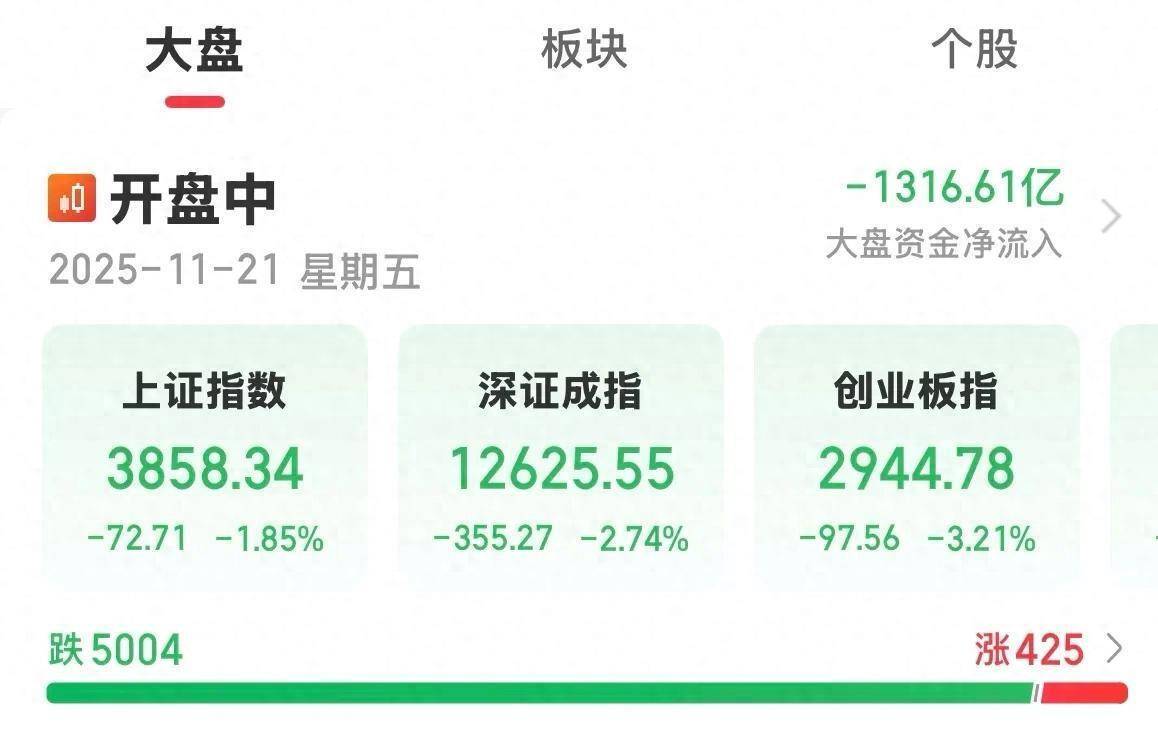
超5000股集体跳水,毫无预警,全线暴跌,毫无防备,谁惹了A股
Sou Hu Cai Jing· 2025-11-22 04:42
Market Overview - The A-share market experienced a significant drop on November 21, with the Shanghai Composite Index falling below the 3900-point mark and the ChiNext Index declining over 2% [1] - By midday, over 5000 stocks were down, with only around 300 stocks showing gains, indicating widespread panic among investors [1] - The lithium battery sector was heavily impacted, with leading stocks like Tianqi Lithium and Ganfeng Lithium dropping over 8%, while storage chip stocks also saw declines exceeding 8% [1] Global Market Influence - The decline in the A-share market was not an isolated incident, as the U.S. stock market experienced extreme volatility, with the Nasdaq index swinging from a nearly 3% gain to a drop of over 2% [1] - This volatility in the U.S. market had a ripple effect across the Asia-Pacific region, with significant declines in indices such as the Nikkei 225 and the Hang Seng Index [1] Economic Indicators - Uncertainty surrounding the Federal Reserve's monetary policy was identified as a key factor driving global market fluctuations, with conflicting signals from U.S. non-farm payroll data [3] - The probability of a 25 basis point rate cut by the Federal Reserve in December was reported at only 39.6%, contributing to market uncertainty [3] Sector Performance - The A-share market showed structural differentiation, with growth sectors facing significant sell-offs, particularly in energy metals and technology stocks, which saw declines of over 8% [5] - Defensive sectors demonstrated resilience, with certain agricultural stocks rising due to acquisition news, indicating a shift in investor preference towards lower valuation and stable cash flow stocks [5][6] Capital Flow - There was a notable outflow of main capital, with trading volume in the Shanghai and Shenzhen markets increasing by 200.4 billion compared to the previous day, reflecting heavy selling pressure [9] - Northbound capital also showed a net outflow, totaling over 20 billion since November, indicating a lack of confidence in the market [9] Investor Sentiment - The recent market downturn has exposed new investors to the harsh realities of stock trading, as many had previously underestimated the risks involved [9] - Despite some fund managers achieving over 50% returns this year, general investor anxiety remains high due to the unexpected market decline [9]