市场窄化

Search documents
高盛交易员:美股涨势"极端窄化",七巨头屡创新高但整体跑输全球市场
美股IPO· 2025-11-01 10:18
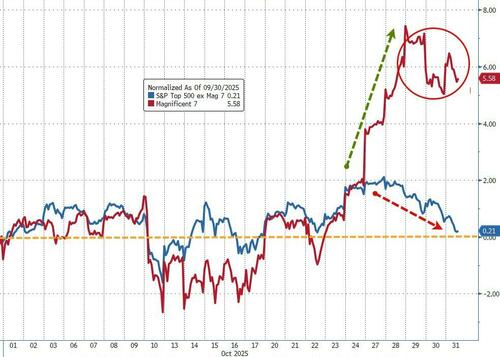
Core Insights - The U.S. stock market is experiencing extreme divergence, with the tech giants reaching new highs while the overall market has underperformed globally for 18 consecutive months [1][5][6] - The concentration of gains among the top seven tech companies (Mag-7) is at an all-time high, indicating a narrowing market breadth [6][10] - Despite strong performance from U.S. tech companies, the overall market has not generated excess returns compared to global markets, influenced by a weakening dollar and recovery in non-U.S. markets [5][11] Market Performance - The Nasdaq index has recorded a 5% increase for two consecutive months, but market concentration has reached extreme levels, with the ratio of advancing to declining stocks in the S&P 500 hitting a historical low [3][10] - The top seven tech stocks have significantly outperformed the remaining 493 stocks in the S&P 500, which have remained relatively flat [6][9] Investment Trends - Continuous AI investments by major tech companies are a key factor supporting their stock performance, with companies like Amazon, Google, and Microsoft showing strong growth in their cloud businesses [9] - Meta is facing scrutiny regarding its investment returns, yet it is unlikely to reduce spending due to competitive pressures, as evidenced by its record demand for a $125 billion bond issuance [9] Global Market Dynamics - European markets are undergoing significant changes, with mergers in the satellite industry and ongoing consolidation in the telecommunications sector, indicating a shift towards traditional industries benefiting from AI efficiencies [11][12] - The Asian market outlook remains positive, supported by trends in the dollar and revised GDP expectations for China [14][15]


高盛交易员:美股涨势"极端窄化",七巨头屡创新高但整体跑输全球市场
Hua Er Jie Jian Wen· 2025-11-01 02:37
Core Insights - The U.S. stock market is exhibiting two major contradictions: tech giants are driving indices to new highs, yet market breadth has narrowed to extreme levels, with U.S. stocks lagging behind global markets for 18 consecutive months [1][5]. Group 1: Market Performance - The Nasdaq index recorded a 5% increase for two consecutive months, but market concentration has reached historical extremes [1][6]. - On a recent Tuesday, the ratio of advancing to declining stocks in the S&P 500 hit the lowest level on record, indicating that large tech stocks are dominating while the other 493 components remain stagnant [1][8]. - Despite the strong performance of U.S. tech giants, the overall U.S. market has underperformed compared to global markets, failing to generate excess returns over the past 18 months [5][6]. Group 2: Tech Giants and Investment Trends - The seven major tech companies (Mag-7) significantly outperformed the remaining S&P 500 components, which remained nearly flat during the same period [6]. - Meta is facing investor skepticism regarding its return on investment, yet its $125 billion bond issuance received record demand, indicating its continued investment capability [7]. - Following the third-quarter earnings report, the capital expenditure plans for the seven giants may be adjusted upward by $60 billion for 2026, with Nvidia becoming the first company to surpass a $5 trillion market cap [7][9]. Group 3: Global Market Dynamics - The global market breadth is impressive, supported by valuation and positioning, suggesting a continuation of this trend [3][12]. - Significant changes are occurring in the European market, with companies like Airbus and Thales merging satellite businesses, indicating a shift in traditional industries towards AI efficiency [10]. - The Asian market is also showing positive trends, with expectations for earnings per share and overall market performance supported by the dollar's trajectory and an upward revision of China's GDP forecast [12].