
市场结构调整

Search documents
从参会观众真实声音,看 ACCSI 为何成为仪器行业年度必赴盛会!
仪器信息网· 2026-03-24 09:02
Core Viewpoint - The ACCSI (China Scientific Instrument Development Annual Conference) is recognized as a valuable platform for connecting key industry players and facilitating meaningful exchanges and collaborations in the scientific instrument sector [1][2][17]. Group 1: Feedback from Academia and Research Institutions - The ACCSI is seen as a platform that genuinely aids in the development of the industry, with academic institutions and research organizations acknowledging its academic depth and long-term value [3][4]. - Experts from various institutions highlighted the conference's focus on core industry issues, practical discussion value, and its role in connecting academia, industry, and research [6][8]. - The conference successfully gathers a diverse range of industry representatives, fostering a strong demand for innovation and high-quality development amidst complex economic conditions [5][6]. Group 2: Feedback from Corporate Executives and Management - For corporate executives, the value of the ACCSI lies in its ability to facilitate brand exposure, business expansion, and strategic decision-making [9][10]. - Several companies reported successful business outcomes from the conference, including sales and partnerships, indicating the event's effectiveness in promoting real-world collaborations [10][11][12]. - The ACCSI is increasingly viewed as a premier industry summit, with calls for more targeted collaboration opportunities among companies to enhance the event's industrial value [12][16]. Group 3: Overall Impact and Future Outlook - The ACCSI has evolved into a critical platform for companies to formulate annual market strategies and integrate industry resources, with its influence and value confirmed by participant feedback [16][17]. - The upcoming 19th ACCSI in 2026 aims to further advance the scientific instrument industry towards a new era of intelligence, emphasizing the importance of high-level exchanges among various stakeholders [21].


资金持续流出沪深300、中证1000、上证50等宽基ETF
Ge Long Hui· 2026-01-26 09:21
Market Overview - The three major A-share indices collectively declined today, with the Shanghai Composite Index down 0.09% to 4132 points, the Shenzhen Component Index down 0.85%, and the ChiNext Index down 0.91%. The total market turnover was 3.28 trillion yuan, an increase of 162.5 billion yuan compared to the previous trading day, with over 3700 stocks declining [1]. ETF Fund Flow - According to Zhongtai Securities, there has been a significant outflow of funds from "Huijin" ETFs following regulatory signals aimed at cooling down the overheated A-share market. From January 15 to January 23, approximately 12 ETFs heavily weighted by Huijin experienced a total outflow of 559.09 billion yuan, averaging nearly 80 billion yuan per trading day. The outflow was primarily concentrated in the CSI 300 (59% of outflows) and the CSI 1000 index (16% of outflows) [2][3]. Market Structure and Style - Despite the outflow of ETF funds, there has not been a significant risk-averse sentiment in the market. The trading activity and thematic trading remained active, indicating that the market temperature is still relatively high. The large-cap indices faced pressure, while smaller-cap stocks showed resilience, with funds shifting towards smaller market capitalization segments [3][4]. Individual Stock Impact - Value stocks have been notably impacted by the outflows, particularly in the CSI 50 sector, which faced dual pressure from both the CSI 300 ETF and the CSI 50 ETF redemptions. In contrast, thematic hot stocks remained largely unaffected, suggesting that low turnover and low heat value sectors experienced the most significant impact [3][4]. Regulatory Environment - Current market sentiment remains on the warmer side, indicating strong speculative inertia. Financial regulatory authorities are likely to continue and strengthen their "cooling" approach to mitigate localized overheating risks. Investors are advised to reduce exposure to crowded and overvalued thematic assets until a clear signal of market style change emerges [4].
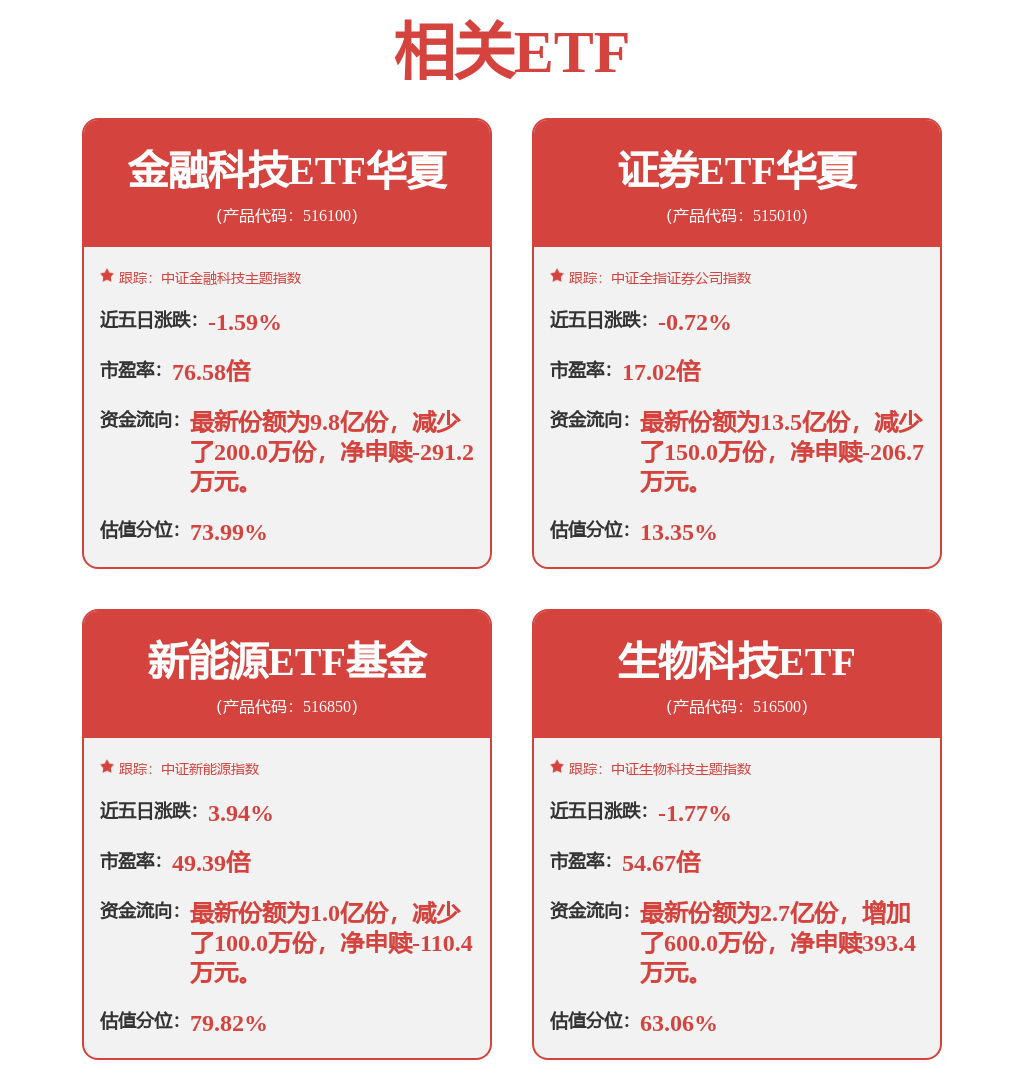
中证A500ETF大跌2.76%点评
Mei Ri Jing Ji Xin Wen· 2025-11-21 13:50
Market Performance - The A-share market experienced a significant decline, with the Shanghai Composite Index dropping by 2.45%, the Shenzhen Component Index falling by 3.41%, and the ChiNext Index decreasing by 4.02% as of the close on November 21 [1] - The total market turnover reached 1.98 trillion yuan, an increase of 260.96 billion yuan compared to the previous trading day [1] Market Influences - The market adjustment was influenced by several factors, including the Federal Reserve's hawkish signals, which reinforced expectations for prolonged high interest rates, leading to increased uncertainty in the global liquidity environment [3] - The lack of clear incremental funding sources as the year-end approaches has resulted in a defensive stance among institutional investors, with limited willingness for new capital to enter the market [5] - A significant change in the exchange rate environment, with a strengthening dollar, has weakened the external conditions that previously supported the A-share market [5] Market Structure - The recent market pullback reflects a consolidation phase following substantial gains in certain sectors, with high-weight sectors entering a correction phase [7] - The overall A-share index only retreated by 1.87%, supported by the performance of smaller weight sectors, which have low volatility and value-oriented characteristics [7] Volatility and Sentiment - The VIX index, an important indicator of market sentiment, has risen significantly due to the stock market decline, indicating a shift towards risk aversion among investors [8] - The market is expected to remain in a phase of emotional repair and volatility digestion, with potential opportunities arising as fear subsides and volatility decreases [10] Future Outlook - If the Federal Reserve's stance becomes more dovish and the liquidity situation improves, market sentiment may gradually recover, providing a more favorable entry point for mid-term investments [11] - The current market pullback is viewed as a rebalancing of structural contradictions rather than a fundamental trend reversal, suggesting that investors should focus on balanced large-cap indices and defensive dividend products for mid-term opportunities [13]

一线二手房 “补跌” 再发酵:核心区价格松动,买房人该怎么看?
Sou Hu Cai Jing· 2025-10-17 20:31
Core Viewpoint - The real estate market in China is experiencing a significant divergence, with first-tier cities facing a continuous decline in second-hand housing prices, while the new housing market remains relatively stable [1][5]. Group 1: Second-Hand Housing Market - In August, second-hand housing prices in first-tier cities fell by 1.0% month-on-month, marking the fifth consecutive month of decline, with a notable "catch-up" drop over the past four months [1][3]. - The month-on-month decline in first-tier cities has been increasing, from 0.2% in April to 1.0% in August, indicating a strengthening downward trend [3]. - Among the four first-tier cities, Beijing experienced the most significant decline at 1.2%, followed by Shanghai (1.0%), Guangzhou (0.9%), and Shenzhen (0.8%), highlighting a more severe adjustment in northern cities [3]. - Year-on-year, Guangzhou led with a 7.6% decline, while Shenzhen, Beijing, and Shanghai saw decreases of 3.7%, 2.3%, and 1.6% respectively, indicating a downward shift in market valuations [3]. Group 2: New Housing Market - In contrast to the second-hand market, new housing prices in first-tier cities only fell by 0.1% month-on-month in August, significantly less than the decline in second-hand prices [5]. - Shanghai's new housing prices even increased by 0.4%, while Beijing, Guangzhou, and Shenzhen saw minor declines of 0.4%, 0.2%, and 0.4% respectively, all lower than the adjustments in the second-hand market [5]. - The resilience of new housing prices in first-tier cities reflects strategic pricing control by developers and local price regulation policies, contrasting with the pressures faced by second and third-tier cities [5]. Group 3: Market Dynamics and Implications - The current real estate market is undergoing a critical structural adjustment, with the ongoing "catch-up" decline in second-hand housing prices and signs of price softening in core urban areas [5][6]. - The divergence between new and second-hand housing markets, along with the differences across city tiers, suggests a need for a multi-dimensional approach to understanding market trends [5]. - For stakeholders in real estate and finance, closely monitoring transaction data and price changes in core urban areas will be essential for assessing market bottoming [6].

美联储降息“靴子落地”利好兑现? A股冲高跳水 成交额超三万亿元
Sou Hu Cai Jing· 2025-09-18 16:12
Group 1 - The A-share market experienced significant volatility, with the Shanghai Composite Index closing down 1.15% at 3831.66 points, the Shenzhen Component down 1.06% at 13075.66 points, and the ChiNext Index down 1.64% at 3095.85 points, despite a substantial trading volume of 31.352 billion yuan, an increase of 7.584 billion yuan from the previous day [1] - The Federal Reserve's decision to cut the federal funds rate by 25 basis points to a target range of 4.00%-4.25% was expected to provide liquidity support and lower corporate financing costs, typically benefiting the stock market [1] - The afternoon market drop may be attributed to profit-taking behavior following the rate cut announcement, as investors often sell off after a widely anticipated positive event materializes [1] Group 2 - Investors are advised to exercise caution in the current market environment, particularly regarding high-performing stocks that may face significant adjustment pressure due to profit-taking and shifts in market sentiment [2] - The technical analysis indicates that the Shanghai Composite Index has broken below the 5-day moving average, with the KD indicator forming a death cross, suggesting a potential short-term weakening [2] - Despite the recent market turbulence, there are still positive signals, and the market is likely to continue in a range-bound pattern, providing opportunities for structural investments amid rotating market hotspots [2]