
中证A500ETF

Search documents
从“卖产品”到“造生态”!5万亿市场加码生态圈建设
证券时报· 2026-03-26 08:51
Core Viewpoint - The ETF market is transitioning from a focus on individual product sales to a comprehensive ecosystem approach, emphasizing brand recognition and service capabilities to meet evolving investor demands [1][9]. Group 1: ETF Ecosystem Development - Fund companies are increasingly investing in building ETF ecosystems, marking a fundamental shift in competition logic within the ETF industry [2][4]. - Major fund companies like Jiashi Fund, China Merchants Fund, and Southern Fund are actively enhancing their ETF ecosystems through product family development, brand IP creation, and service system upgrades [4][5]. Group 2: Trends in ETF Ecosystem Construction - The ETF ecosystem is evolving in four distinct trends: product differentiation, service enhancement, educational engagement, and operational synergy [10][11]. - Product ecosystems are shifting towards combination and differentiation, with leading public funds focusing on creating diverse product matrices rather than just popular single products [11][12]. - Service ecosystems are extending towards "refined, full-process" offerings, with public institutions increasing service investments to provide comprehensive support for investors [13]. Group 3: Brand Recognition and Competitive Advantage - The branding of ETFs is becoming crucial, as the industry moves towards a unified naming convention that emphasizes the fund manager's brand, thereby increasing its influence on investor decisions [6][5]. - The transition to an ecosystem approach is not merely a marketing tactic but a long-term strategy aimed at fostering investor loyalty through integrated product, service, and educational offerings [15].

从“卖产品”到“造生态”!5万亿市场加码生态圈建设
券商中国· 2026-03-26 06:15
Core Viewpoint - The ETF industry is transitioning from a focus on individual product sales to a comprehensive ecosystem approach, emphasizing brand recognition and service capabilities to meet evolving investor demands [1][2][7]. Group 1: ETF Ecosystem Development - Fund companies are increasingly investing in building ETF ecosystems, with notable actions from firms like Jiashi Fund, CMB Fund, Southern Fund, and Ping An Fund, focusing on product family enhancement, brand IP creation, and service system upgrades [3][4]. - Jiashi Fund has created an immersive investment education ecosystem, exemplified by the successful "Jiashi Super Index Festival," which integrates product promotion and investor education [3]. - Ping An Fund has launched a brand renewal initiative, aiming to create a one-stop ETF investment ecosystem in collaboration with Ping An Securities, highlighting the importance of brand recognition in investment decisions [4]. Group 2: Shift in Competitive Logic - The ETF market is moving from a competition based on "first-mover advantage" to one focused on building a comprehensive ecosystem that includes products, services, and investor education [5][7]. - The traditional model of competing through individual products is becoming less sustainable as the market expands and product homogenization increases, leading to a need for a more integrated approach [6][7]. Group 3: Trends in ETF Ecosystem Construction - The construction of the ETF ecosystem is showing four distinct trends: product differentiation, service enhancement, operational synergy, and educational innovation [8]. - Leading public funds are shifting towards creating diversified product matrices rather than focusing solely on popular single products, which allows for more effective competition [8][9]. - The service ecosystem is evolving to provide comprehensive, fine-tuned support for investors, with many firms launching dedicated service applications to enhance user experience [10][11]. Group 4: Educational Innovations - The educational approach within the ETF ecosystem is becoming more engaging and scenario-based, moving away from traditional methods to include interactive and immersive experiences [10][11]. - The emphasis on brand building is not merely about renaming products but involves a deep integration of product features, service capabilities, and educational efforts to foster investor loyalty [11].

极端情绪下的微观交易结构观察:暴雨洗尘,春山可望
Orient Securities· 2026-03-24 02:47
1. Report Industry Investment Rating - The report does not mention the industry investment rating [8] 2. Core Viewpoints of the Report - During the recent market adjustment, many major broad - based index ETFs showed the characteristics of increasing trading volume day by day and during the session, especially on March 23, when many products had a significant increase in volume at the end of the session [7][10] - After the market closed on March 23, the quantitative signals quickly strengthened, but there was differentiation among sectors. The technology sector had relatively weak signals [7] - In terms of style, the mid - cap blue - chip market is still favored, and the agriculture and manufacturing industries are optimistic, with a focus on the photovoltaic sector [7] 3. Summaries According to the Directory 3.1 3月23日主要宽基指数ETF成交量明显放大 - During the recent market adjustment, many major broad - based index ETFs showed the characteristics of increasing trading volume day by day and during the session. On March 23, when the market had a significant adjustment, many ETFs showed significant volume increases after 14:45. For example, the trading volume of Huatai - Berries CSI 300ETF, Huaxia SSE 50ETF, Southern CSI 500ETF, and Southern CSI 1000ETF in the last 15 minutes accounted for 10.5%, 17.8%, 8.8%, and 15.9% of the whole - day trading volume respectively [10] 3.2 盘后量化模型信号迅速转强,市场有望迎来反弹 3.2.1 下跌后估值安全边际提升 - As of March 23, 2026, with the change in market sentiment, the price - to - earnings ratios of major A - share broad - based indexes have fallen back to a reasonable range. Compared with March 2, the valuation quantiles of major broad - based indexes have significantly decreased, and the market has become more rational. Currently, they are mostly in the 70 - 80 quantiles, providing a higher safety margin for equity assets [24] 3.2.2 3月23日盘后量化信号迅速转强 - **Broad - based index short - term signal strengthening**: The short - term signal of broad - based indexes has a good historical performance. On March 23, the quantitative signals of major broad - based indexes quickly strengthened after the market closed. Since 2026, the quantitative signals were strong in January, neutral in February, and weakened at the end of March. With the rapid decline of the market on March 23, the quantitative signals returned to the previous high level [30][35] - **Industry medium - term signal strengthening but sector differentiation**: The monthly medium - term signal of industry indexes also has an indicative effect. Similar to the performance of broad - based index signals, the quantitative signals indicating the industry strength in the next month also strengthened, but there was differentiation among sectors. The signals of value - based sectors were strong, while the expectations of the technology sector were still relatively weak, and the mid - cap blue - chip style is expected to continue to strengthen [38][40] 3.3 继续看好农业与制造,重点关注光伏板块 - Despite the high uncertainty in the external situation, the investment opportunities still focus on stocks with medium - risk characteristics, and the characteristics of mid - cap blue - chips will be further strengthened, with a focus on the cyclical and manufacturing sectors. In the context of the prominent global energy security requirements, the new energy industry (photovoltaic, wind power, power transmission) with global competitive advantages in China is the core main line of the manufacturing sector. The report lists relevant ETFs in the photovoltaic, power, and agricultural sectors for reference [46]
一只指数衍生6种产品!公募“一指多发”再迎新赛道
券商中国· 2026-03-18 10:44
Core Viewpoint - The article discusses the increasing trend of fund companies adopting a "one index, multiple products" strategy, particularly focusing on the launch of various products based on the CSI A500 index, including the latest quantitative enhancement funds [1][2]. Group 1: Product Development - On March 17, 2024, China Europe Fund announced the issuance of a quantitative enhancement fund for the CSI A500 index, marking a new product form in the fund company's strategy [2]. - The product forms related to the CSI A500 index have reached six types, including ETFs, enhanced strategies, and quantitative enhancement products [5]. - As of March 17, 2024, over 60 fund companies have launched enhanced products based on the CSI A500 index, but only four have introduced quantitative enhancement products [2][3]. Group 2: Investment Strategies - The quantitative enhancement funds utilize quantitative stock selection strategies, combining fundamental factors and momentum sentiment factors to optimize investment value [4]. - Fund managers for these quantitative enhancement products are experienced in quantitative investment, with notable managers from companies like Huatai-PB and E Fund [4]. Group 3: Market Trends - The "one index, multiple products" strategy is not limited to the CSI A500 index but is also observed in other indices like the CSI 300, indicating a broader trend in the market [7]. - The demand for different types of funds is driven by the need to cater to various investor channels and types, with quantitative enhancement products appealing to institutional investors [7][8]. - As of mid-2025, the scale of quantitative index funds reached 188.38 billion, showing a significant increase from previous years [8].

量化资金、一线游资联手抢筹汉缆股份,多路资金激烈博弈宏景科技
摩尔投研精选· 2026-03-12 10:41
Core Viewpoint - The article highlights the trading activities in the Shanghai and Shenzhen stock markets, focusing on the top traded stocks, sector performances, and significant fund flows, indicating potential investment opportunities and market trends [1][2][5]. Group 1: Trading Volume and Top Stocks - The total trading volume for the Shanghai and Shenzhen Stock Connect reached 296.18 billion, with Cambricon Technologies and CATL leading in trading volume for the Shanghai and Shenzhen markets, respectively [1]. - The top traded stocks in the Shanghai market included Cambricon Technologies (2.48 billion), followed by Industrial Fulian (1.47 billion) and Kweichow Moutai (1.41 billion) [3]. - In the Shenzhen market, CATL topped the list with 5.65 billion, followed by Sungrow Power (3.74 billion) and Tianfu Communication (2.74 billion) [4]. Group 2: Sector Performance - The basic chemical sector saw the highest net inflow of funds, amounting to 3.13 billion, with a net inflow rate of 1.69% [6]. - Other sectors with notable performance included coal mining and power generation, while the military industry sector experienced the largest decline [5]. Group 3: Fund Flows - The top stocks with significant net inflows included Sanan Optoelectronics (1.35 billion) and China Aluminum (0.97 billion), indicating strong investor interest [8]. - Conversely, the stocks with the highest net outflows were Huagong Technology (-2.61 billion) and China Energy Construction (-2.50 billion), suggesting caution among investors [9][10]. Group 4: ETF Trading - The A500 ETF Fund (512050) recorded the highest trading volume among ETFs, while the Hang Seng Dividend Low Volatility ETF (159545) saw a remarkable 221% increase in trading volume compared to the previous trading day [12][13]. Group 5: Market Activity - The article notes that institutional trading activity was moderate, with significant transactions in stocks like Yuyin Co. and Hongjing Technology, which saw mixed buying and selling from institutions [15][16]. - Retail investors showed increased activity, particularly in stocks like Hancable, which experienced a strong surge and significant buying from retail funds [16].


6万亿大赛道,要变天了?
虎嗅APP· 2026-03-03 02:13
Core Viewpoint - The ETF market is experiencing a significant shift due to the withdrawal of state-owned funds, leading to a structural adjustment in growth dynamics and product rankings within the industry [3][5][32]. Group 1: Market Overview - The ETF market saw rapid growth, with total scale reaching 6.02 trillion yuan by the end of 2025, a year-on-year increase of 61.4% [2]. - However, by February 25, 2026, the total market scale dropped to 5.43 trillion yuan, a decrease of 600 billion yuan, or 10% [3][9]. - The recent decline in ETF scale is attributed to the exit of "helping funds" and state-owned capital, which had previously supported the market [4][11]. Group 2: Product Structure Changes - The withdrawal of state funds has led to a re-ranking of ETF products, with the CSI 300 ETF experiencing the largest decline, losing nearly 590 billion yuan since the beginning of the year [11]. - The CSI A500 ETF has gained momentum, with its scale decreasing by only 376 billion yuan, significantly narrowing the gap with the CSI 300 ETF [12][13]. - As of February 25, 2026, the CSI 300 ETF's scale is 596.9 billion yuan, while the CSI A500 ETF stands at 263.2 billion yuan, reducing the difference to approximately 330 billion yuan [11]. Group 3: Fund Management Companies - Major fund management companies like Huaxia and E Fund continue to lead the market, but their scales have decreased significantly due to the withdrawal of state funds [21][22]. - As of February 25, 2026, Huaxia Fund's scale is 7439.32 billion yuan, while E Fund's is 6949.94 billion yuan, both showing substantial reductions from previous levels [23]. - Companies focusing on industry ETFs, such as Guotai Fund, are benefiting from the current market dynamics, with a potential to surpass others in the future [25]. Group 4: Future Growth Drivers - The growth of the ETF market is expected to shift from state-driven investments to demand from institutional and retail investors, with a focus on thematic and industry-specific ETFs [31][33]. - The anticipated influx of funds from household savings, insurance, and pension funds is expected to provide a stable source of capital for ETFs, potentially covering the 600 billion yuan gap left by state fund withdrawals [34][35]. - The trend towards thematic ETFs, particularly in sectors like AI, semiconductors, and renewable energy, is likely to drive future growth, as these areas attract significant investor interest [33][36].

市场早盘震荡调整,中证A500指数下跌0.49%,2只中证A500相关ETF成交额超58亿元
Sou Hu Cai Jing· 2026-02-27 03:50
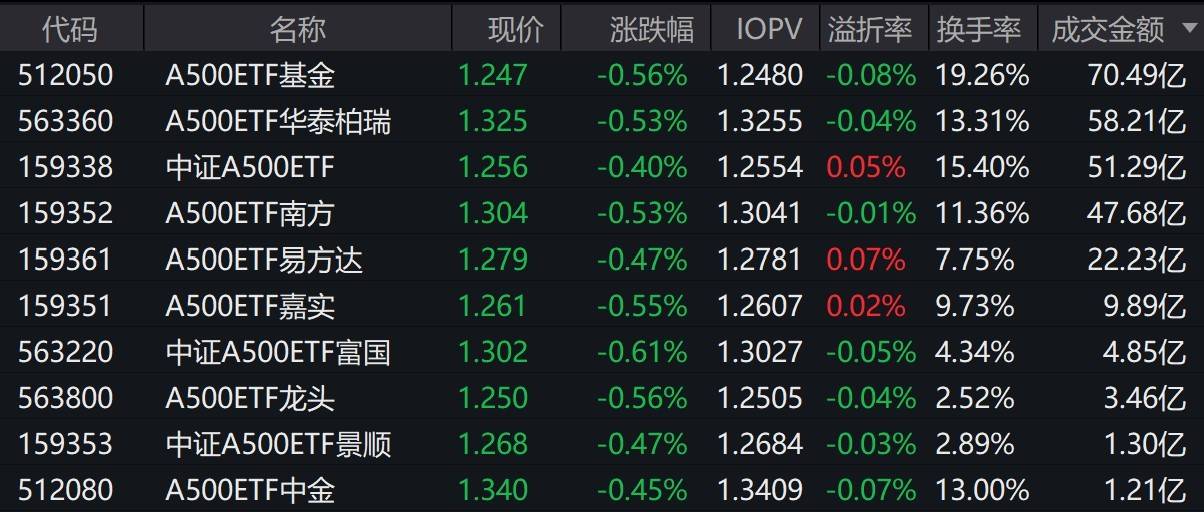
Market Overview - The market experienced fluctuations in the early session, with the ChiNext Index dropping over 1% and the CSI A500 Index declining by 0.49% [1] - The computing power leasing concept saw a collective surge, while the non-ferrous metals sector remained active. In contrast, the semiconductor and communication sectors weakened [1] ETF Performance - As of the morning close, ETFs tracking the CSI A500 Index showed slight declines, with 10 related ETFs having transaction volumes exceeding 100 million yuan, and 2 surpassing 5.8 billion yuan. The A500 ETF Fund and A500 ETF Huatai-PB had transaction volumes of 7.049 billion yuan and 5.821 billion yuan, respectively [1] - Specific ETF performance included: - A500 ETF Fund: Current price 1.247, down 0.56% - A500 ETF Huatai-PB: Current price 1.325, down 0.53% - CSI A500 ETF: Current price 1.256, down 0.40% [2] Analyst Insights - Some brokerages indicated that, from a medium-term perspective, the current economic fundamentals, macro policies, and overseas markets do not support a trend-driven rally in A-shares. They recommend reasonable position control and waiting for macro factors to clarify, as well as for the market to self-select a breakout direction and main sectors [1]
资金回流部分宽基ETF 市场主线向“盈利驱动”切换
Zhong Guo Zheng Quan Bao· 2026-02-26 20:28
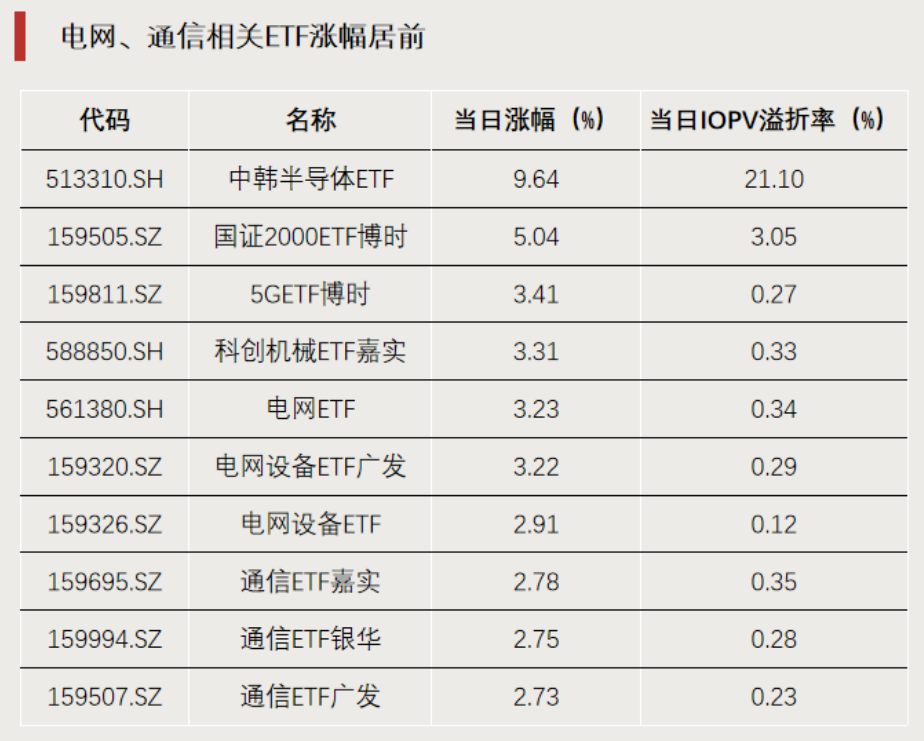
Group 1 - The South Korea-China Semiconductor ETF (513310) surged by 9.64%, leading the market on February 26, with a premium rate of 21.10% and a turnover rate exceeding 125% [2][3] - The semiconductor equipment sector continues to rise, driven by a sustained "supply-demand imbalance" in the global storage industry, which is expected to maintain its upward trend until after 2027 [2] - The strong performance of the semiconductor design sector is attributed to Nvidia's impressive earnings report and the ongoing demand for AI computing power, alongside accelerated domestic industry development and supportive policies [2] Group 2 - The short-term bond ETF Hai Futong (511360) recorded a transaction volume exceeding 66 billion yuan, ranking first in the market [3] - Several A500 ETFs, including A500 ETF Fund (512050) and A500 ETF Huatai Baichuan (563360), saw significant trading volumes, indicating renewed investor interest in broad-based ETFs [3] - There was a notable net inflow into the Hang Seng Technology and Hong Kong internet-themed ETFs, suggesting a shift in investor sentiment despite market volatility [4] Group 3 - The market is expected to transition from valuation-driven logic to earnings-driven logic, with a focus on the quality of earnings, cash flow, and dividend capabilities of listed companies [5] - The dual focus on cyclical and technology sectors is emerging, with the performance of both sectors likely to depend on the verification of fundamental strengths [5][6] - In the context of economic recovery, the market is anticipated to maintain a volatile upward trend, favoring large and mid-cap blue-chip stocks [6]
大幅溢价!这只ETF逼近涨停
Zhong Guo Zheng Quan Bao· 2026-02-26 12:45
Group 1 - The South Korea-China Semiconductor ETF (513310) surged by 9.64%, nearing the daily limit, leading the market ETFs with a premium rate of 21.10% and a turnover rate of 125.76% [1][4][8] - The Short-term Bond ETF (511360) recorded a transaction volume exceeding 66 billion yuan, ranking first among all market ETFs [2][8][9] - Several A500 ETFs, including A500 ETF Fund (512050) and A500 ETF Huatai (563360), saw significant trading volumes, indicating strong investor interest [2][8] Group 2 - The semiconductor equipment sector continues to rise, driven by a sustained "supply-demand imbalance" in the global storage industry, with expectations of continued growth until after 2027 [6] - The chip design sector experienced a significant rally, supported by strong performance from Nvidia and ongoing domestic industry development and policy support [6] - The film and insurance sectors faced declines, with the Hong Kong pharmaceutical sector experiencing substantial drops, as multiple Hong Kong pharmaceutical ETFs fell over 3% [6][7] Group 3 - Funds began to flow back into broad-based ETFs such as the CSI 500 ETF (510500) and the A500 ETF Southern (159352) on February 25, indicating a shift in investor sentiment [10] - The Hong Kong technology and internet-themed ETFs saw significant net inflows, suggesting a renewed interest in these sectors despite market volatility [10] - The market is expected to transition from "valuation-driven" to "earnings-driven" as investor focus shifts towards the quality of earnings and cash flow of listed companies [12]
基于BLACK-LITTERMAN模型融合资产择时与风格轮动的资产配置研究
Southwest Securities· 2026-02-26 10:30
Asset Allocation Model - The report introduces a dual-driven asset allocation model based on the Black-Litterman (BL) framework, integrating strategic and tactical approaches to enhance decision-making and investment performance[1] - The strategic component utilizes asset timing and regression analysis to generate posterior distributions of asset returns, improving the foresight of allocation decisions[1] - The tactical component focuses on style rotation strategies in the A-share market, dynamically tracking market style shifts to optimize investment portfolios[1] Timing Strategies - The bond timing strategy is based on economic fundamentals (economic growth, real estate cycle) and market interest rates (repo rates, government bond yields) to time government bonds[2] - The commodity timing strategy for gold incorporates financial, monetary, and commodity attributes, analyzing real interest rates, inflation expectations, risk aversion, and supply-demand relationships[2] - The stock timing strategy for A-shares evaluates liquidity (money market rates, credit expansion), international influences (China-US interest rate differentials, exchange rates), and valuation metrics[2] Style Rotation Strategies - The size and value rotation strategy examines macroeconomic changes and the performance of large versus small-cap stocks, utilizing indicators like credit spreads and foreign capital inflows to construct timing metrics[3] - The growth versus value rotation strategy is driven by macro liquidity and micro technical factors, with liquidity being the core driver of growth-value style rotation[3] Performance Metrics - From December 31, 2013, to December 31, 2025, the BL model strategy achieved an annualized return of 12.10%, a Sharpe ratio of 2.38, and a maximum drawdown of 4.72%[7] - The latest asset allocation weights as of December 31, 2025, include 4.54% in money market funds, 58.64% in government bonds, 18.00% in gold, and 18.82% in A-shares, with A-shares equally allocated between small-cap and growth styles[8]