
幂律分布

Search documents
捕获高赔率的最优解,逻辑起点在哪里?
雪球· 2026-03-29 04:08
Core Viewpoint - The article emphasizes that high odds are the primary driver of investment returns and explores the distribution of high odds in the context of compounding investment strategies [3][4][7]. Group 1: High Odds and Investment Returns - High odds are identified as the first driving force behind investment returns, suggesting that understanding their distribution is crucial for optimizing investment strategies [4][7]. - The article posits that the distribution of investment returns follows a power law, indicating that high odds may also exhibit a power law distribution [5][6]. Group 2: Technological Paradigm Shifts - The article outlines historical market capitalization ceilings across different technological eras: IBM at $40 billion during the mainframe era, Microsoft at $500 billion during the PC internet era, Apple at $3.8 trillion during the mobile internet era, and a projected $10 trillion for the AI digital era [10][11][12][13]. - Each technological cycle shows a significant leap in market capitalization, suggesting that high odds in investment returns are linked to these paradigm shifts [14]. Group 3: Investment Strategies and Market Dynamics - The article discusses the importance of understanding trends and end values in stock investments, highlighting that significant returns can be achieved by buying during market dips [15]. - It suggests that for ordinary investors, cryptocurrencies may offer better opportunities than traditional equity markets, with potential returns of 100x to 1000x during early-stage investments [15]. - The article concludes that capturing high odds requires a strategic approach to portfolio composition, emphasizing the need for a structured investment strategy to optimize returns [15].





幂律分布,复利投资最优解的又一个数学必然!
雪球· 2026-03-26 08:10
Core Viewpoint - The optimal investment strategy is to focus on high-odds, long-term, and high-certainty investments, as derived from the nature of compound interest and the power law distribution of returns [17][25]. Group 1: Investment Dynamics - In the real investment world, a small number of assets contribute the majority of total returns, while most assets contribute little to negative returns [6]. - The process of compounding returns is multiplicative, leading to extreme differentiation where winners continue to win and losers continue to lose [9][10]. - Market dynamics such as network effects, scale effects, and brand effects amplify the advantages of leading assets, marginalizing followers [11][12]. Group 2: Cognitive Limitations - Market participants have limited cognitive bandwidth, making it impossible to deeply understand all assets simultaneously [13][14]. - Only a few individuals can identify extreme values, while most follow trends or make guesses, further concentrating returns [15]. Group 3: Investment Strategy - The investment return distribution follows a power law, where a few extreme values account for the majority of total returns, making it essential to pursue high-odds opportunities [16][18]. - Selecting a small number of high-potential assets is crucial, as spreading investments too broadly dilutes overall returns [20]. - High conviction in selected assets is necessary; low allocation to identified extreme values results in minimal contribution to total returns [21]. Group 4: Time Horizon - Extreme values require time to fully materialize; thus, a long-term investment horizon is essential to realize the full potential of these assets [23]. - The conclusion emphasizes that in a power law distribution, diversification leads to systematic dilution of value, while concentration allows for precise capture of value [24]. Group 5: Conclusion - The findings converge on the idea that high-conviction, long-term investments in high-odds opportunities are not merely a preference but a mathematical necessity under power law dynamics [25][26].

a16z 合伙人自述:精品 VC 已死,做大规模才是 VC 的终局
Xin Lang Cai Jing· 2026-02-21 16:12
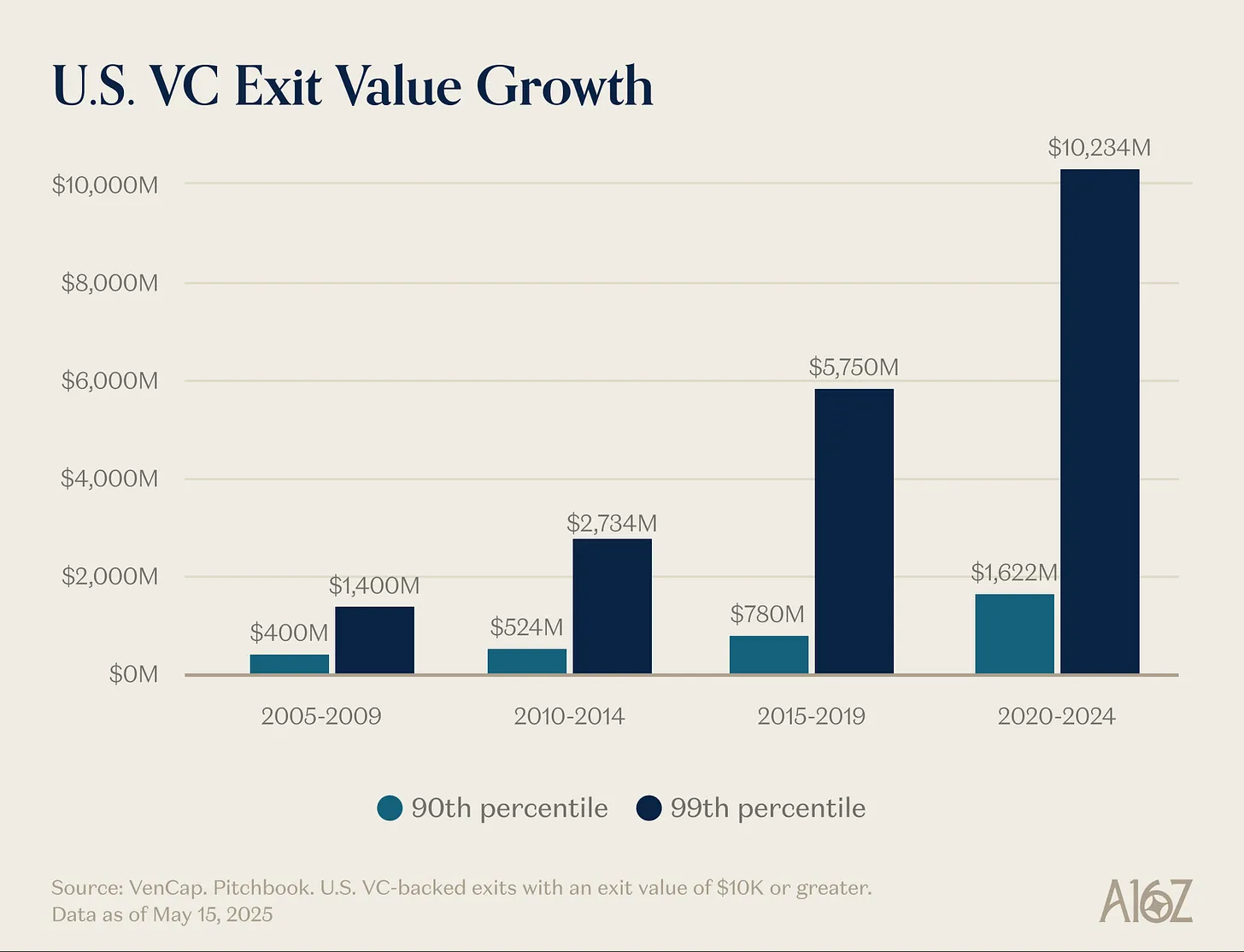
Core Argument - The article argues that the venture capital (VC) industry is transitioning from a "judgment-driven" model to a "deal-winning capability-driven" model, emphasizing the need for large-scale platforms like a16z to support founders in the evolving landscape of software and AI [1][3][4] Industry Evolution - The VC industry is evolving in response to the "software is eating the world" trend, with a significant increase in the number of founders and the scale of companies being built [2][6] - The traditional narrative that larger VC firms will fail due to their size is challenged, as the demand for capital and support from founders has increased [3][4] Market Dynamics - The number of successful companies has increased dramatically, with around 150 companies now generating over $100 million in revenue annually, compared to about 15 a decade ago [5] - The growth of software companies has shifted the economic landscape, with private tech companies now representing 22% of the S&P 500 index [6] Capital Requirements - Modern tech companies are capital-intensive, requiring billions for infrastructure, which necessitates larger VC funds to meet these demands [8][9] - The VC industry must scale to accommodate the increased funding needs of successful startups, as the potential market size for new ventures is larger than previously anticipated [7][9] Competitive Landscape - The competition for deals has intensified, with more VC firms vying for a limited number of high-quality startups, making the ability to win deals as important as selecting the right companies [15][16] - The efficiency of the VC market has improved, with more repeat entrepreneurs creating iconic companies, leading to a faster scaling of successful startups [17] Future of VC - The future of the VC industry is expected to be a "barbell" structure, with a few large players and many specialized smaller firms, both thriving in their respective niches [23][24] - The article suggests that the growth of VC funding is beneficial for the startup ecosystem, as it can lead to higher valuations and more innovation [13][22]
对话 Monolith 曹曦:有趣可以当饭吃
晚点LatePost· 2025-12-08 03:20
Core Viewpoint - The investment landscape has shifted significantly, requiring new strategies and approaches to identify and capitalize on opportunities, particularly in the AI sector [5][10][30]. Group 1: Investment Philosophy - The essence of good investment is akin to recognizing lightning; it is rare and difficult to articulate, yet instinctively understood when encountered [4][24]. - The new fund Monolith aims to be one of the best GPs in Asia, focusing on both primary and secondary markets, reflecting a shift in the investment paradigm [5][7]. - The investment strategy emphasizes betting on the best companies within the largest changes, particularly in AI, while maintaining a concentrated portfolio [48][49]. Group 2: Market Dynamics - The market has transitioned from a period of excess liquidity to a more cautious environment, with a significant reduction in the scale of investments [30][31]. - The previous decade saw a 100-fold increase in the scale of capital in China's primary market, but this has now contracted by approximately 70% [30][31]. - The current investment climate allows for more thorough evaluations of projects, as time has become cheaper and capital more expensive [30][31]. Group 3: Fundraising and Investor Relations - Monolith successfully raised $488 million, exceeding its initial target by 60%, indicating renewed interest in Chinese investments [7][9]. - The fund's early investors include notable CEOs, reflecting a strong network built on trust and past relationships [8][9]. - The current generation of entrepreneurs is more financially equipped and willing to support the next wave of startups, contributing to the fund's success [9][10]. Group 4: Entrepreneurial Insights - Successful entrepreneurs often exhibit resilience and a unique ability to see the essence of their business, which is crucial for long-term success [45][41]. - The new generation of entrepreneurs, particularly those born in the 1990s, is characterized by a more balanced and rational approach, shaped by a stable economic environment [52][53]. - The investment community is increasingly recognizing the importance of understanding an entrepreneur's background and personal story as indicators of their potential [54][55].

李骁军:存在手机里的52条年度感悟丨2025尾声
暗涌Waves· 2025-12-05 03:45
Part 01: Talent, Career, and Investment - When hiring or evaluating entrepreneurs, it is essential to have a growth perspective, focusing on their potential for future success rather than past achievements [5] - The core competitiveness of a company should be transferable to individuals, who must also be able to adapt their skills to new environments. It is crucial to identify individuals who can continue to shine over the next decade [5][6] - Investors' taste and cognitive ceilings are often determined by their exposure to the best entrepreneurs in the industry, emphasizing the importance of learning from top talent [5] - Talent often appears in clusters, and value distribution follows a power law [6] - Different industries and careers can be categorized into structures such as Winner-takes-all, Power law, and Fragmented, which influences investment strategies [7] - The best careers are those that are compounding, scalable, and capitalizable, as exemplified by Warren Buffett [7] - Individuals in their upward phase are typically more self-driven and easier to manage, while those in a defensive mindset after peak performance may struggle with new business challenges [7] - AI models provide insights into the importance of practical experience in generating cognitive models and maintaining focus on critical tasks [8][9] - Investors should balance the fear of missing out with the urgency of decision-making, understanding market sentiments and consensus [10][11] - The value of institutions often surpasses that of individuals in the financial services industry, with long-term career value tied to institutional growth [14] Part 02: Cultivation and Growth - Learning to breathe correctly can enhance calmness and awareness of one's body, emphasizing the importance of physical well-being [16] - Recognizing personal peak times can significantly impact mood and efficiency throughout the day [22] - The greatest recognition often comes from the strongest competitors, highlighting the importance of self-acknowledgment over external validation [25] - The core of each individual's model consists of faith, ability, and personality, with the need for continuous calibration in the AI era [26] - Choosing what not to pursue can be more critical than knowing what to pursue, as the motivations behind actions can differ significantly [27] Part 03: Life and the World - Understanding one's self-awareness over time is crucial, as is identifying absolute and relative value advantages in a changing world [39] - The concept of friendship is framed as mutual support for personal growth, emphasizing the relational aspect of success [42] - The quality of time spent and the ability to annotate experiences significantly influence personal development and cognitive models [47] - Major life decisions regarding where to live, career choices, and relationships greatly impact overall life quality [49] - The timing and rhythm of life are essential, with success often linked to how well one resonates with the pulse of the times [52]

普通人拿不到大结果,关键并不在于能力
Hu Xiu· 2025-08-29 00:42
Core Insights - The article discusses the difference between ordinary individuals and high achievers, emphasizing that the key factor is not ability or resources, but rather a mindset that favors seeking "outliers" over "stable values" [1][2]. Group 1: The Concept of "Climbing the Wrong Mountain" - The story of Chris Dixon, a successful crypto venture capitalist, illustrates how individuals often remain in unfulfilling careers due to the allure of immediate rewards, rather than pursuing their true aspirations [3][4][5]. - Many ambitious individuals express a desire to work in tech startups but often choose to stay in their current roles, leading to years of stagnation [7][8]. - The "climbing" analogy highlights the risk of only pursuing immediate gains, which may lead to settling for lower peaks instead of striving for higher goals [10][12]. Group 2: The "Stable Value" Mindset - The tendency to settle for "good enough" results and avoid high-risk opportunities is rooted in an ancient survival algorithm that prioritizes stability and predictability [21][34]. - This mindset is reinforced by biological, cognitive, and social factors that favor low variance and risk aversion, making individuals less likely to pursue high-reward opportunities [22][30][31]. Group 3: The "Outlier" World - The modern business landscape operates under a power law distribution, where a small percentage of outliers generate the majority of returns, contrasting with the traditional bell curve [35][36]. - Most individuals operate under a linear mindset, focusing on optimizing performance rather than embracing the volatility necessary for significant success [40][41]. Group 4: Strategies for Cultivating an "Outlier" Mindset - High achievers adopt strategies that involve seeking out high-variance opportunities, such as investing in ideas that may initially seem flawed but have the potential for significant returns [44][48]. - The approach of "batch testing" and setting clear exit strategies allows individuals to navigate risks effectively while maximizing potential rewards [58][63]. - Embracing uncertainty and viewing life as a series of experiments rather than a quest for perfection can lead to greater opportunities for success [70][71].