幂律法则

Search documents
开年连获三个人工智能IPO,对话启明创投周志峰:遵循幂律法则,坚定布局长雪坡、大赛道里的科技标的
IPO早知道· 2026-02-11 03:12
Core Viewpoint - The article emphasizes that IPOs are not the end but a starting point for companies, serving as a gathering place for resources and strength to face greater challenges ahead [4][8]. Group 1: Recent IPOs and Market Context - In the first 40 days of 2026, five AI-related hard tech companies completed their IPOs through the Hong Kong Stock Exchange's "Special Line for Science and Technology Enterprises" [3]. - Qiming Venture Partners, a prominent investor in the AI sector, has invested in more than half of these IPO projects, highlighting its role in supporting these companies from early stages [3][5]. - The success of these IPOs is attributed to a combination of favorable policies, market conditions, and the growing interest in AI technology [5][6]. Group 2: Investment Philosophy and Strategy - Qiming Venture Partners adheres to the Power Law principle in venture capital, believing that a few high-quality projects can generate significant returns, which are essential for the fund's overall value [7]. - The firm focuses on investing in core sectors of the AI ecosystem, such as cloud GPUs, large models, and AI inference chips, which are characterized by substantial market demand and technological depth [7]. - The investment strategy includes early intervention and comprehensive support for companies, from technology development to commercialization and IPO [6][7]. Group 3: Future Outlook and Challenges - The article suggests that companies should focus on their core value creation capabilities to achieve sustainable growth and maintain a reasonable market valuation post-IPO [8]. - The IPO is viewed as a milestone rather than a celebration, with the real challenge being the journey towards long-term success and innovation after going public [4][8]. - Historical examples, such as NVIDIA's post-IPO innovations, are cited to illustrate the potential for companies to leverage IPOs for further growth and market leadership [9].


“科技投资大师”詹姆斯·安德森:投资里最难的部分,不是发现那些少数赢家,而是熬过它们的回撤……
聪明投资者· 2025-09-01 07:03
Core Viewpoint - True wealth creation must be viewed over decades or even an entire company lifecycle to be realized [2] Group 1: Investment Philosophy - James Anderson, a prominent figure in global growth stock investment, emphasizes long-termism and imagination in identifying great companies [4][6] - The market is not a mean-reverting world but is driven by a power law, where a few winners generate most of the returns [8][22] - The real challenge in investing is not finding these great companies but enduring the inevitable significant drawdowns they experience [9][34] Group 2: Market Dynamics - Since 1926, 57% of U.S. companies have underperformed government bonds over their lifetimes, indicating that holding stocks does not guarantee systematic returns [24][25] - From 1990, one-third of excess returns in the U.S. stock market came from just 10 companies, highlighting the concentration of market performance [20][21] - Globally, only 1% of companies have generated all excess returns since 1990, reinforcing the idea of a few companies driving market value [22] Group 3: Investment Strategy - Investors should focus on identifying and supporting a small number of truly great companies, even if it means buying at unreasonable prices [46][48] - The investment approach should prioritize long-term value creation over short-term gains, moving away from the prevalent short-termism in the industry [38][66] - Companies that are ambitious and willing to challenge boundaries are essential for long-term investment success [94] Group 4: Future Outlook - The investment landscape is becoming increasingly inefficient, and the diversity of investment thinking is diminishing [38][56] - There is a need to shift focus back to genuinely creating value rather than merely trading and financial engineering [64] - The potential for significant advancements in sectors like healthcare and renewable energy suggests that the next wave of investment opportunities may arise from companies addressing fundamental issues [78][80]

蚂蚁集团CTO何征宇揭秘AI四大挑战:未来所有数据公司都将成为AI公司
Xin Lang Ke Ji· 2025-05-17 23:48
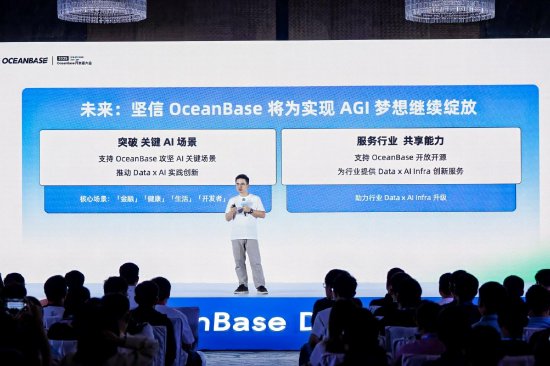
Core Insights - OceanBase has launched PowerRAG, an AI-focused application product that enables ready-to-use RAG application development, marking its commitment to the AI era [1] - The company aims to evolve from an integrated database to an integrated data foundation, focusing on a comprehensive layout across computing power, infrastructure, platform, application, and delivery forms [1] - Ant Group's CTO emphasized the importance of data in the development of AI and large models, highlighting four major challenges: increased data acquisition costs, scarcity of rigorous industry data, the need for enhanced multi-modal data processing capabilities, and difficulties in data quality assessment [1][7] Company Strategy - Ant Group will support OceanBase in achieving breakthroughs in key AI scenarios across finance, healthcare, and daily life, while promoting the Data×AI concept and architectural innovation [2][10] - OceanBase is positioned as a representative of Ant Group's continuous innovation and technical breakthroughs, particularly in handling massive transaction data [9] Industry Challenges - The cost of data acquisition has significantly increased, with readily available and inexpensive data resources nearing exhaustion, leading to a focus on generating high-quality data as a key success factor for digital enterprises [7] - High rigor industries, such as legal and healthcare, face challenges in data circulation due to stringent data quality requirements and a lack of digital knowledge, which hampers the effective application of generative AI [8] - The processing of multi-modal data remains a significant challenge, as future data will encompass not only text but also visual and tactile information, necessitating advanced handling capabilities [8] - Quality assessment of data is crucial, as it directly impacts the performance of large models, with the need for extensive evaluation data posing a significant challenge [9]
速递|大公司吃肉,小公司喝汤?AI投资或与移动互联网投资的逻辑截然不同
Z Finance· 2025-03-10 06:47
Core Insights - The article highlights a surge in venture capital funding for U.S. startups, driven by investor enthusiasm for artificial intelligence (AI), reaching over $30 billion in the first quarter of this year, the highest since 2021 [1][2] - The funding landscape is increasingly concentrated among a few large private tech companies, with significant investments planned for firms like OpenAI and Anduril [1][2] Investment Trends - In Q1 2024, the U.S. venture capital market is expected to reach $80 billion, marking the best quarterly performance since 2021, with 40% of this growth attributed to six major deals involving companies like OpenAI and Databricks [1][2] - Notable recent funding rounds include Stripe and Ramp, valued at $91.5 billion and $13 billion respectively, and AI startups Anthropic and Shield AI, valued at $61.5 billion and $5.3 billion [2] Shift in Investment Logic - The article discusses a shift in venture capital logic, where investors are now focusing on larger, more established companies with significant revenue, rather than solely on early-stage startups [3][4] - This change is driven by the belief that established companies have a clearer path to profitability, despite the uncertainties in the AI sector [3] Market Polarization - The venture capital market is becoming polarized, with substantial capital available for rapidly growing companies like OpenAI and Anduril, while other startups struggle to secure funding [5][6] - The article notes that even with a total funding of $80 billion in the current quarter, a significant portion may come from a single transaction, indicating a concentration of capital [6]