
平台常态化监管

Search documents
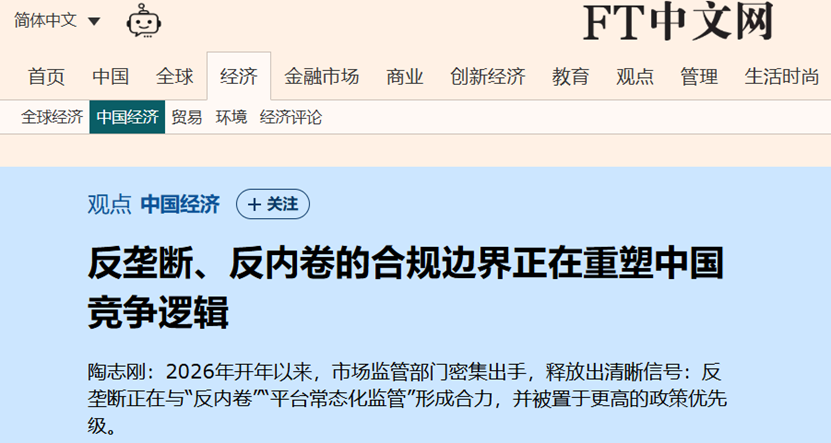
反垄断措施密集出台,《金融时报》发文称正重塑中国竞争逻辑
Huan Qiu Wang· 2026-02-12 01:01
Group 1 - The State Council's Anti-Monopoly and Anti-Unfair Competition Committee has issued guidelines for the public utility sector to prevent and curb monopolistic behaviors in water, electricity, gas, and heating services, aiming to maintain fair market competition and protect consumer and public interests [1] - The upcoming national market supervision work meeting in 2025 has prioritized "strengthening anti-monopoly and anti-unfair competition" as a key task, indicating that anti-monopoly efforts are now a crucial part of China's competitive order adjustment [1] Group 2 - In 2026, market regulatory authorities have intensified anti-monopoly enforcement actions targeting food delivery platforms, the polysilicon industry alliance, and online travel platforms, signaling a clear message that anti-monopoly is being integrated with "anti-involution" and "platform normalization regulation" at a higher policy priority [3] - The primary goal of anti-monopoly measures is to prevent monopolistic behaviors from causing systemic harm to consumers and suppliers, as monopolies can raise prices for consumers and lower earnings for upstream suppliers [3] - Unlike the reliance on judicial litigation in Europe and the U.S., China's anti-monopoly approach is primarily administrative, characterized by high efficiency, short cycles, and quick corrections, allowing early intervention to prevent long-term damage to consumers and suppliers [3]

互联网平台治理任重道远
Zhong Guo Qing Nian Bao· 2026-01-19 22:49
Core Viewpoint - The recent investigation into Ctrip for alleged monopolistic practices serves as a warning to all platform enterprises, highlighting the ongoing tightening of regulations in China's platform economy [2][3]. Group 1: Regulatory Actions and Investigations - As of December 17, 2025, China has handled 35 cases of monopoly agreements and 25 cases of abuse of market dominance, with total fines amounting to 2.93 billion yuan [4]. - Ctrip is under investigation for suspected abuse of market dominance, with the company stating it will cooperate with the investigation [2]. - The National Market Supervision Administration has emphasized the need for continuous regulation of platform economies, with key tasks for 2026 including strengthening regular oversight and ensuring compliance [2]. Group 2: Impact on Platform Enterprises - Ctrip may face operational adjustments, confiscation of illegal gains, and substantial fines, estimated between 533 million to 5.33 billion yuan based on its 2024 revenue of 53.3 billion yuan [3]. - The investigation serves as a critical reminder for all platform enterprises to abandon monopolistic practices and ensure transparency and fairness in transactions [3]. Group 3: Broader Regulatory Framework - The Chinese government has been enhancing its antitrust framework, with recent statistics showing a significant increase in enforcement actions against monopolistic practices [4][6]. - New regulations, such as the "Internet Platform Antitrust Compliance Guidelines," aim to delineate compliance boundaries and encourage self-assessment among platform operators [6]. - The government is also focusing on addressing "involutionary" competition, which is characterized by low-quality, low-price competition that disrupts market efficiency [4][6]. Group 4: Specific Industry Regulations - The food delivery platform sector is under scrutiny, with new national standards introduced to regulate competition and address issues like excessive subsidies and price wars [4]. - The Market Supervision Administration is conducting evaluations of the competitive landscape in the food delivery industry to mitigate monopolistic risks and ensure market order [4]. Group 5: Responsibilities of Platform Enterprises - Platform enterprises are seen as key players in the regulatory landscape, with a need for clear delineation of responsibilities in various scenarios [10][11]. - New regulations will require platform operators to fulfill obligations related to product information disclosure and quality monitoring, reinforcing their role as market order maintainers and consumer rights protectors [12].

15天3起“反垄断”,说明了什么?
经济观察报· 2026-01-16 07:30
Core Viewpoint - The article emphasizes that antitrust regulations in China are entering a "strong regulatory" phase, with recent actions indicating that there is no room for complacency among companies regarding antitrust compliance [2][5]. Group 1: Recent Regulatory Actions - In January, the State Administration for Market Regulation (SAMR) has conducted three significant antitrust investigations targeting the food delivery industry, the polysilicon alliance, and Ctrip, all aimed at reinforcing antitrust measures [2][3]. - The discussions with the polysilicon industry highlighted that agreements on production capacity, utilization rates, sales volumes, and pricing are prohibited, signaling a strict stance against collusion [3][4]. Group 2: Misconceptions About Antitrust - Many companies hold a false sense of security regarding antitrust laws, believing that the current "anti-involution" policies might allow for some leniency in monopolistic practices, which is a dangerous misconception [2][4]. - The article argues that the belief in "winner-takes-all" in the internet sector leads to a misunderstanding of market competition, as companies think that size alone can protect them from antitrust scrutiny [4][5]. Group 3: Importance of Antitrust Regulations - Antitrust laws are described as the foundational rules of a market economy, ensuring market vitality and innovation through external constraints [5]. - The article stresses that a well-structured market economy is essential for addressing "anti-involution" and fostering technological advancement and economic growth [5].

15天3起“反垄断”,说明了什么?
Jing Ji Guan Cha Wang· 2026-01-16 07:01
Core Viewpoint - The Chinese government is intensifying its antitrust regulations, signaling a shift towards a "strong regulatory" period in response to market monopolies and unfair competition [2][5]. Group 1: Antitrust Actions - The State Administration for Market Regulation (SAMR) has conducted three significant interventions in January, targeting the food delivery industry, polysilicon alliances, and travel platforms like Trip.com, all aimed at reinforcing antitrust measures [2]. - Recent discussions with the China Silicon Corporation and leading polysilicon companies emphasized that agreements on production capacity, utilization rates, sales volumes, and pricing are prohibited, highlighting that "anti-involution" cannot be used as an excuse for monopolistic practices [3]. Group 2: Market Competition Dynamics - The belief that larger scale equates to immunity from antitrust scrutiny is prevalent, especially in the internet sector, where companies operate under the "winner takes all" mentality [3][4]. - Local governments sometimes interfere in market competition to protect local economies, leading to de facto market segmentation or regional monopolies, which complicates regulatory enforcement [4]. Group 3: Importance of Antitrust Regulations - Antitrust laws are fundamental to maintaining market order and ensuring competition, which is essential for market vitality and innovation [4]. - The recent surge in antitrust investigations across various sectors indicates that there is no room for complacency regarding compliance with antitrust regulations [5].

细化法规政策 构建长效机制——专家解读《网络交易平台收费行为合规指南(征求意见稿)》
Xin Hua She· 2025-05-25 15:55
Core Viewpoint - The article discusses the release of the "Guidelines for Compliance of Charging Behavior on Online Trading Platforms (Draft for Public Comment)" by the State Administration for Market Regulation, aiming to standardize platform charging behaviors and protect the rights of operators and consumers [1][2]. Group 1: Guidelines Overview - The draft consists of 28 articles focusing on five main areas: principles for platform charging, advocating for reduced burdens on operators, strengthening self-discipline, regulating charging behaviors, and enhancing supervision and implementation [1]. - The draft defines "platform operators" as individuals or organizations selling goods or services through online platforms and outlines various forms of fees that platforms may charge, including commissions, registration fees, and advertising fees [1]. Group 2: Principles and Regulations - The draft emphasizes transparency, standardization, and legality in charging practices, requiring platforms to set fees based on operational costs and service agreements while adhering to principles of fairness and honesty [2]. - It specifies eight types of "unreasonable charges" and provides guidance on the practice of "free first, charge later," mandating platforms to publicly disclose any changes in charging practices [2]. Group 3: Encouragement and Support for Operators - The draft encourages platforms to adopt flexible pricing strategies to reduce the financial burden on operators and to provide discounts or support for small businesses [3]. - It aims to balance the interests of platforms, operators, and consumers, promoting sustainable development within the platform economy [3]. Group 4: Long-term Mechanism and Market Impact - The draft not only addresses immediate issues but also emphasizes the establishment of long-term mechanisms to encourage platforms to innovate and reduce costs for merchants while enhancing consumer services [4]. - Experts believe that the implementation of these guidelines will lead to more transparent charging behaviors, better protection of rights for operators and consumers, and a more equitable market competition environment [4].