平台抽成

Search documents
交通运输部1月网约车数据:聚合平台高德打车 百度打车 腾讯出行等合规率靠后
Sou Hu Cai Jing· 2026-02-24 11:27
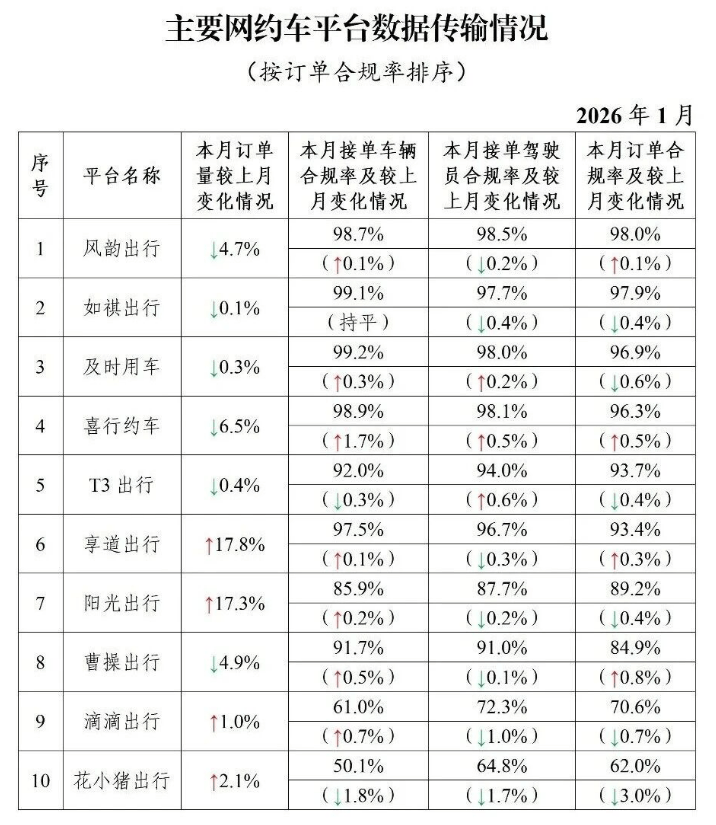
Core Insights - The Ministry of Transport released the operational data for the ride-hailing industry for January 2026, indicating a total of 396 licensed ride-hailing platforms, an increase of one from the previous month, with a total of 9.74 billion orders processed [1]. Group 1: Industry Overview - As of January 31, 2026, there are 396 licensed ride-hailing platforms in China, reflecting a growth of one platform compared to the previous month [1]. - The total number of orders received in January 2026 reached 9.74 billion [1]. Group 2: Order Compliance Rates - The top ten platforms by order compliance rate are ranked as follows: Fengyun Travel, Ruqi Travel, Jishi Travel, Xixing Travel, T3 Travel, Xiangdao Travel, Sunshine Travel, Cao Cao Travel, Didi Travel, and Huaxiaozhu Travel [1]. - The platforms with the highest growth in order compliance rates are Cao Cao Travel (+10.5%), Xixing Travel (+10.5%), and Xiangdao Travel (+10.3%) [1]. - The platforms with the lowest growth in order compliance rates are Jishi Travel (-0.6%), Didi Travel (-0.7%), and Huaxiaozhu Travel (-3.0%) [1]. Group 3: Order Volume and Compliance - The order volume for the top ten platforms shows significant changes, with Fengyun Travel experiencing a 14.7% increase, and Xiangdao Travel showing a remarkable 117.8% increase in order volume [2]. - The compliance rates for the top platforms are as follows: Fengyun Travel (98.7%), Ruqi Travel (99.1%), and Jishi Travel (99.2%) [2]. Group 4: Regional Compliance Rates - In major cities, the order compliance rates are highest in Xiamen, Chengdu, Shenzhen, and Hangzhou, with 26 cities reporting compliance rates above 80% [8]. - The cities with the highest growth in compliance rates are Yinchuan, Zhengzhou, and Haikou, while Guiyang, Changchun, and Harbin reported declines [8].

21调查|苹果腾讯讲和,微信小程序官宣接入iOS端虚拟支付
2 1 Shi Ji Jing Ji Bao Dao· 2025-11-14 08:16
Core Viewpoint - Apple has announced a reduction in the App Store commission rate from 30% to 15% for certain app developers, contingent upon their participation in the new "Mini Apps Partner Program," which aims to balance interests with platforms like WeChat, Alipay, and Douyin [1][2]. Group 1: Commission Structure - The new commission structure allows Apple to take a 15% cut from developers with annual revenues exceeding $1 million, while those below this threshold will continue to pay 15% [1]. - Tencent has reached an agreement with Apple to handle payments for WeChat mini-games and apps, with Apple taking a 15% share [1][2]. - The commission of 15% is expected to apply only to in-app purchases (IAP) and not to advertising revenue [3]. Group 2: Payment Channels and Market Dynamics - Apple's commission, often referred to as "Apple tax," is primarily based on its payment channels, which allows it to track app revenue [4]. - Advertising revenue typically does not go through Apple's payment system, making it difficult for Apple to collect fees from this channel [4]. - Current market commission rates for similar platforms show that WeChat's IAA revenue share is around 15%, while other operating systems have higher rates, indicating that Apple's 15% may be competitive [5][6]. Group 3: Ecosystem Implications - The agreement between Apple and Tencent reflects a mutual need to enhance the iOS market, as the lack of in-app purchases for mini-programs has negatively impacted user experience and platform ecology [10]. - The new commission structure may lead to a shift of paid applications to mini-program platforms, potentially increasing their market power and bargaining capabilities [11]. - The agreement also suggests a redefinition of the responsibilities and influence among ecosystem participants, including hardware platforms, mini-program platforms, developers, and users [11]. Group 4: Regulatory Context - Apple's adjustments in commission rates and payment structures are influenced by increasing antitrust scrutiny in various regions, prompting the company to seek revenue growth through partnerships with mini-program platforms [12][13]. - The "Mini Apps Partner Program" requires developers to integrate Apple's technology and share user data, which raises potential compliance risks under antitrust laws [14].


清华大学调研:滴滴月度平均抽成15.3%,九成司机低于20%
Xin Lang Ke Ji· 2025-09-28 04:00
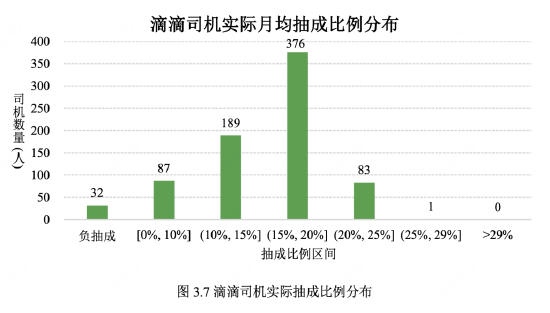
Core Insights - The research conducted by Tsinghua University's Environmental College indicates that electrification significantly benefits the environment and reshapes the economic landscape of the ride-hailing industry [1] - The study reveals that the average monthly commission for Didi drivers is 15.3%, with 90% of drivers earning a monthly commission below 20% [1][2] - A notable finding is that 71.8% of Didi drivers overestimate their commission rates, with many believing their average commission exceeds 25%, despite evidence showing only one out of 768 drivers actually falls into that category [2] Summary by Sections Research Methodology - The study was conducted between July and August of this year, involving a survey of 894 Didi drivers, in-depth interviews with 31 drivers, and income report verification from 768 drivers [2] Commission Insights - Approximately 49.0% of surveyed drivers reported a monthly commission rate between 15%-20%, while 24.6% reported a rate of 10%-15%, and 4% reported a negative commission [2] - The calculated average commission of 15.3% is slightly higher than Didi's reported average of 14% for all orders in 2024 [2] - The report suggests that drivers' perceptions of commission rates are often inflated due to a focus on individual order commissions and a lack of understanding of monthly statements [2] Driver Demographics and Income - The majority of Didi drivers are middle-aged individuals with a high school education or lower, with an average monthly income exceeding 8,000 yuan [3] - Income levels vary significantly by city, with drivers in Shanghai earning an average of 14,000 yuan per month, while those in Beijing and Shenzhen earn around 10,000 yuan [3] - Drivers in smaller cities tend to have lower incomes and often work part-time due to market constraints [3]

从“收入没有增加”到“谁补贴乘客”争议:一场直抵人心的滴滴司机与平台对话
Mei Ri Jing Ji Xin Wen· 2025-09-26 12:45
Core Insights - The core issue raised by drivers during Didi's open day is the decreasing income despite long working hours, highlighting a disconnect between driver efforts and earnings [1][3][11] - Didi's average commission rate is approximately 14%, with a commitment to reduce the upper limit of commission to 27% by the end of the year [1][10] - The number of licensed ride-hailing drivers has surged, with a 159% increase from 2020 to 2024, indicating a saturated market [3] Group 1: Driver Concerns - Drivers expressed frustration over low earnings despite long hours, with some reporting daily revenues as low as 500 yuan for extensive work [3][10] - The open dialogue allowed drivers to voice their concerns directly to the platform, emphasizing the need for transparency and fairness in commission structures [2][11] - Many drivers are confused about the relationship between passenger discounts and their earnings, with Didi clarifying that discounts do not directly reduce driver income [5][8] Group 2: Platform Responses - Didi is actively working to improve driver income by enhancing service quality and introducing better vehicle options, rather than relying solely on price competition [4][6] - The platform's commission structure is dynamic, adjusting based on supply and demand, which can lead to varying commission rates [7][8] - Didi has committed to addressing driver concerns regarding transparency in commission calculations and has promised to optimize the commission structure by the end of the year [10][11] Group 3: Market Dynamics - The ride-hailing industry is experiencing increased competition, with a significant rise in the number of platforms and drivers, leading to market saturation [3][4] - Didi's commission rates are comparatively lower than those of global competitors, with Uber's commission around 30% and European platforms at approximately 18% [8] - The platform aims to balance supply and demand through flexible commission adjustments, incentivizing drivers during peak times while offering discounts to passengers during low-demand periods [8][10]
滴滴2024年所有订单平均抽成14%
第一财经· 2025-09-13 02:21
Core Viewpoint - Didi's average commission rate for all orders in 2024 is projected to be 14%, indicating a focus on maintaining a sustainable service ecosystem rather than maximizing profit through commission alone [1] Group 1 - The majority of the commission collected by Didi is utilized for subsidies to drivers and passengers, as well as for various operational costs including platform system maintenance, payment and settlement security, customer service, insurance and claims, compliance, and taxes [1]
网约车平台集体官宣下调抽成比例
第一财经· 2025-08-21 12:07
Core Viewpoint - The recent announcements from ride-hailing platforms like Didi Chuxing, T3 Mobility, and Cao Cao Mobility to lower commission rates are aimed at improving driver earnings and addressing long-standing concerns regarding high commission fees [4][6][10]. Group 1: Commission Rate Reductions - Didi Chuxing plans to reduce the maximum commission rate from 29% to 27% by the end of this year, with a further commitment to an average commission rate of 14% in 2024 [6][10]. - T3 Mobility will also lower its commission rate, ensuring that the proportion of orders with a commission rate between 26% and 27% decreases from 21% to 17% [6][10]. - Cao Cao Mobility has reduced its commission cap from 22.7% to 22.5% as of August 15 [7]. Group 2: Regulatory Influence - The collective decision to lower commission rates is influenced by increased regulatory scrutiny, with multiple local authorities having previously engaged with ride-hailing platforms regarding high commission issues [10][11]. - Regulatory bodies have emphasized the need for platforms to self-regulate, set reasonable commission rates, and protect the rights of drivers [10][11]. Group 3: Driver Perspectives - Drivers have expressed that the reduction in commission rates is beneficial, as it increases their actual earnings per order and reduces their operational time and workload [7][10]. - A driver with over five years of experience highlighted that various factors, including order volume and platform fee structures, have contributed to income fluctuations, with order volume being the primary concern [7][10]. Group 4: Market Dynamics - The ride-hailing industry is characterized by significant supply and demand fluctuations, necessitating flexible pricing and subsidies to maintain order matching [12]. - While the recent commission reductions primarily benefit drivers, the overall income levels are still subject to the industry's supply-demand dynamics [12].