并购融资

Search documents
并购票据新机制“敲开”企业融资大门 市场生态有望扩容
Shang Hai Zheng Quan Bao· 2026-01-11 22:02
Core Insights - The issuance mechanism for merger notes has undergone systematic optimization, leading to a rapid increase in the use of these financing tools in the interbank market since December 2025 [1][2] - Merger notes are becoming an important link between capital markets and corporate merger needs, alleviating reliance on credit resources and providing flexible mid-to-long-term funding support for industrial integration [1][4] Group 1: Mechanism Optimization - The recent notification from the interbank market trading association has significantly improved the merger note system, reducing operational thresholds and enhancing market adaptability and issuance efficiency [2][3] - The establishment of a "green channel" for registration and the expansion of fundraising purposes have effectively lowered compliance costs and shortened registration cycles, making merger notes more aligned with the fast-paced nature of merger transactions [3][4] Group 2: Market Demand and Bank Strategy - There is a growing demand for mergers in both emerging strategic industries and traditional sectors undergoing transformation, with companies facing challenges such as long merger cycles and large funding needs [3][4] - Banks are shifting from being mere credit providers to actively participating in merger note projects, which allows them to broaden revenue sources and strengthen long-term relationships with enterprises [5][6] Group 3: Institutional Value and Financing Structure - The introduction of merger notes is seen as a way to reduce excessive reliance on bank credit resources for merger financing, providing a more institutionalized direct financing path for companies [4][5] - Merger notes, as a new financing tool, offer advantages such as lower financing costs, flexible terms, and high issuance efficiency, effectively filling the market gap for mid-to-long-term, low-cost merger financing [4][5] Group 4: Future Considerations - As the scale of merger notes expands, there is a need for improved risk control, information disclosure, and investor education to ensure the long-term healthy development of this financing tool [6][7] - The current market for merger notes is primarily dominated by state-owned banks and leading joint-stock banks, but as the system matures and demand continues to grow, more financial institutions are expected to participate, creating a multi-layered and collaborative market ecosystem [7]
历史最大单!中信银行牵头主承50亿元并购票据
Jin Rong Jie· 2025-12-12 13:04
Group 1 - The core viewpoint of the news is that the successful issuance of a 5 billion yuan merger financing note by a major state-owned enterprise, led by CITIC Bank, marks a significant milestone in China's merger financing market, being the largest of its kind in history and a pilot project under new regulations [1][2] - The project focuses on investing in strategically important and scarce national resources, providing timely financing for the restructuring and integration of large state-owned enterprises, which is expected to be completed within the year [1][2] - CITIC Bank's ability to quickly raise the full amount of 5 billion yuan in just two working days demonstrates its strong execution capabilities and innovative practices in supporting state-owned asset optimization and major strategic restructuring [1][3] Group 2 - The successful issuance indicates a potential new dual-driven model in the domestic merger financing market, combining "merger loans + merger bonds" [2] - The recent notification from the China Interbank Market Dealers Association aims to guide bond market funds to support corporate mergers and acquisitions, facilitating economic structural adjustments and resource optimization [2] - CITIC Bank has established a leading position in bond financing and merger finance, leveraging its advantages in information disclosure, transaction structure, and financing efficiency to optimize financing scales, terms, and costs for enterprises [2][3] Group 3 - CITIC Bank has a long-standing commitment to direct financing and has excelled in expanding the breadth and depth of corporate bond financing, showcasing its strong support for the real economy [3] - The bank has led the market in various aspects, including bond underwriting service scale, total client volume, and support for private enterprises, contributing significantly to economic circulation and industrial transformation [3] - The successful launch of the largest merger note is a testament to CITIC Bank's comprehensive credit bond financing service system and its robust service capabilities across various market segments [3]

并购新标尺!中信银行牵头主承50亿历史最大单并购票据
Xin Lang Cai Jing· 2025-12-12 08:29
Core Insights - The successful issuance of a 5 billion yuan merger note by CITIC Bank marks a significant milestone in China's merger financing market, being the largest in history and a pilot project under new regulations [1][4] - The project focuses on investing in strategically important resources, providing timely financing for the restructuring and upgrading of large state-owned enterprises [1][4] Group 1 - The issuance is expected to initiate a new dual-driven model of "merger loans + merger bonds" in the domestic merger financing market [2][5] - CITIC Bank has leveraged its expertise in bond financing and merger finance to optimize financing scales, terms, and costs for enterprises, showcasing its innovative capabilities [2][6] Group 2 - CITIC Bank has been a leader in direct financing, enhancing the breadth and depth of corporate bond financing, and has played a crucial role in supporting the real economy [3][6] - The bank has consistently been at the forefront of financial support for national strategies, having underwritten over 40% of the first batch of pilot projects for the "Technology Board" launched in May [3][6]
低利率催热并购债券市场,季度融资规模创四年新高
Zhi Tong Cai Jing· 2025-12-08 13:17
Group 1 - The current favorable conditions have led companies to rush into the bond market for cheap merger financing, resulting in a global M&A financing scale of $113 billion this quarter, the largest in four years and one of the highest on record [1][4] - Merck and GE Healthcare raised a combined $9.25 billion in a single day for acquisitions announced two weeks prior, indicating strong credit sentiment as corporate spreads approach historical lows [1][4] - The pharmaceutical sector has been particularly active, with Novo Nordisk raising €4 billion for the acquisition of Akero Therapeutics and Pfizer selling $6 billion in bonds for the acquisition of Metsera [4] Group 2 - Demand for bonds has been so strong that borrowers do not need to pay a premium even when including clauses for debt buybacks if mergers are not completed on time, reducing the risk of accumulating additional debt if deals fail [4][5] - Companies like Magnum have included clauses in their bonds allowing for early repayment if their spin-off does not finalize by mid-next year, indicating a strategic approach to financing [5] - The return of M&A activity is being strongly felt, with banks underwriting approximately $65 billion in debt related to leveraged buyouts for 2026, and expectations for a broader recovery in M&A activity in 2026 [6]




并购重组全局整理:29 交易结构设计之融资安排
Sou Hu Cai Jing· 2025-12-02 23:36
Financing Decision Dimensions - M&A financing decisions typically consider seven dimensions, including financing type combinations, maturity, yield basis, currency, innovative clauses, control, and issuance methods [4][6][7][8][9][10]. - The optimal financing combination usually starts with internal financing, followed by debt financing, and finally equity financing, aiming for maximum company value [6]. Financing Channels - M&A financing channels can be classified into internal and external categories. Internal channels include retained earnings and tax liabilities, while external channels encompass bank loans, non-financial institution funds, and foreign capital [10]. - External financing is characterized by speed and flexibility but comes with higher costs and risks [10]. Special Financing Methods - M&A funds pool third-party capital for acquisitions, often involving private equity funds and listed companies, leveraging both financial tools and platform resources [15]. - Leveraged buyouts (LBOs) utilize financial leverage to acquire companies with minimal upfront capital, relying on the target's assets and future cash flows for repayment [16]. - Management buyouts (MBOs) involve company management acquiring shares, aligning ownership and management roles, typically in stable cash flow environments [17]. - Asset securitization transforms illiquid assets into liquid asset-backed securities, enhancing cash flow management [18]. Evaluating M&A Financing Plans - The evaluation of M&A financing plans should consider flexibility, risk, return, control, and timing [19]. - Comparing different financing options, such as debt versus equity, reveals trade-offs in liquidity, risk exposure, earnings per share, control dilution, and market perception [19][20].

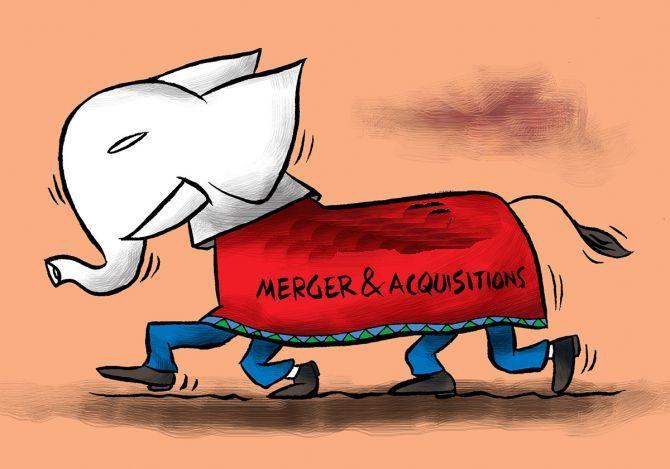
Banks can now fund India Inc's M&A drive
Rediff· 2025-10-02 08:35
Core Viewpoint - The Reserve Bank of India (RBI) has allowed banks to finance acquisitions by Indian companies, addressing a long-standing demand and expanding banks' capital market lending capabilities [1][3]. Group 1: Regulatory Changes - The RBI's decision aims to provide an enabling framework for Indian banks to finance acquisitions, particularly as corporate credit growth has slowed, leading companies to seek alternative funding sources [3][5]. - Historically, Indian banks have been restricted from lending for mergers and acquisitions (M&As) due to concerns over over-leverage and the potential lack of direct asset creation [5][13]. Group 2: Market Implications - The move is expected to shift acquisition financing back to banks from the private credit market, where borrowing costs are significantly higher [6]. - Banks are anticipated to focus on smaller acquisitions, particularly from micro, small, and medium enterprises (MSMEs), debt-free companies, and players in the pharmaceutical sector [7]. Group 3: Financial Projections - If 30% of the estimated 40% debt component of M&A deals is financed by banks, this could lead to a potential credit growth of ₹1.2 trillion [9]. - M&A deals in FY24 were valued at over $120 billion (₹10 trillion), indicating a substantial market for acquisition financing [8]. Group 4: Industry Response - The Indian Banks Association has formally requested the RBI to allow domestic banks to finance M&As, starting with listed companies for greater transparency [4]. - Experts believe that allowing acquisition financing will create business opportunities for banks and support strong Indian corporates in acquiring companies at attractive valuations [12].