杠杆收购

Search documents
国内最赚钱的航司,创下史上最大破产案
商业洞察· 2026-03-23 09:37
Core Viewpoint - The article discusses the rise and fall of HNA Group, highlighting its aggressive leveraging strategy and subsequent financial collapse, which serves as a cautionary tale in the business world [3][5]. Group 1: HNA's Rise - HNA Group, once a major player in the aviation industry, became the most profitable airline in China by leveraging debt and aggressive expansion strategies [5]. - The company started with a small capital of 10 million yuan and quickly raised 250 million yuan through financial institutions, showcasing its ability to attract investment [8]. - By 1999, HNA became the first airline in China to list on the stock market, marking its entry into capital markets and further expanding its operations [12]. Group 2: Aggressive Expansion - HNA's growth strategy involved extensive acquisitions across various sectors, including logistics, retail, finance, and real estate, leading to a diversified business model [17]. - Between 2013 and 2017, HNA executed over 80 overseas acquisitions totaling more than $50 billion, significantly increasing its global footprint [20]. - By 2017, HNA's total assets reached 1 trillion yuan, making it one of the largest private enterprises in China [20]. Group 3: Financial Struggles - By the end of 2018, HNA's total liabilities soared to approximately 750 billion yuan, with 61% being short-term debt, indicating severe financial pressure [24]. - The company faced a daily interest payment of 150 million yuan, which its operations could not cover, leading to a liquidity crisis [25]. - Regulatory changes aimed at reducing leverage further strained HNA's financial situation, culminating in a forced asset liquidation [25][26]. Group 4: Collapse and Aftermath - HNA's internal conflicts and management issues exacerbated its financial troubles, leading to a power vacuum following the death of co-founder Wang Jian [28][30]. - The COVID-19 pandemic dealt a final blow to HNA, crippling its cash flow and forcing it to sell assets at significant discounts [31]. - In January 2021, HNA Group filed for bankruptcy reorganization, marking one of the largest corporate bankruptcies in China's history, with its assets being taken over by various stakeholders [32].



溢价超三倍、新增5亿元商誉 爱博医疗押宝德美医疗
Bei Jing Shang Bao· 2026-02-26 08:30
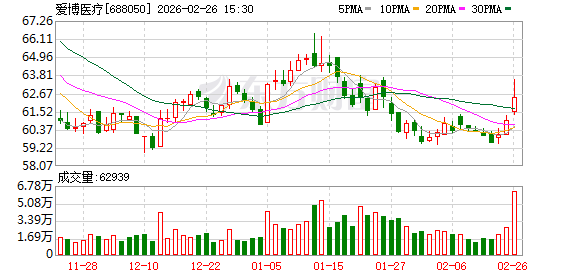
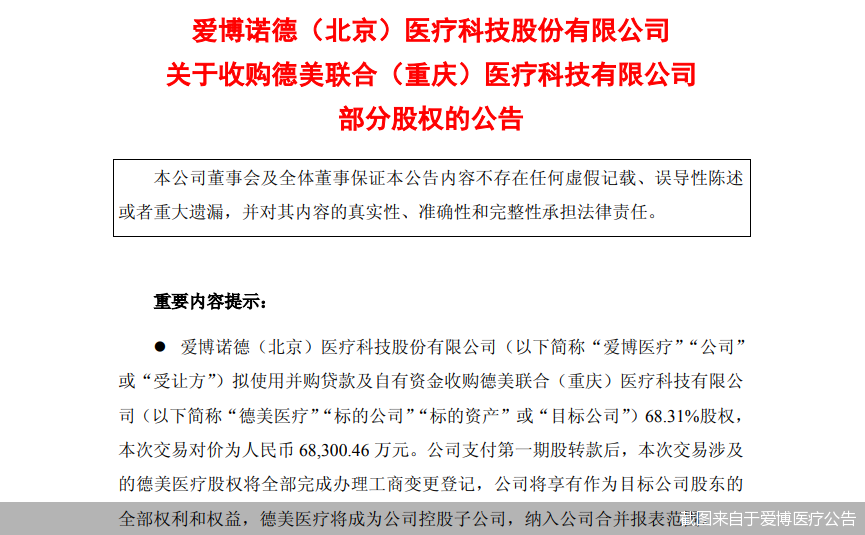
Core Viewpoint - Aibo Medical (688050), a leading ophthalmic device company, plans to enter the sports medicine sector through the acquisition of 68.31% of Demai Medical (Chongqing) Technology Co., Ltd. for 683 million yuan, which is approximately three times the net asset book value, expected to generate around 500 million yuan in goodwill [2][8]. Group 1: Acquisition Details - The acquisition price of 683 million yuan will be funded approximately 70% to 80% through bank loans, with the remaining from the company's own funds [5][6]. - After the first payment, Aibo Medical will complete the registration changes for Demai Medical, making it a wholly-owned subsidiary included in the consolidated financial statements [5]. - Demai Medical is a leading player in the domestic sports medicine field, with its core products accounting for about 80% of its revenue [5][6]. Group 2: Financial Implications - The acquisition is expected to increase Aibo Medical's goodwill by approximately 500 million yuan, raising the total goodwill to 1.91 billion yuan [8]. - As of the end of Q3 2025, Aibo Medical had a cash balance of 680 million yuan and a debt-to-asset ratio of 22.93% [7]. - The company anticipates that the acquisition will enhance revenue and gross margins, optimizing its strategic layout and consolidating its industry position [10]. Group 3: Performance Expectations - Demai Medical is projected to achieve significant revenue growth, with expected revenues of 236 million yuan and 286 million yuan for 2024 and 2025, respectively, and adjusted net profits of approximately 9.29 million yuan and 23.60 million yuan [10]. - Aibo Medical aims to leverage this acquisition to cultivate new profit growth points, especially as its current growth has slowed [10][12]. - The founders of Demai Medical have committed to achieving specific performance targets for 2026-2028, ensuring a minimum annual net profit of 45 million yuan, 55 million yuan, and 65 million yuan, or a cumulative net profit of at least 165 million yuan [10]. Group 4: Market Context - The sports medicine sector is experiencing rapid growth, driven by trends such as increased public fitness awareness and aging populations, presenting significant opportunities for domestic companies [11][12]. - In contrast, the ophthalmic sector is facing slower growth and intensified competition, making the acquisition a strategic move for Aibo Medical to diversify and enhance its market presence [12].

溢价超三倍、新增5亿元商誉,爱博医疗押宝德美医疗
Bei Jing Shang Bao· 2026-02-26 08:12
Core Viewpoint - Aibo Medical (688050), a leading ophthalmic device company, plans to enter the sports medicine sector through the acquisition of 68.31% of Demai Medical for 683 million yuan, with a significant premium over net asset value, expected to create approximately 500 million yuan in goodwill [1][7]. Group 1: Acquisition Details - The acquisition price of 683 million yuan represents about three times the net asset value of Demai Medical, with the transaction expected to generate around 500 million yuan in goodwill [1][7]. - Funding for the acquisition will primarily come from bank loans, estimated to cover 70% to 80% of the transaction value [4][5]. - Following the acquisition, Demai Medical will become a wholly-owned subsidiary of Aibo Medical, fully integrated into its consolidated financial statements [4]. Group 2: Financial Performance and Projections - Demai Medical, a leading player in the sports medicine field, is projected to achieve rapid revenue and net profit growth, with expected revenues of 236 million yuan and 286 million yuan for 2024 and 2025, respectively [9]. - Aibo Medical's revenue for the first three quarters of 2025 was 1.144 billion yuan, a year-on-year increase of 6.43%, while net profit decreased by 8.64% due to declining sales in artificial lenses and contact lenses [9]. - The acquisition is anticipated to enhance Aibo Medical's revenue and gross margin, optimizing its strategic positioning in the market [9]. Group 3: Market Context and Strategic Rationale - The sports medicine sector is experiencing rapid growth, driven by increasing demand from the aging population and supportive government policies, presenting a significant opportunity for Aibo Medical [10]. - Aibo Medical aims to leverage synergies in R&D, manufacturing, and sales channels through this acquisition, which is expected to provide new growth momentum amid slowing performance in its core ophthalmic business [1][10]. - The acquisition aligns with Aibo Medical's strategy to diversify its portfolio and tap into high-growth markets, contrasting with the more competitive and slower-growing ophthalmic sector [10].
高瓴“守”不住了?格力电器马年遇“七年之痒”
Xin Lang Cai Jing· 2026-02-26 01:24
Core Viewpoint - Gree Electric announced that its largest shareholder, Zhuhai Mingjun (an entity under Hillhouse Capital), plans to reduce its stake by up to 112 million shares, accounting for 2% of the total share capital, within three months, raising approximately 4.3 billion yuan for debt repayment [1][10]. Group 1: Financial Context - Hillhouse Capital acquired a 15% stake in Gree in 2019 at 46.17 yuan per share, totaling 41.662 billion yuan, with around 20 billion yuan financed through bank loans [2][11]. - By the end of 2026, Hillhouse faces a repayment pressure of over 25 billion yuan, including principal and interest, due to the seven-year loan cycle [3][12]. - Despite receiving over 13 billion yuan in dividends over six years, this amount is insufficient to cover the principal of over 20 billion yuan, necessitating the stock reduction to bridge the financial gap [3][12]. Group 2: Investment Performance - Hillhouse's nominal holding cost is approximately 46.17 yuan per share, but after accounting for about 12 yuan per share in dividends, the effective cost drops to around 34 yuan per share, resulting in a paper gain of about 13% at the current price of 38.49 yuan [4][13]. - Including annual loan interest of about 1 billion yuan (totaling around 6 billion yuan over six years), the comprehensive cost per share could rise to 53 yuan, indicating a potential loss on the investment [4][13]. Group 3: Company Performance and Governance - Gree Electric's revenue for the first three quarters of 2025 was 137.654 billion yuan, a year-on-year decline of 6.62%, with net profit down 2.27% to 21.461 billion yuan, indicating operational pressure [4][14]. - Despite declining performance, Gree continues to offer substantial dividends, which support Hillhouse's cash flow for debt repayment and provide a cushion for the current stock price [5][14]. - Hillhouse, while being the largest shareholder, does not control the board, as it can only nominate one non-independent director, requiring approval from Gree's CEO, Dong Mingzhu, who holds significant board influence [6][14]. Group 4: Market Reaction and Future Outlook - Following the reduction, Zhuhai Mingjun's shareholding will decrease from 16.11% to approximately 14.11%, maintaining its status as the largest shareholder without altering control [7][14]. - The market reaction has been mixed, with some investors expressing concerns about hidden issues behind the sell-off, reflecting a broader sentiment of uncertainty [8][14]. - As the annual report period approaches, the reduction is viewed as a normal exit strategy for a specialized fund entering a liquidation phase, although it may impact investor confidence and expectations [15].

13 亿美元加码东南亚教育,KKR 敲定 XCL 教育多数股权收购,深化区域投资布局
3 6 Ke· 2026-02-25 00:19
Core Viewpoint - KKR has agreed to acquire a majority stake in XCL Education Holdings, a Southeast Asian K-12 education operator, with the deal valuing the company at approximately $1.3 billion [1][3]. Group 1: KKR Overview - KKR, founded in 1976 and headquartered in New York, is a leading private equity firm known for pioneering the leveraged buyout (LBO) model, alongside Blackstone, Carlyle, and TPG [3]. - As of September 2024, KKR manages assets totaling $624.4 billion across various sectors, including private equity, credit, infrastructure, and real estate, with a current market capitalization of approximately $82.174 billion [3]. Group 2: XCL Education Holdings - XCL Education, established on July 16, 2019, and based in Singapore, focuses on K-12 education services in Southeast Asia and is backed by Temasek Holdings, a significant sovereign investment entity [4]. - The company operates several international school campuses in Southeast Asia, including XCL World Academy in Singapore, Bangkok American School, and Australian International School in Vietnam, catering to a diverse student body from over 40 countries [4]. Group 3: KKR's Investment Strategy - KKR has a broad investment strategy in the education sector, with a focus on Asia, including investments in Lighthouse Learning in India, Taylor's Education Group in Southeast Asia, and EQuest Education Group in Vietnam [5]. - The firm has invested approximately $15 billion in the Southeast Asian market, with notable transactions including a $6.6 billion acquisition of STT GDC and a $750 million financing to Chandra Asri Group for acquiring ExxonMobil's Esso retail business in Singapore [5]. Group 4: Southeast Asia M&A Market - The Southeast Asian M&A market has shown significant improvement in 2026, with total transaction value nearing $12 billion, more than tripling compared to the same period last year [6]. - Other notable transactions include Sunway Bhd's proposed acquisition of IJM Corp Bhd for approximately 11 billion Malaysian Ringgit (around $3.2 billion Singapore dollars), highlighting the region's growing appeal to international capital [6].

奥联电子控股股东变更,业绩持续承压引关注
Jing Ji Guan Cha Wang· 2026-02-11 10:00
Group 1: Core Insights - The core event is the change of controlling shareholder of Aolian Electronics, with Tianjin Chaocheng Innovation Technology Co., Ltd. acquiring 19.09% of shares for 6.3 billion yuan at a price of 19.29 yuan per share, leading to a shift in actual control to Zhang Yan [1] - The acquisition raises concerns about the stability of the funding chain, as the acquiring company was established recently in October 2024 and relies on leverage for funding [1] Group 2: Stock Performance - Aolian Electronics' stock price experienced significant volatility, with a 4.72% increase on February 9, 2026, following the announcement, but subsequently fell by 1.87% and 1.40% on the following days, closing at 17.60 yuan [2] - The stock's trading range reached 8.42%, with a turnover rate of 4.72% on February 9, indicating active trading [2] - The current stock price is below the acquisition price of 19.29 yuan per share, reflecting market concerns regarding the leveraged acquisition and the company's fundamentals [2] Group 3: Financial Performance - Aolian Electronics expects a net loss of 60 million to 68 million yuan for the year 2025, primarily due to provisions for investor lawsuits affecting non-recurring gains and losses [3] - Despite a slight revenue increase of 1.08% in the first three quarters of 2025, the company's main business profitability has not improved significantly, relying on non-recurring gains for support [3] - The company has faced continuous pressure on its performance, with a reported loss of 8.506 million yuan in 2024 and a decline in net profit for three consecutive years [3] Group 4: Analyst Opinions - Analysts note that the automotive industry is highly competitive, with Aolian Electronics' revenue growth of only 1.08% in the first three quarters of 2025 falling short of the industry growth rate, where new energy vehicle production and sales increased by over 40% in the first half of 2025 [4] - The company's R&D expenses decreased by 15% year-on-year, indicating pressure from technological iterations amid the electrification transition [4] - The new controlling shareholder's focus on semiconductors may suggest potential asset injection or business transformation, but the lack of clarity regarding the actual controller's background adds uncertainty [4]
财说丨连续三年净利下滑,奥联电子股权腾挪暗藏多重悬念
Xin Lang Cai Jing· 2026-02-09 23:07
Core Viewpoint - The announcement from Aolian Electronics reveals a significant change in control, with the new major shareholder, Chaocheng Innovation, acquiring 19.09% of the company through a leveraged buyout, raising concerns about the company's financial stability and future direction amid ongoing operational challenges [1][2]. Group 1: Shareholder Changes - The controlling shareholder, Guangxi Ruiying Asset Management Co., reduced its stake from 30.34% to 11.25%, while Chaocheng Innovation became the new controlling shareholder with a 19.09% stake [2][3]. - The acquisition price was set at 19.29 yuan per share, totaling 630 million yuan for 32.67 million shares [1]. Group 2: Financial Implications - Chaocheng Innovation plans to finance the acquisition through a combination of its own funds and loans, with at least 50% of the funds coming from its own resources [3]. - The leveraged buyout raises concerns about the future financial management of Aolian Electronics, especially given its ongoing performance issues [3]. Group 3: Company Performance - Aolian Electronics has faced declining profits, with a reported revenue of 440 million yuan in 2024, down 9.85% year-on-year, and a net loss of 8.51 million yuan, a significant drop of 263% [8]. - The company has experienced three consecutive years of declining net profits, with a concerning trend of losses in its core operations [8][11]. Group 4: Industry Context - The automotive industry is undergoing significant changes, with intense competition and a shift towards electric and smart vehicles, which poses additional challenges for Aolian Electronics [12]. - Despite a slight revenue increase of 1.08% in the first three quarters of 2025, the company's performance remains weak compared to industry growth rates [12]. Group 5: Regulatory and Legal Issues - Aolian Electronics has faced administrative penalties from the regulatory authorities, leading to ongoing litigation risks from investors seeking compensation for losses [14][16]. - The company's financial statements reveal significant risks, with goodwill and receivables making up over 28% of its net assets, indicating potential asset quality issues [17].

摩根大通开始发售200亿美元EA收购案的部分债务
Jin Rong Jie· 2026-01-30 16:29
Group 1 - Major banks, including JPMorgan Chase, have begun issuing $20 billion in debt financing to support the acquisition of Electronic Arts (EA), marking the largest leveraged buyout in history [1] - Small banks from the Middle East, Asia, and Europe are actively purchasing approximately $3 billion in Class A term loans for the video game manufacturer [1] - The issuance process will continue until the end of February, with underwriters having the flexibility to adjust the size of the Class A term loans based on market conditions [1]

5万亿国际巨头,加注一家白蘑菇公司
Zhong Guo Ji Jin Bao· 2026-01-21 14:52
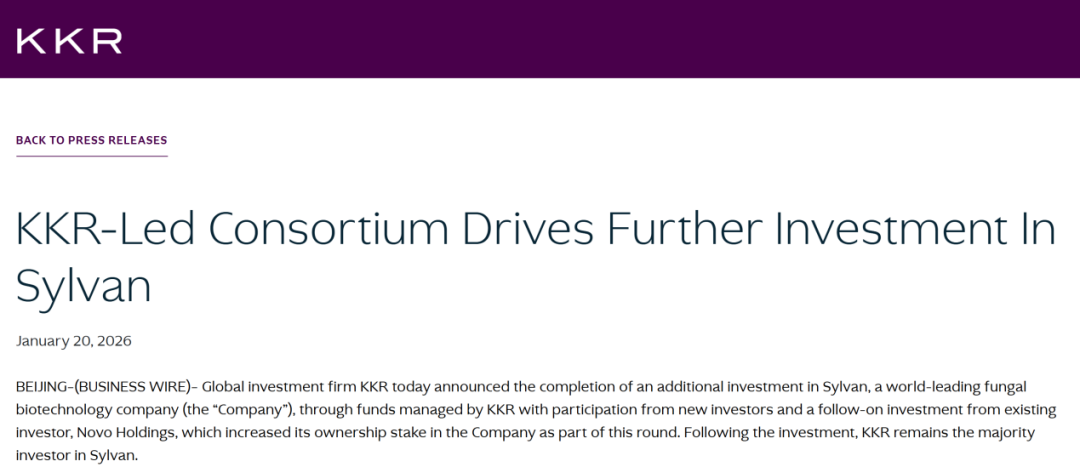
Core Viewpoint - KKR has announced a new round of investment in Sylvan, a leading global mushroom cultivation and fungal biotechnology company, through its managed dollar and RMB funds, including its first RMB fund [1] Group 1: Company Overview - Sylvan is backed by Jiangsu Yuguan Modern Agricultural Technology Co., Ltd., founded by Huang Jianguang, known as the "Mushroom King" in China [2] - Huang Jianguang started his mushroom business in the 1980s, leading to significant market share in canned mushrooms, with his company producing 68% of the canned mushrooms exported from China to the U.S. [4] - Jiangsu Yuguan was established in 2010 to cultivate high-quality fresh white mushrooms, which account for 40% of the edible mushroom market globally [4] Group 2: Investment Details - KKR's initial investment in Jiangsu Yuguan was approximately 2 billion RMB, which helped the company become the largest single production unit for white mushrooms globally [4] - KKR facilitated the full acquisition of Sylvan and its research laboratories by Jiangsu Yuguan, expanding its global operational footprint [5] - The latest investment aims to support Sylvan's expansion plans, including capacity enhancement, R&D strengthening, and product line diversification in the rapidly industrializing Asian mushroom and bioproducts market [5] Group 3: KKR's Investment Strategy - KKR's assets under management (AUM) reached $723 billion (approximately 5 trillion RMB) as of September 30, 2025, with a diverse portfolio across private equity, private credit, and real estate [7] - KKR has been actively increasing its investments in Chinese assets, including the establishment of its first onshore RMB fund in Shanghai [6][7] - The firm recently completed a $2.5 billion (approximately 17 billion RMB) fundraising for an Asian private credit fund, focusing on high-quality credit assets in the Asia-Pacific region [7][8]
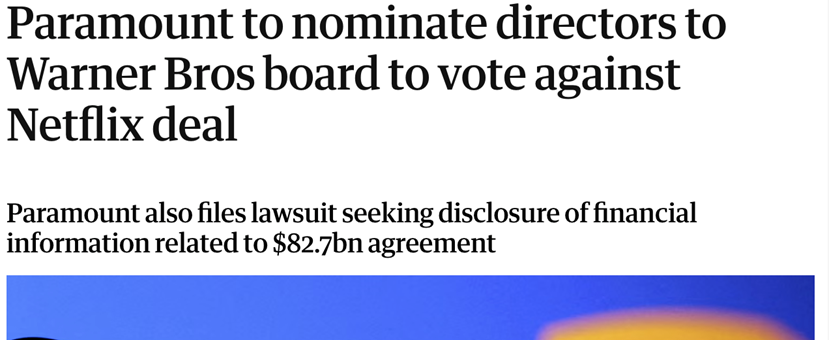
外媒:派拉蒙将提名人选加入华纳董事会,投票反对Netflix收购案
Huan Qiu Wang· 2026-01-13 03:00
Group 1 - Paramount's Skydance plans to nominate directors to the Warner Bros. Discovery (WBD) board to oppose WBD's $82.7 billion acquisition deal with Netflix and promote its own acquisition proposal [1][3] - Paramount has filed a lawsuit demanding WBD disclose financial information related to the deal, including evaluations of WBD's global television network business [1][3] - Paramount's CEO David Ellison stated that the outcome may depend on shareholder votes at the annual meeting unless WBD decides to negotiate under the Netflix merger agreement [3][4] Group 2 - Paramount proposed an acquisition offer of $108.4 billion for WBD, while Netflix's offer includes a personal guarantee of $40 billion from Oracle co-founder Larry Ellison [3][4] - The Netflix deal offers $23.25 per share in cash, stock, and equity in the split-off Paramount global television network, while Paramount's offer is $30 per share in cash [4] - WBD's board previously rejected Paramount's offer, labeling it as the "largest leveraged buyout in history," and indicated that accepting Paramount's bid would incur $4.7 billion in costs [4]