广告模式

Search documents
Stratechery创始人深度访谈:预警2029年“芯片荒”,SaaS模式将终结,广告才是AI终极商业闭环
Hua Er Jie Jian Wen· 2026-02-15 10:02
Group 1 - The core concern raised by Ben Thompson is the conservative capacity expansion of TSMC, which he believes is a limiting factor for global AI expansion [2][3] - Thompson predicts a significant chip shortage around 2029 due to insufficient capital expenditure growth to meet the exponential demand for computing power driven by AI [2][3] - He emphasizes that TSMC's cautious approach to capacity expansion is rational, as they prefer to avoid the risks associated with overcapacity and its impact on profit margins [2][3] Group 2 - Thompson advocates for tech giants to support companies like Intel or Samsung through prepayments or other means to mitigate future capacity bottlenecks [3] - He argues that the advertising model is the most effective monetization strategy for AI applications, countering the prevalent skepticism in Silicon Valley regarding advertising [4][5] - Thompson cites Facebook's advertising system as a successful automated agent, highlighting its effectiveness in delivering results for businesses [4][5] Group 3 - Thompson provides insights on the performance of major tech companies, labeling Meta as the strongest in execution despite concerns over its capital expenditures [5] - He describes Google as chaotic yet resilient, comparing it to a slime mold that adapts effectively despite its apparent disorder [5] - Concerns are raised about Amazon's chip strategy in the AI era, suggesting that its low-cost approach may not be sustainable in a rapidly evolving market [5] Group 4 - Thompson discusses the potential end of the SaaS business model if AI leads to a reduction in workforce, indicating a growth ceiling for per-seat pricing [6] - He posits that in a world of infinite content, live experiences will gain value, as they cannot be personalized by AI [7] - The future of AI-generated content will redefine value based on scarcity, emphasizing the importance of shared experiences [7]
ChatGPT植入广告、疯狂挖角Meta员工,OpenAI越来越像Facebook了?
Hua Er Jie Jian Wen· 2026-01-20 07:10
Core Insights - OpenAI is shifting towards commercialization by introducing an advertising model and hiring former Meta employees, indicating a move towards a business-driven approach despite its non-profit origins [1][2][4]. Financial Performance - OpenAI's annualized revenue for 2025 has surpassed $20 billion, a significant increase from $6 billion in 2024, but the company has consumed approximately $8 billion in cash in 2025 [1][3]. - The introduction of advertising in ChatGPT aims to address the financial pressure and fill the funding gap created by high operational costs [1][4]. Strategic Shift - The decision to enter the online advertising space is seen as a rational choice to alleviate financial stress, with ads being displayed in both free and certain paid tiers of ChatGPT [4]. - OpenAI's recruitment strategy, particularly the hiring of around 630 former Meta employees, suggests a potential shift towards optimizing user engagement and maximizing commercial value [5]. User Engagement and Privacy Concerns - Analysts warn that the introduction of an advertising model may reshape the incentive mechanisms of the AI platform, raising concerns about user privacy and the potential manipulation of user habits for ad revenue [2][6]. - OpenAI has publicly committed not to optimize user engagement time on ChatGPT, but this promise may be difficult to enforce in an ad-driven model [6][7]. Market Dynamics - ChatGPT currently has a substantial user base, with approximately 900 million interactions weekly and average session lengths of 15 to 20 minutes, making it attractive to advertisers [8]. - The financial pressures faced by OpenAI may lead to a transformation of ChatGPT from a simple tool to a product designed to cultivate user habits, similar to social media platforms like Facebook [8].
当AI时代软件成本趋于零时,商业模式会有哪些变化?
Hu Xiu· 2025-09-04 00:26
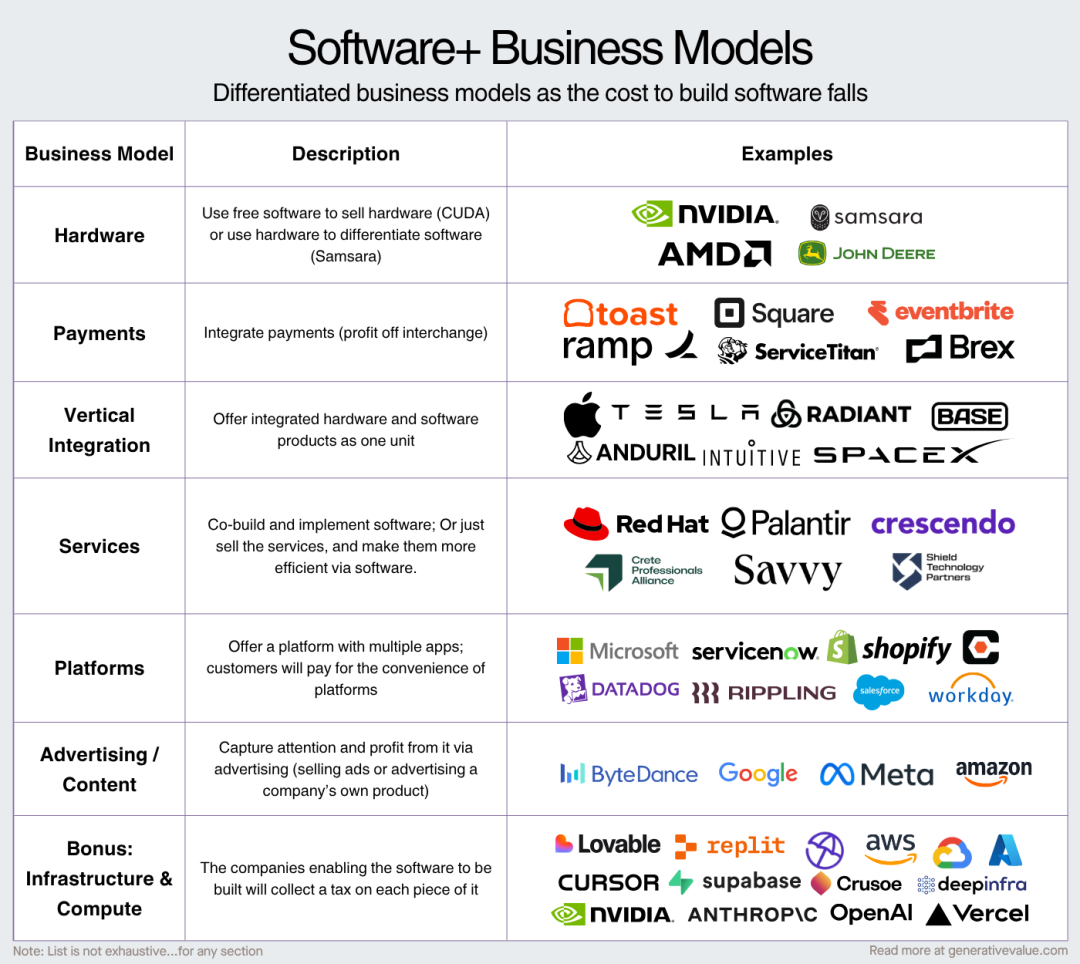
Group 1 - The software business model is undergoing a significant transformation, with AI tools drastically reducing software development costs, leading to a fundamental restructuring of the software industry's commercial logic [1][3][36] - As software creation costs approach zero, traditional software sales models become unsustainable, necessitating differentiation in other areas [1][3][36] - Historical parallels are drawn, indicating that the current shift resembles the free software movement of the 1990s, which began with companies like Red Hat [5][48] Group 2 - The decline in software development costs will impact the distribution of value within the industry, making it harder to create and maintain technological differentiation [3][41] - Companies are likely to adopt various business models, including hardware differentiation, vertical integration, and service-oriented approaches, to adapt to the changing landscape [2][10][12] Group 3 - Hardware is becoming a core differentiator in the new software landscape, with companies like Nvidia successfully using free software to enhance their hardware offerings [7][9] - The trend of vertical integration is expected to rise, allowing companies to control user experiences more effectively and innovate within their sectors [10][12] Group 4 - Service models are evolving, with companies needing to ensure software adoption and optimal usage through human labor integration [13][16] - The payment model is highlighted as a way to integrate software into existing financial infrastructures, allowing companies to profit without charging directly for software [19][20] Group 5 - Platform strategies are gaining importance, as companies seek to provide integrated solutions that simplify user experiences and reduce the management burden of multiple software tools [23][28] - Advertising models are also emerging, where companies leverage software to capture attention and monetize it, similar to Google and Facebook [29][30] Group 6 - The infrastructure model is becoming crucial, as companies providing the foundational services for software development will capture significant value in the AI era [32][34] - The shift towards free software may lead to a dual-track market, where low-risk applications dominate with free models, while high-risk, complex applications retain traditional pricing structures [45][46] Group 7 - The implications of these changes extend to talent needs and organizational structures, requiring companies to build multidisciplinary teams and adapt to new roles [51][53] - Investors and entrepreneurs must rethink traditional metrics for evaluating software companies, as new business models may not align with conventional SaaS indicators [55][59] Group 8 - The future of the software industry will depend on understanding user needs and building sustainable business models, rather than merely focusing on coding skills [60][61] - The barriers to software development are diminishing, allowing more individuals to create software and businesses, which will intensify competition in the market [61][62]