聚合理论

Search documents
Stratechery创始人深度访谈:预警2029年“芯片荒”,SaaS模式将终结,广告才是AI终极商业闭环
Hua Er Jie Jian Wen· 2026-02-15 10:02
Group 1 - The core concern raised by Ben Thompson is the conservative capacity expansion of TSMC, which he believes is a limiting factor for global AI expansion [2][3] - Thompson predicts a significant chip shortage around 2029 due to insufficient capital expenditure growth to meet the exponential demand for computing power driven by AI [2][3] - He emphasizes that TSMC's cautious approach to capacity expansion is rational, as they prefer to avoid the risks associated with overcapacity and its impact on profit margins [2][3] Group 2 - Thompson advocates for tech giants to support companies like Intel or Samsung through prepayments or other means to mitigate future capacity bottlenecks [3] - He argues that the advertising model is the most effective monetization strategy for AI applications, countering the prevalent skepticism in Silicon Valley regarding advertising [4][5] - Thompson cites Facebook's advertising system as a successful automated agent, highlighting its effectiveness in delivering results for businesses [4][5] Group 3 - Thompson provides insights on the performance of major tech companies, labeling Meta as the strongest in execution despite concerns over its capital expenditures [5] - He describes Google as chaotic yet resilient, comparing it to a slime mold that adapts effectively despite its apparent disorder [5] - Concerns are raised about Amazon's chip strategy in the AI era, suggesting that its low-cost approach may not be sustainable in a rapidly evolving market [5] Group 4 - Thompson discusses the potential end of the SaaS business model if AI leads to a reduction in workforce, indicating a growth ceiling for per-seat pricing [6] - He posits that in a world of infinite content, live experiences will gain value, as they cannot be personalized by AI [7] - The future of AI-generated content will redefine value based on scarcity, emphasizing the importance of shared experiences [7]
面对谷歌的挑战,英伟达和OpenAI谁更脆弱
美股IPO· 2025-12-02 05:02
Core Insights - The article discusses the competitive landscape in the AI industry, focusing on the contrasting challenges faced by Nvidia and OpenAI due to Google's resurgence with its Gemini model and TPU chips [1][4][5]. Group 1: Nvidia's Challenges - Nvidia's business model is vulnerable as its profits heavily rely on a few large cloud customers capable of "breaking down the CUDA ecosystem wall" [1][5]. - The emergence of Google's TPU as a market competitor threatens Nvidia's previously secure position, raising questions about the sustainability of its high profit margins [8][9]. - Nvidia's advantages, including superior performance and a strong developer ecosystem built around CUDA, are being challenged as Google’s TPU technology catches up [10]. Group 2: OpenAI's Position - OpenAI possesses a significant advantage with over 800 million active users, creating a strong network effect that is difficult to disrupt [11][13]. - The stability of OpenAI's moat is directly proportional to the number of independent users, making it harder for competitors to change user habits compared to influencing a few large corporate clients [13]. - Despite its user base, OpenAI is criticized for not adopting an advertising model, which could enhance monetization and improve its product through user feedback [15][16]. Group 3: Google's Counterattack - Google has launched its Gemini 3 model, which outperforms OpenAI's models in several benchmarks, undermining OpenAI's position as the leading model provider [7]. - Google is now marketing its TPU chips as alternatives to Nvidia's GPUs, establishing itself as a formidable competitor in Nvidia's lucrative market [8]. Group 4: The Future of Competition - The competition between these tech giants raises questions about whether vast resources or the ability to control user demand will prevail in defining the future of technology platforms [17].



面对谷歌的挑战,英伟达和OpenAI谁更脆弱
华尔街见闻· 2025-12-02 04:21
Core Insights - The article discusses the competitive landscape in the AI industry, likening its development to a classic "hero's journey" narrative, with OpenAI and NVIDIA as the main protagonists facing a strong counterattack from Google [1][2]. Group 1: OpenAI and NVIDIA's Position - OpenAI and NVIDIA are identified as the two main players in the AI field, with OpenAI transitioning from a startup to a consumer tech phenomenon, while NVIDIA has evolved from a gaming chip manufacturer to a cornerstone of the AI revolution [2]. - Both companies are facing challenges, with OpenAI burning cash and NVIDIA printing money, but OpenAI's competitive advantage may be more robust due to its user base [3][10]. - OpenAI has over 800 million weekly active users, which provides a significant network effect that is difficult for competitors to disrupt [10][12]. Group 2: Google's Counterattack - Google has launched its Gemini 3 model, which surpasses OpenAI's advanced models in several benchmark tests, undermining OpenAI's position as the top model provider [5]. - Google is also selling its TPU chips as alternatives to NVIDIA's GPUs, forming partnerships with major companies like Anthropic and Meta, thus entering NVIDIA's profitable market [6]. Group 3: NVIDIA's Vulnerabilities - NVIDIA's competitive advantages include superior performance, greater versatility, and a strong developer ecosystem built around its CUDA platform. However, the performance of Google's TPU is catching up, weakening NVIDIA's first advantage [7]. - The concentration of NVIDIA's customer base among a few large companies poses a risk, as these companies have the motivation and resources to move away from CUDA, similar to how AMD challenged Intel in the data center market [8]. Group 4: OpenAI's Strategic Misstep - Despite its large user base, OpenAI is criticized for not implementing an advertising model, which is seen as a significant business error. This model could enhance user engagement and provide valuable data for improving its offerings [14][16]. - The lack of an advertising strategy is viewed as a failure to capitalize on its aggregator platform potential, allowing competitors like Google to capture the free user market [16]. Group 5: The Future of Competition - The competition between Google and OpenAI raises questions about whether resource dominance or user demand control is more critical in the tech industry. This ongoing battle will likely redefine the fundamental rules of competition in the technology sector [18].

语境聚合才是人工智能真正的战场
3 6 Ke· 2025-11-10 02:44
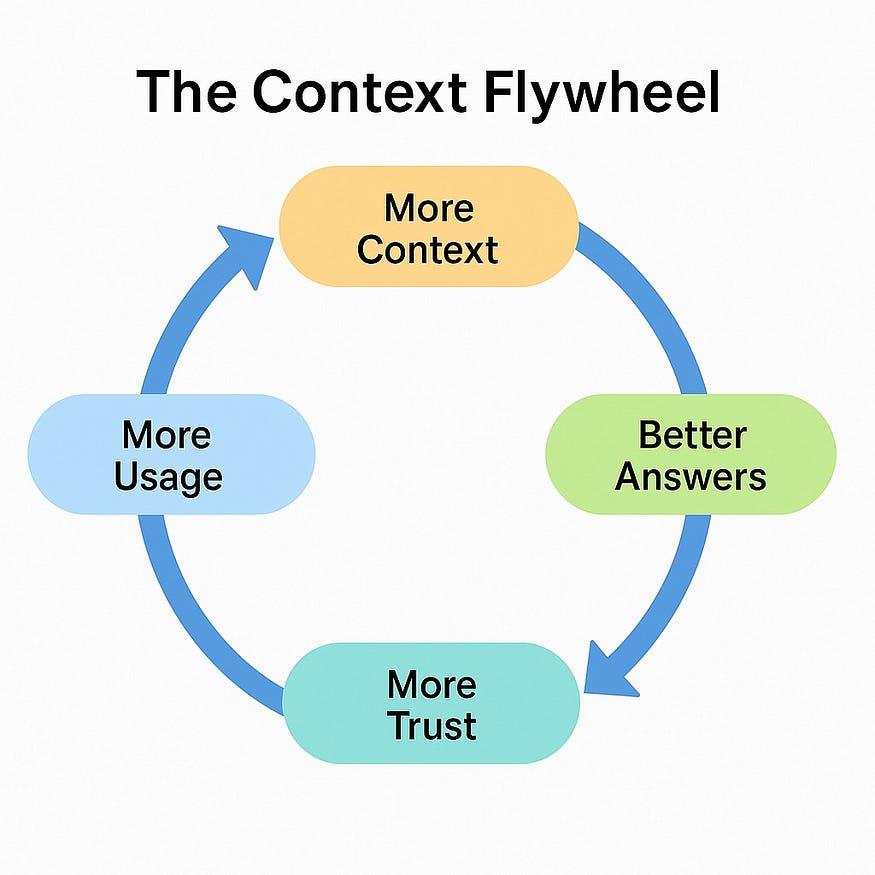
Core Insights - The competition in artificial intelligence (AI) is increasingly centered around the accumulation of contextual information, which significantly enhances user experience and provides a competitive edge [1][15]. Group 1: Understanding Context - Context is defined as the accumulated knowledge and experiences over time, similar to how a spouse understands a partner's life better than a search engine [2][3]. - AI models require relevant background information to generate accurate and useful responses, which includes chat history and world knowledge [4]. Group 2: User Adoption Challenges - Not all individuals are currently using AI, and the challenge lies in converting skeptical users who make up a significant portion of the market [5]. - Skeptical users will only adopt AI when it feels personalized, useful, and frictionless, which necessitates a rich contextual understanding [5]. Group 3: Context Aggregation - Context aggregation involves continuously collecting and connecting various aspects of a user's life to create a unified understanding, leading to highly personalized experiences [6][8]. - The integration of user context can create a competitive moat that surpasses existing consumer platforms [8]. Group 4: Multi-Modal AI Importance - Multi-modal inputs (voice, photos, sensors) are crucial for reducing the friction in providing contextual information, which can accelerate AI development [9][10]. - Lowering friction not only helps in building context faster but also enhances network effects, as new users contribute more meaningful context [11]. Group 5: Competitive Dynamics - Companies like Google, Netflix, and Amazon serve broad markets, but trust and privacy will significantly influence user willingness to share contextual information [12][14]. - The potential for AI companies to aggregate sufficient contextual information could allow them to provide unique user experiences without requiring extensive input from new users [14]. Group 6: Future Considerations - The ultimate winner in the context aggregation battle will be the entity that possesses the most reliable and rich contextual information, translating it into unparalleled user experiences [15][16]. - Trust in AI systems will be built through delivering exceptional results, which in turn encourages users to share more information, creating a positive feedback loop [16].