廉洁从业管理

Search documents
2025年公募基金销售业务监管处罚分析
Xin Lang Cai Jing· 2026-01-23 02:17
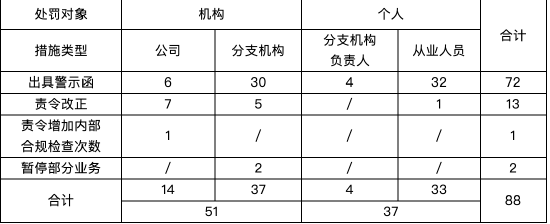
Summary of Regulatory Penalties in Public Fund Sales in 2025 Overview of Penalties - In 2025, public fund sales institutions and personnel received a total of 88 penalties from the China Securities Regulatory Commission (CSRC) and its local agencies [2][25]. - The penalties included 51 against institutions and 37 against individuals, with 14 institutions facing dual penalties involving 18 individuals [3][25]. - The majority of penalties were warnings (72), followed by orders for correction (13), and suspensions of certain business activities (2) [3][25]. Types of Penalties - The penalties were categorized into various types, with institutions receiving 51 penalties and individuals 37 penalties [3][25]. - The breakdown of penalties by institution type showed that securities firms received 70 penalties, banks 17, and independent fund sales institutions 1 [4][25]. Reasons for Penalties - The main reasons for penalties included issues related to personnel qualifications, prohibited sales behaviors, suitability management, incentive assessments, promotional materials, and integrity in operations [5][27]. - Specific violations in suitability management were noted 30 times, including failures in understanding client financial situations and improper sales recommendations [8][30]. Characteristics of Penalties - The regulatory penalties in 2025 exhibited three main characteristics: 1. Violations were dispersed across various issues, but specific behaviors were concentrated [43]. 2. Securities firms were the most affected, accounting for nearly 80% of penalties [43]. 3. There was a trend towards dual penalties for both institutions and individuals, with over 25% of institutions receiving dual penalties [43]. Recommendations for Improvement - Institutions are advised to enhance compliance controls regarding suitability management and ensure that sales personnel possess the necessary qualifications [21][44]. - Regular checks on sales personnel behavior and adherence to promotional material regulations are recommended to prevent prohibited sales practices [21][44]. - Fund managers should conduct thorough due diligence when selecting sales institutions and continuously assess their compliance with regulatory standards [21][44].

国泰海通证券以全链条廉洁从业管理体系护航高质量发展
Zhong Guo Jing Ji Wang· 2025-12-04 03:12
Core Viewpoint - The company is committed to enhancing its integrity culture and management system, which is essential for its high-quality development and integration since its merger and restructuring [1]. Group 1: Strengthening Party Leadership and Integrity Culture - The company’s party committee plays a crucial role in guiding and implementing strict party governance, focusing on integrating party work with integrity practices [2]. - Special actions have been initiated to address issues such as violations of central regulations, reinforcing a strong message of accountability [2]. - Educational programs have been established to promote integrity culture among all employees, including the revision of compliance manuals and annual signing of integrity commitments [2]. Group 2: Improving Internal Control Management - The company has developed a comprehensive integrity management system, incorporating integrity goals into its corporate governance framework [3]. - A leadership group for integrity management has been established, ensuring oversight across all levels of the organization [3]. - Regular self-assessments and risk evaluations are conducted to identify and mitigate integrity risks within various departments [3]. Group 3: Focusing on Key Areas for Enhanced Integrity Control - The company is implementing targeted measures to address integrity risks in investment banking, including stricter due diligence processes and project evaluations [4]. - A management system for employee investment behavior has been established, ensuring compliance through pre-approval and post-check mechanisms [4]. - Financial discipline is being enforced to control risks associated with expense reimbursements and procurement processes [4]. Group 4: Cultivating a Positive Integrity Culture - The company integrates the "Five Musts and Five Must Nots" of Chinese financial culture into its new cultural framework, embedding integrity as a core value [5]. - Continuous educational initiatives are being conducted to raise awareness and promote integrity among employees through various platforms [5]. - A youth-led integrity culture promotion team has been formed to enhance grassroots engagement and education on integrity practices [5].

13家券商领罚!两大业务是重灾区
券商中国· 2025-11-17 07:43
Core Viewpoint - The article highlights the increasing regulatory scrutiny faced by brokerage firms in China, particularly in the areas of brokerage and investment banking, with multiple firms receiving penalties for various compliance failures [1][5]. Summary by Sections Penalties Overview - Since the beginning of the fourth quarter, 13 brokerage firms have received penalties from exchanges and local securities regulatory authorities, with violations primarily in brokerage and investment banking services [1][2]. Specific Penalty Cases - Notable penalties include Shanghai Securities and its branch receiving warnings for violations of integrity and compliance management, reflecting systemic issues within the firm [3][4]. - Other firms like Huafu Securities and Minsheng Securities also faced warnings for their investment banking practices, indicating a trend of increased regulatory action in this sector [5][6]. Focus on Integrity Management - The regulatory focus on integrity management has intensified, with new guidelines emphasizing the importance of compliance in personnel evaluations and promotions [4]. - Several brokerage firms have been penalized for failing to adhere to integrity standards, such as improper commission practices and unauthorized use of client accounts [4][8]. Investment Banking Regulations - The investment banking sector has seen strict regulatory measures, with six firms penalized for various compliance failures, including inadequate diligence in bond issuance processes [5][6]. - Specific cases include First Entrepreneurship Securities being investigated for failing to fulfill its supervisory responsibilities in a bond project [5]. Issues in Derivative and Internal Management - Apart from brokerage and investment banking, some firms have been penalized for issues related to over-the-counter derivatives and internal management failures [8][9]. - For instance, Caitong Securities was ordered to rectify its derivative business practices due to inadequate management mechanisms and compliance controls [8]. Regulatory Environment - The regulatory environment is becoming increasingly stringent, with the China Securities Regulatory Commission emphasizing the need for robust compliance and internal controls to prevent misconduct [9].





近两个月13家券商收罚单 投行、经纪业务是重灾区
Zheng Quan Shi Bao· 2025-11-16 18:01
Core Viewpoint - The regulatory environment for securities firms has intensified, with multiple firms facing penalties for violations related to compliance, internal controls, and business practices, particularly in brokerage and investment banking sectors [1][2][4]. Group 1: Brokerage Business Violations - Thirteen securities firms have received penalties from exchanges and local regulatory bodies since the fourth quarter, with a significant focus on brokerage and investment banking violations [1]. - Shanghai Securities and its subsidiary faced multiple penalties for internal control failures and violations of integrity in business practices, highlighting the need for improved compliance management [2]. - Other firms, such as Jin Yuan Securities and Bank of China Securities, were penalized for improper client account management and violations of integrity regulations [3]. Group 2: Investment Banking Violations - Six securities firms have been penalized for violations in investment banking, with specific cases including First Capital Securities being investigated for lack of diligence in a bond project [4]. - Five Mining Securities faced criticism for mismanagement during a bond issuance process, leading to incorrect announcements regarding issuance results [4][5]. - Both Huafu Securities and Minsheng Securities were penalized for failing to adequately supervise and verify the accuracy of information in their advisory roles [5]. Group 3: Derivative and Internal Control Issues - Financial derivatives and internal management issues have also led to penalties, with firms like Caixin Securities facing corrective measures for inadequate management of derivative products [6]. - Huayin Securities was penalized for compliance failures related to employee management and internal control systems [6]. - Regulatory bodies are emphasizing the importance of robust internal controls and compliance to prevent failures in the securities industry [6].
佛山一国资控股金融机构营业部被指涉廉洁管理缺失,最新情况
Nan Fang Du Shi Bao· 2025-10-28 11:40
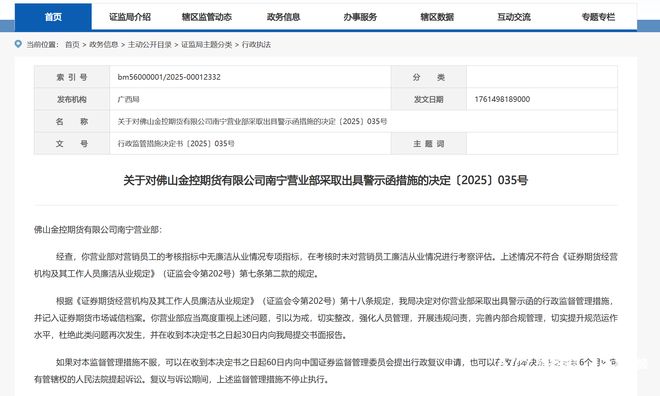
Group 1 - The Guangxi Securities Regulatory Bureau issued a warning letter to Foshan Jinkong Futures Co., Ltd. Nanning Branch for failing to include integrity assessment in the performance evaluation of marketing staff, violating regulations [1] - The warning letter is part of administrative supervision measures, and the branch is required to improve internal compliance management and submit a written report within 30 days [1] - The company has the option to appeal the decision within 60 days or file a lawsuit within six months [1] Group 2 - Foshan Jinkong Futures Co., Ltd. was established in January 1996 with a registered capital of 316 million RMB, and it is the only state-owned futures company platform in Foshan [2] - The company is headquartered in Guangdong Financial High-tech Zone and has established 10 branches in various provinces including Guangdong, Guangxi, Shandong, Jiangxi, Henan, and Shanxi [2] - The shareholders consist of a state-owned enterprise, Foshan Financial Investment Holding Co., Ltd. (51% ownership), and a private enterprise, Foshan Ximingzhu Enterprise Group Co., Ltd. (49% ownership) [2]
防范利用内幕信息获利!中基协出手,来看四大要点
券商中国· 2025-04-12 23:19
Core Viewpoint - The article discusses the revised "Implementation Rules for the Integrity of Fund Management Institutions and Their Staff," aimed at fostering a healthy development of the fund industry and protecting investors' rights through enhanced self-discipline and management [1][2]. Group 1: Background of the Revision - The rapid development of the fund industry has led to a demand for a strong industry culture, prompting the need for a politically aware and ethically sound financial workforce [4]. - The original rules were established in March 2020 to guide fund management institutions in implementing integrity management, but shortcomings were identified, necessitating updates to address new risks and issues [4]. Group 2: Key Points of the Revision - The revised rules focus on four main areas: enhancing the role of party building, improving integrity supervision mechanisms, strengthening internal control management, and reinforcing self-discipline [5][2]. Group 3: Specific Provisions - **Enhancing Party Building and Supervision**: The rules emphasize the importance of party work in integrity management, establishing a dual interaction mechanism between internal supervision and integrity management [7]. - **Strengthening Internal Control Management**: Responsibilities for integrity management are clarified, including strict measures against bribery and non-compliant financial behaviors, and the need for timely adjustments to marketing standards [10][11]. - **Detailing Integrity Requirements in Key Business Areas**: The rules now include comprehensive integrity management for fund advisory services, investment research, fund liquidation, and performance assessment [14][16][17]. - **Reinforcing Self-Discipline**: There is a strong emphasis on punishing bribery and updating self-discipline measures in accordance with existing regulations [19][20].