
场外衍生品业务

Search documents
期货公司加速向多元业务协同转型
Qi Huo Ri Bao Wang· 2026-01-29 03:10
Core Insights - The futures industry in China has shown robust growth in 2025, with total net profit reaching 11 billion yuan, significantly higher than the previous year's 9.47 billion yuan, indicating a positive trend in operational efficiency [1][2] - The increase in net profit outpaced revenue growth, reflecting improved operational effectiveness within the industry [2] - The market environment has shifted, leading to increased demand for risk management from real economy enterprises, which has positively impacted the futures market [2][3] Group 1: Financial Performance - In December 2025, the total revenue of 150 futures companies reached 4.918 billion yuan, with a net profit of 684 million yuan, both showing month-on-month growth [1] - For the entire year of 2025, the cumulative revenue was 42.015 billion yuan, surpassing 41.293 billion yuan in 2024, while cumulative net profit was 11 billion yuan, up from 9.471 billion yuan in 2024 [1] - The cumulative trading volume and trading value in the futures market increased by 17.4% and 23.74% year-on-year, respectively, providing a solid foundation for business development [2] Group 2: Business Structure and Strategy - The futures industry is transitioning from a reliance on traditional brokerage services to a model that emphasizes diversified business collaboration and comprehensive service empowerment [1][2] - Internal business structure optimization has become a key driver for net profit growth, with risk management, asset management, proprietary investment, and international business emerging as new profit sources [2][3] - The growth of over-the-counter derivatives and the increase in asset management scale and actively managed products indicate strong development potential within the industry [3] Group 3: Future Outlook - The year 2026 is expected to provide broader development opportunities for the futures industry, particularly in supporting national strategies and enhancing market functions [3] - Continuous product launches and deepening international openness are anticipated to expand market depth and increase international influence, potentially attracting new capital [3] - Companies are advised to focus on cost control and operational efficiency while investing in financial technology and risk management to prepare for the industry's transformation during the 14th Five-Year Plan [4]
港股异动丨南华期货股份创上市新高,已被纳入港股通
Ge Long Hui· 2026-01-27 06:29
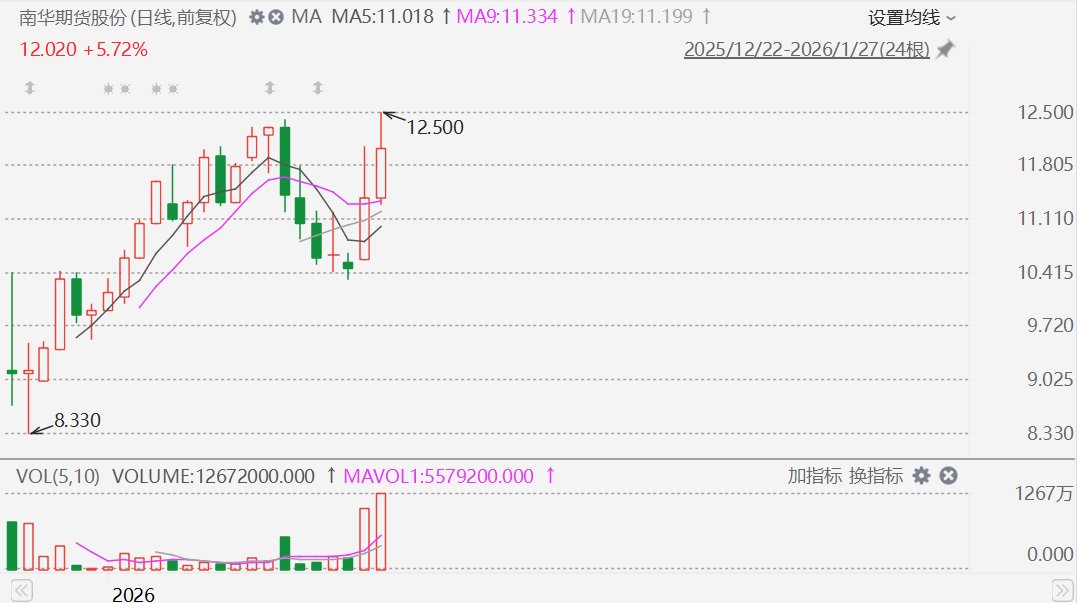
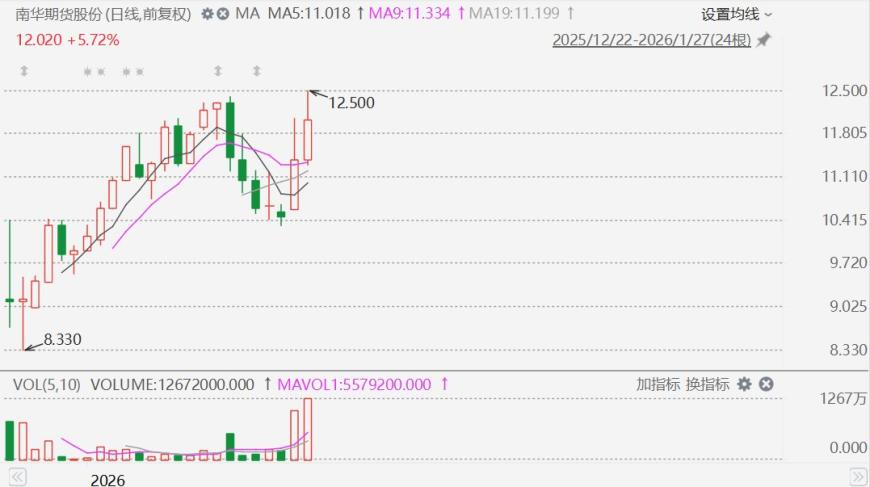
Group 1 - Nanhua Futures Co., Ltd. (2691.HK) experienced a nearly 10% increase in stock price, reaching a new high of 12.5 HKD, following a positive market trend [1] - On January 19, Nanhua Futures was included in the Hong Kong Stock Connect, which is expected to enhance its market visibility and investor interest [1] - The company has confirmed through an interactive platform that its domestic and international brokerage businesses, as well as over-the-counter derivatives, involve futures products such as gold and silver [1] Group 2 - Huaxi Securities noted that Nanhua Futures possesses a complete set of futures business licenses and has achieved significant results in its global layout, indicating a strong competitive advantage in overseas operations [1] - The company aims to leverage its strengths in international business as a key driver for rapid development [1]


南华期货股份创上市新高,已被纳入港股通
Ge Long Hui· 2026-01-27 06:28
Group 1 - The core viewpoint of the article highlights the significant rise in the stock price of Nanhua Futures Co., which increased nearly 10% to HKD 12.5, reaching a new high since its listing [1] - On January 19, Nanhua Futures was included in the Hong Kong Stock Connect, which is expected to enhance its market visibility and investor interest [1] - The company has a comprehensive range of futures business licenses and has achieved notable success in its global expansion, particularly in its overseas brokerage and OTC derivatives businesses involving commodities like gold and silver [1] Group 2 - Huaxi Securities previously indicated that Nanhua Futures' overseas business advantages will continue to be a key driver for the company's rapid growth [1]
南华期货股份盘中涨超9% 公司期货业务牌照齐全 近日进入港股通名单
Zhi Tong Cai Jing· 2026-01-27 06:11
Core Viewpoint - Nanhua Futures (603093) shares have surged over 9% during trading, reaching a new high of 12.5 HKD, with a current price of 12.3 HKD and a trading volume of 144 million HKD [1] Group 1: Company Performance - Nanhua Futures has seen significant growth in its stock price, with an increase of 8.18% at the time of reporting [1] - The company has a complete set of futures business licenses and has achieved notable results in its global layout, particularly in its overseas operations [1] Group 2: Business Operations - The company has indicated that its domestic and international brokerage businesses, as well as its over-the-counter derivatives business, involve futures products such as gold and silver [1] - Analysts believe that the inclusion of Nanhua Futures in the Hong Kong Stock Connect is expected to significantly enhance its trading liquidity [1]
上海徽丰公司以自我革命精神深化党建业务融合推动高质量发展迈新步
Xin Lang Cai Jing· 2025-12-07 04:10
Core Viewpoint - Shanghai Huifeng Company is leveraging its "Golden Key" party-building brand to create the "Golden Shield" brand, focusing on risk management and integrating party-building with business operations to enhance compliance and support high-quality development in the economy [1][9]. Group 1: Party Building and Business Integration - The party branch of Shanghai Huifeng Company emphasizes its political responsibility in state-owned enterprises, using standardized construction as a foundation for party-building [3][11]. - The company has launched the "Golden Shield Red Classroom" to focus on risk prevention and compliance, conducting four specialized party classes [3][11]. - As of the end of October, the nominal principal of the off-market derivatives business reached 5.93 billion, with 93 new industrial clients added, significantly improving core business efficiency [3][11]. Group 2: Institutional Innovation and Compliance Control - Shanghai Huifeng Company prioritizes institutional development, revising key regulations to establish compliance boundaries for business operations [5][13]. - The company has conducted compliance self-inspections and established a quarterly compliance check mechanism since 2025, along with five compliance training sessions throughout the year [5][13]. - The "Golden Shield Contribution" initiative encourages employee participation in corporate governance and party-building efforts [5][13]. Group 3: Integrity Education and Cultural Development - The company focuses on building a culture of integrity through the "Golden Shield Integrity Education" series, reinforcing the importance of compliance among employees [7][15]. - Regular integrity education talks and initiatives are conducted to maintain a strong focus on ethical practices within the organization [7][15]. Group 4: Practical Achievements and Future Directions - Shanghai Huifeng Company has achieved notable success in various business areas, including being recognized as an "Outstanding Trader" for four consecutive years in the basis trading sector [9][17]. - The copper business, a core segment, has established a stable supply network with major industry players, ensuring a monthly long-term supply of no less than 2,800 tons in 2025 [9][17]. - The company aims to continue integrating party-building with business operations to drive high-quality development and achieve further innovative breakthroughs [9][17].

券商频频“输血”海外子公司,释放什么信号?
证券时报· 2025-11-28 09:31
Core Viewpoint - Chinese securities firms are significantly increasing capital support for their overseas subsidiaries, driven by the demand for cross-border investment banking and wealth management expansion, particularly in high-margin OTC derivatives business [1][5][7]. Group 1: Capital Support Mechanisms - Huatai Securities announced the issuance of four medium-term notes totaling $230 million, backed by its wholly-owned subsidiary [1]. - Common methods for capital supplementation by Chinese securities firms include direct shareholder capital increases, issuance of perpetual bonds/subordinated debt, and capital loans with shareholder support [3][5]. - Notable firms such as Dongxing Securities, Shanxi Securities, and Bank of China Securities have announced capital increases for their Hong Kong subsidiaries, with amounts reaching up to 2.137 billion HKD [4]. Group 2: Business Expansion Drivers - The demand for capital supplementation is primarily driven by the expansion of cross-border business and the growth of high capital-consuming operations, particularly in OTC derivatives [7][8]. - The surge in cross-border client demand and the need for risk management and asset allocation services are pushing Chinese securities firms to enhance their capital base [7][8]. - The Hong Kong market is becoming a hub for cross-border wealth management, benefiting Chinese securities firms due to their inherent advantages [8]. Group 3: Challenges in Capital Supplementation - Despite the push for capital increases, challenges remain, including restrictions on cross-border capital injection, difficulties in overseas financing, and liquidity risks [11][12]. - Current foreign exchange management policies limit the ability of Chinese securities firms to conduct cross-border transactions effectively, creating obstacles in capital flow and business development [11][12]. - The need for regulatory policy optimization, group-level coordination, and transformation of subsidiaries into lighter capital businesses is emphasized to overcome these challenges [12].

广发证券(000776) - 2025年11月20日投资者关系活动记录表
2025-11-20 11:40
Group 1: Wealth Management Business - The company focuses on high-quality development and digital transformation in wealth management, emphasizing high-quality client groups and efficient online operations [2] - It aims to enhance its asset allocation capabilities and improve the comprehensive service system for institutional clients [2] - The company is committed to compliance and risk management, ensuring that operations are conducted within regulatory boundaries [2] Group 2: Investment Management Business - The investment management segment includes asset management, public fund management, and private fund management, with a focus on building a diverse product supply system [3] - As of September 2025, the public fund management scale of Guangfa Fund and E Fund ranks third and first in the industry, respectively, excluding money market funds [3] - The company is enhancing its research and management capabilities to optimize its business structure [3] Group 3: Derivatives and Investment Banking - The company is a primary dealer in the OTC derivatives market, focusing on pricing, trading, and client service capabilities [3] - It aims to support the real economy and enhance direct financing services while strengthening its position in key markets like the Greater Bay Area and Yangtze River Delta [3] - The company is advancing its digital transformation and risk management strategies to ensure stable development [4]

13家券商领罚!两大业务是重灾区
证券时报· 2025-11-17 09:18
Core Viewpoint - The article highlights the increasing regulatory scrutiny faced by securities firms in China, particularly in the areas of brokerage and investment banking, with multiple firms receiving penalties for various compliance failures [1][3][8]. Summary by Sections Penalty Overview - Since the beginning of the fourth quarter, 13 securities firms have received penalties from exchanges and local securities regulatory authorities, including Shanghai Securities, Huafu Securities, and Minsheng Securities [1][2]. Types of Violations - The majority of penalties are related to brokerage and investment banking activities, with some firms penalized for issues related to over-the-counter derivatives and internal management deficiencies [3][14]. Specific Cases of Penalties - On November 14, the Zhejiang Securities Regulatory Bureau issued six penalties to Shanghai Securities and its employees for violations of integrity and compliance management from 2017 to 2021 [5][6]. - Financial penalties were also imposed on firms like First Capital Securities for failing to perform due diligence in a convertible bond project, and on Huafu Securities and Minsheng Securities for inadequate oversight in their investment banking activities [10][11]. Focus on Integrity Management - There is a growing emphasis on integrity management within the industry, as evidenced by recent regulatory updates that make integrity a key component of employee evaluations and promotions [7][9]. - Several firms, including Jinyuan Securities and Zhongyin International Securities, faced penalties for failing to adhere to integrity standards, such as improper commission returns and unauthorized use of client accounts [7][12]. Regulatory Environment - The regulatory environment has become increasingly stringent, with the China Securities Regulatory Commission emphasizing the need for improved compliance and internal controls among securities firms [15]. - The article notes that the regulatory authorities are actively working to prevent lapses in oversight, reinforcing the role of securities firms as gatekeepers in the capital markets [15].




13家券商领罚!两大业务是重灾区
券商中国· 2025-11-17 07:43
Core Viewpoint - The article highlights the increasing regulatory scrutiny faced by brokerage firms in China, particularly in the areas of brokerage and investment banking, with multiple firms receiving penalties for various compliance failures [1][5]. Summary by Sections Penalties Overview - Since the beginning of the fourth quarter, 13 brokerage firms have received penalties from exchanges and local securities regulatory authorities, with violations primarily in brokerage and investment banking services [1][2]. Specific Penalty Cases - Notable penalties include Shanghai Securities and its branch receiving warnings for violations of integrity and compliance management, reflecting systemic issues within the firm [3][4]. - Other firms like Huafu Securities and Minsheng Securities also faced warnings for their investment banking practices, indicating a trend of increased regulatory action in this sector [5][6]. Focus on Integrity Management - The regulatory focus on integrity management has intensified, with new guidelines emphasizing the importance of compliance in personnel evaluations and promotions [4]. - Several brokerage firms have been penalized for failing to adhere to integrity standards, such as improper commission practices and unauthorized use of client accounts [4][8]. Investment Banking Regulations - The investment banking sector has seen strict regulatory measures, with six firms penalized for various compliance failures, including inadequate diligence in bond issuance processes [5][6]. - Specific cases include First Entrepreneurship Securities being investigated for failing to fulfill its supervisory responsibilities in a bond project [5]. Issues in Derivative and Internal Management - Apart from brokerage and investment banking, some firms have been penalized for issues related to over-the-counter derivatives and internal management failures [8][9]. - For instance, Caitong Securities was ordered to rectify its derivative business practices due to inadequate management mechanisms and compliance controls [8]. Regulatory Environment - The regulatory environment is becoming increasingly stringent, with the China Securities Regulatory Commission emphasizing the need for robust compliance and internal controls to prevent misconduct [9].

近两个月13家券商收罚单 投行、经纪业务是重灾区
Zheng Quan Shi Bao· 2025-11-16 18:01
Core Viewpoint - The regulatory environment for securities firms has intensified, with multiple firms facing penalties for violations related to compliance, internal controls, and business practices, particularly in brokerage and investment banking sectors [1][2][4]. Group 1: Brokerage Business Violations - Thirteen securities firms have received penalties from exchanges and local regulatory bodies since the fourth quarter, with a significant focus on brokerage and investment banking violations [1]. - Shanghai Securities and its subsidiary faced multiple penalties for internal control failures and violations of integrity in business practices, highlighting the need for improved compliance management [2]. - Other firms, such as Jin Yuan Securities and Bank of China Securities, were penalized for improper client account management and violations of integrity regulations [3]. Group 2: Investment Banking Violations - Six securities firms have been penalized for violations in investment banking, with specific cases including First Capital Securities being investigated for lack of diligence in a bond project [4]. - Five Mining Securities faced criticism for mismanagement during a bond issuance process, leading to incorrect announcements regarding issuance results [4][5]. - Both Huafu Securities and Minsheng Securities were penalized for failing to adequately supervise and verify the accuracy of information in their advisory roles [5]. Group 3: Derivative and Internal Control Issues - Financial derivatives and internal management issues have also led to penalties, with firms like Caixin Securities facing corrective measures for inadequate management of derivative products [6]. - Huayin Securities was penalized for compliance failures related to employee management and internal control systems [6]. - Regulatory bodies are emphasizing the importance of robust internal controls and compliance to prevent failures in the securities industry [6].