
开发式帮扶

Search documents
长久守牢不发生规模性返贫致贫的底线(权威访谈)
Ren Min Ri Bao· 2026-02-28 00:55
Core Viewpoint - The article discusses the successful completion of the five-year transition period for consolidating and expanding poverty alleviation achievements in China, emphasizing the importance of effective policies and strategies in preventing large-scale poverty recurrence and promoting rural revitalization [1][2]. Group 1: Achievements in Poverty Alleviation - The transition period has successfully maintained a bottom line of no large-scale return to poverty, with 98.99 million rural poor lifted out of poverty, 832 impoverished counties removed from the poverty list, and 128,000 impoverished villages eliminated [2][3]. - The average disposable income of rural residents in poverty-stricken counties is expected to grow faster than the national average for five consecutive years from 2021 to 2025, indicating a more stable and sustainable foundation for poverty alleviation [2][3]. Group 2: Key Measures Implemented - A comprehensive monitoring and assistance mechanism has been established to prevent poverty recurrence, with over 7 million monitored individuals receiving targeted support [3]. - Employment and industry support have been prioritized, with over 30 million individuals from impoverished populations maintaining stable employment for five consecutive years [3]. - A collaborative effort involving various societal forces has been mobilized, including partnerships between eastern and western provinces, central government support, and private sector involvement [3]. Group 3: Global Contribution and Experience Sharing - China's poverty alleviation experience offers valuable insights for other developing countries, demonstrating that poverty can be effectively addressed and prevented from recurring [4][5]. - The four key principles of China's poverty alleviation strategy include: 1. Upholding the leadership of the Communist Party [4] 2. Adopting a people-centered development approach [5] 3. Implementing precise strategies tailored to specific needs [5] 4. Emphasizing development-oriented assistance to empower individuals [6]. Group 4: Future Strategies for Sustained Support - A permanent mechanism for preventing poverty recurrence will be established, integrating assistance into the rural revitalization strategy [7]. - Continuous monitoring and targeted support will be implemented to identify and assist at-risk populations effectively [7][8]. - Development of local industries and employment opportunities will remain a core strategy for sustaining poverty alleviation efforts [8][9]. - The existing assistance policies will be maintained with minor adjustments to enhance effectiveness, focusing on industry support, employment, and development in underdeveloped areas [9].
为全球减贫事业贡献中国方案、中国智慧——访农业农村部党组书记、部长韩俊
Xin Hua She· 2026-02-25 15:11
Core Viewpoint - China has successfully completed its poverty alleviation campaign and is now focusing on consolidating and expanding the achievements made during this period, with a strong emphasis on preventing the risk of returning to poverty and promoting comprehensive rural revitalization [1] Group 1: Achievements and Measures - The transition period has seen the completion of all objectives, maintaining a baseline to prevent large-scale poverty return, with improvements in education, healthcare, housing, and drinking water safety for the impoverished population [2] - From 2021 to 2025, the disposable income growth rate of rural residents in poverty-stricken counties is expected to exceed the national average for five consecutive years, indicating a more solid and sustainable foundation for poverty alleviation [2] - Key measures taken during the transition period include: 1. Establishing a monitoring and assistance mechanism to identify and address risks of returning to poverty [2] 2. Fostering dominant industries in 832 poverty-stricken counties and providing employment services, maintaining a stable workforce of over 30 million for five years [2][3] 3. Enhancing social collaboration through partnerships between eastern and western regions, with over 310 central units providing targeted assistance [3] Group 2: Sharing Experiences with Other Developing Countries - China's poverty alleviation experience offers valuable lessons for other developing nations, emphasizing four key principles: 1. Upholding the leadership of the Communist Party in poverty alleviation efforts [4] 2. Adopting a people-centered development approach to address basic needs of impoverished populations [4] 3. Implementing precise strategies tailored to the specific characteristics and causes of poverty [5] 4. Emphasizing development-oriented assistance to empower individuals and communities [5] Group 3: Future Strategies for Rural Revitalization - Post-transition, a mechanism for preventing poverty will be integrated into the rural revitalization strategy, focusing on sustainable development and social security [6] - Continuous monitoring and assistance will be implemented to ensure early identification and intervention for those at risk of returning to poverty [7] - Development of local industries and employment opportunities will be prioritized to ensure stable income for the impoverished population [7] - A stable and improved policy framework for ongoing assistance will be maintained, with a focus on effective resource allocation and collaboration [8]
韩俊:为全球减贫事业贡献中国方案、中国智慧
Xin Lang Cai Jing· 2026-02-25 14:53
Core Viewpoint - China has successfully completed its poverty alleviation campaign over the past five years, establishing a solid foundation for sustainable development and sharing valuable experiences with other developing countries [1][4]. Group 1: Achievements and Measures - The transition period has seen the completion of all objectives, maintaining a baseline to prevent large-scale poverty return, with improvements in education, healthcare, housing, and drinking water safety for the impoverished population [2]. - From 2021 to 2025, the disposable income growth rate of rural residents in poverty-stricken counties has consistently exceeded the national average for rural residents [2]. - Key measures during the transition period include: 1. Establishing a monitoring and assistance mechanism to prevent poverty return, with over 7 million monitored individuals receiving targeted support [2]. 2. Fostering dominant industries in 832 poverty-stricken counties, with over 30 million impoverished individuals engaged in stable employment for five consecutive years [3]. Group 2: Collaborative Efforts - Strengthening cooperation between eastern and western regions, with 8 eastern provinces assisting 10 western provinces, and 310 central units providing targeted support to poverty-stricken counties [3]. - The establishment of a comprehensive social assistance system involving various societal forces, including private enterprises and social organizations, to ensure that impoverished areas do not lag behind in development [3]. Group 3: Lessons for Other Developing Countries - China's poverty alleviation experience offers four key principles for other developing nations: 1. Upholding the leadership of the Communist Party in poverty alleviation efforts [4]. 2. Adopting a people-centered development approach to address basic needs of impoverished populations [4]. 3. Implementing precise strategies tailored to the specific characteristics and causes of poverty [5]. 4. Emphasizing development-oriented assistance to empower impoverished individuals and communities [5]. Group 4: Future Strategies - Post-transition, a mechanism for regular monitoring and assistance will be established to prevent poverty return, integrated into the rural revitalization strategy [6]. - Continuous focus on developing industries and promoting employment for impoverished populations as a fundamental strategy for sustaining poverty alleviation achievements [7]. - Targeted support for underdeveloped areas through financial, land, and talent resources, enhancing economic vitality and development potential [7]. - Maintaining a stable policy framework for assistance, optimizing implementation methods to improve effectiveness [8].
央媒看贵州丨人民日报:侗寨织密兜底网
Xin Lang Cai Jing· 2026-02-15 04:14
Group 1 - The article highlights the transformation of rural life in Guizhou's Zhaoxing Dong Village, showcasing the impact of targeted poverty alleviation efforts led by local officials like Xu Xinji [2][3] - Xu Xinji's approach emphasizes "precision" in assistance, tailoring support to individual needs, as seen in the case of Lu Xinlu, who faced financial difficulties due to medical expenses [2] - The success story of Lu Kunsong, who transitioned from a poverty-stricken household to a business owner of a guesthouse, illustrates the positive outcomes of government support and local entrepreneurship [3] Group 2 - The village's collective income is projected to exceed 3 million yuan by 2025, driven by increased tourism and local business initiatives [3] - The article reflects a broader narrative of hope and improvement in rural areas, contrasting past poverty with current prosperity, as expressed by Xu Xinji [3] - The community's engagement in cultural activities, such as singing and dancing, signifies a revitalization of social life and community spirit in the village [3]

侗寨织密兜底网(新春走基层)
Ren Min Ri Bao· 2026-02-14 23:37
Core Insights - The article highlights the transformation of rural life in Guizhou's Zhaoxing Dong Village, showcasing the impact of targeted poverty alleviation efforts and community support [1][2]. Group 1: Poverty Alleviation Efforts - The village's first secretary, Xu Xinj, plays a crucial role in assisting low-income families, exemplified by his support for Lu Xinlu, who faced financial difficulties due to his wife's medical expenses [1]. - Xu emphasizes the importance of "precision" in ongoing support efforts, ensuring that aid is tailored to the specific needs of families [1]. Group 2: Economic Development - Lu Kun Song, a former poverty-stricken household member, has successfully transitioned to entrepreneurship by opening a guesthouse, benefiting from local tourism and support from community initiatives [2]. - The village anticipates a collective income exceeding 3 million yuan by 2025, driven by the growth of tourism and local businesses [2].
一号文件里的“三农”路线图
Xin Lang Cai Jing· 2026-02-06 08:35
Group 1 - The core document titled "Opinions on Anchoring Agricultural and Rural Modernization and Promoting Comprehensive Rural Revitalization" outlines a clear roadmap for rural revitalization during the 15th Five-Year Plan period, building on the achievements of the 14th Five-Year Plan [2] - The document prioritizes enhancing agricultural production capacity and quality, with a target of stabilizing grain output at around 1.4 trillion jin, indicating a shift in food security focus from merely maintaining production to improving capacity and efficiency [2] - The emphasis on integrating "good land, good seeds, good opportunities, and good methods" aims to leverage technology for increased yield and efficiency while maintaining stable sowing areas [2] Group 2 - A significant policy innovation in this year's document is the introduction of "regularized precise assistance," marking the end of a five-year transitional period and entering a new phase of poverty alleviation efforts [3] - The strategy focuses on embedding regularized assistance within the framework of rural industry, talent, culture, ecology, and organization, shifting the focus towards development-driven assistance that stimulates internal motivation and prevents large-scale poverty [3] - The document highlights the importance of increasing farmers' income, addressing the critical issue of "who grows grain, who benefits," and emphasizes protecting and incentivizing farmers through coordinated policies on pricing, subsidies, and insurance [3] Group 3 - The document sets higher requirements for rural construction, transitioning from merely ensuring availability to pursuing quality in living conditions, with a focus on enhancing convenience, comfort, and satisfaction [4] - It introduces a "regionalization" approach to encourage neighboring villages to plan and develop collaboratively, promoting efficient resource integration and complementary functions [4] - The central theme of the document is to anchor agricultural and rural modernization, ensuring food security and poverty prevention while upgrading development issues related to industrial efficiency, farmer income, and rural construction [4]

锚定农业农村现代化 一批务实管用的政策举措将陆续实施
Shang Hai Zheng Quan Bao· 2026-02-04 18:12
Group 1 - The 2026 Central No. 1 Document emphasizes a combination of goal-oriented and problem-oriented approaches to address urgent issues faced by farmers, introducing practical and valuable policy measures to improve livelihoods [1] - The document outlines a focus on precise and efficient assistance methods, enhancing internal motivation while preventing excessive reliance on aid and avoiding policy cliff effects [1] - Employment support will be strengthened through organized labor output and the utilization of employment channels such as rural public welfare positions [1] Group 2 - The document promotes the coordination of agricultural trade and production, aiming to utilize both domestic and international markets effectively, ensuring sustainable development of agricultural trade [2] - China plans to expand imports of domestically scarce agricultural products while maintaining a balance to ensure food security and the stable development of domestic industries [2] - Measures have been implemented to alleviate the impact on industries like beef, with positive results achieved through various support initiatives [2] Group 3 - The second round of land contract extension trials will be comprehensively launched in 29 provinces, with a principle of "great stability, small adjustments" to ensure the stability of existing land contracts for most farmers [3] - The document emphasizes the development of moderate-scale agricultural operations and the need for a regulated land transfer system that respects the rights of both parties involved [3] - There is a focus on enhancing agricultural social services to support small farmers and address key weaknesses in agricultural production [3] Group 4 - New agricultural operating entities are becoming the main force in agricultural development, with family farms encouraged to improve production capabilities and move towards efficient, green practices [4] - Farmers' cooperatives are urged to enhance development quality and eliminate "shell cooperatives," thereby strengthening their role as a bridge between small farmers and larger markets [4]
五年过渡期收官之际的回望与展望(乡村观察·过渡期这五年)
Ren Min Ri Bao· 2025-12-29 02:55
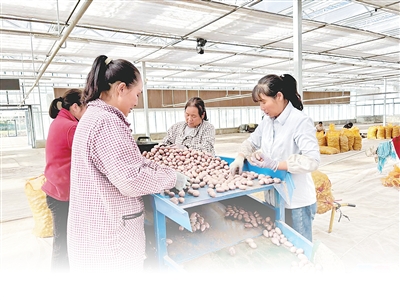
Group 1: Agricultural Development in Gansu - Gansu Province's Weiyuan County is focusing on potato seed breeding, enhancing the entire potato industry chain from seed to product [7][8] - The county has established a model involving "enterprise + cooperative + farmer + base," which has led to increased participation from farmers and improved efficiency in potato cultivation [7][8] - The potato industry in Weiyuan is expected to generate a total output value of 4.4 billion yuan this year, showcasing significant economic potential [8] Group 2: Poverty Alleviation and Support Systems in Jiangxi - Jiangxi Province has implemented a monitoring and support system to prevent poverty, which utilizes big data and cloud computing for timely intervention [5][6] - The system has successfully identified and assisted 613 households at risk of falling back into poverty, with various support measures including increased medical insurance coverage and educational subsidies [5][6] - The county's approach includes a focus on skill training and sustainable development to enhance the self-sufficiency of vulnerable households [6] Group 3: Employment and Skill Development Initiatives - The "Blue Eagle Project" in Zhejiang and Sichuan provinces aims to connect industry needs with local labor resources, providing vocational training and job placement for students [18][20] - The project has established partnerships between educational institutions and businesses, resulting in over 250,000 job opportunities for students in Sichuan [20] - The initiative emphasizes practical training and skill acquisition, enabling graduates to secure employment in high-demand sectors [19][20]
赵一德在商洛市调研检查巩固拓展脱贫攻坚成果同乡村振兴有效衔接工作时强调慎终如始抓好巩固衔接各项工作 坚决守牢不发生规模性返贫致贫底线
Shan Xi Ri Bao· 2025-12-25 00:36
Core Viewpoint - The emphasis is on the importance of consolidating and expanding the achievements of poverty alleviation while effectively connecting with rural revitalization efforts, ensuring no large-scale return to poverty occurs, and laying a solid foundation for comprehensive rural revitalization [1][2]. Group 1: Poverty Alleviation and Rural Revitalization - The need to implement a continuous monitoring system for populations at risk of returning to poverty, focusing on early detection, intervention, and assistance [2]. - The integration of resettlement sites with local urban development is crucial for enhancing living conditions, service levels, and community governance [1]. - The importance of developing local industries and providing employment support to ensure that relocated populations can stabilize and gradually achieve wealth [1][2]. Group 2: Policy Implementation and Community Engagement - The necessity for grassroots party organizations to consolidate resources and address conflicts at their source, while actively engaging in practical assistance for the community [2]. - The call for a coordinated approach to optimize monitoring and support mechanisms, aiming to improve basic guarantees and drinking water safety levels [2]. - The commitment to enhancing the quality and effectiveness of consolidation efforts through shared responsibilities among various levels of leadership [2].
金观平:以开发式帮扶增强内生动力
Jing Ji Ri Bao· 2025-12-22 02:42
Group 1 - The core viewpoint emphasizes China's remarkable achievement in poverty alleviation, having eradicated rural poverty ahead of the UN's 2030 Sustainable Development Goals, with an average of over 12 million people lifted out of poverty annually from 2012 to 2020, while GDP per capita grew at an average rate of 8.1% during the same period [1] - The transition period established by the central government post-poverty alleviation aims to optimize support policies while maintaining stability to prevent large-scale poverty recurrence [1] Group 2 - A key experience highlighted is the importance of development-oriented poverty alleviation, balancing both "intellectual support" and "motivational support" to enhance the internal driving force of the impoverished population [2] - The establishment of a regular mechanism to prevent the recurrence of poverty is crucial, integrating effective methods from the poverty alleviation phase into rural revitalization efforts [2] - Emphasis is placed on developing local advantages and fostering high-quality rural industries tailored to local conditions, avoiding uniform approaches that could lead to instability [3]