
弱美元叙事

Search documents
美元逆流的尾声:美伊冲突中的定价思考
SINOLINK SECURITIES· 2026-03-30 09:28
Group 1 - The core viewpoint of the report indicates that the recent strengthening of the US dollar is primarily due to the relatively lower impact of the Middle East conflict on the US economy, rather than changes in interest rate expectations [3][11][12] - The OECD's latest economic outlook predicts a downward revision of 0.2% for the Eurozone's economic growth in 2026, while the US growth forecast has been revised upward by 0.3% [3][12] - The report highlights that the US has a lower dependency on oil imports and a service-oriented economic structure, which contributes to its resilience compared to European countries that are more affected by rising oil prices [3][12] Group 2 - Following the Middle East conflict, there has been a notable return of funds to US dollar assets, with a decrease in the currency swap basis for major non-USD currencies [4][19] - Despite tightening global dollar liquidity, the report states that it has not reached a crisis level, as indicators of US market liquidity remain healthy [4][19][23] - The report notes that since March 23, the currency swap basis for major non-USD currencies has begun to normalize, suggesting that the most acute phase of dollar liquidity tightening may have passed [4][19] Group 3 - The narrative of a "weak dollar" has been challenged, as the market has seen a reversal in trends, with emerging markets underperforming compared to US stocks since the conflict began [4][29] - The report indicates that the performance of gold has been particularly weak during this liquidity tightening phase, contrasting with its historical resilience during previous crises [4][35][36] - The report suggests that the current environment may lead to a stabilization period for commodity pricing, as the monetary attributes of commodities are expected to fluctuate [5][48] Group 4 - The report emphasizes that the long-term pricing of gold is approaching levels seen before the collapse of the Bretton Woods system, with gold now comprising 25.2% of global official reserves [5][48][49] - It also highlights the potential for the US government to sell gold to finance deficits if fiscal pressures continue to mount, indicating a shift in the dynamics of commodity markets [5][48][50] - The report concludes that future supply and demand changes in industrial metals will become increasingly important to monitor [5]
中加基金权益周报|弱美元叙事受冲击,国际商品市场巨震影响A股
Xin Lang Cai Jing· 2026-02-03 07:41
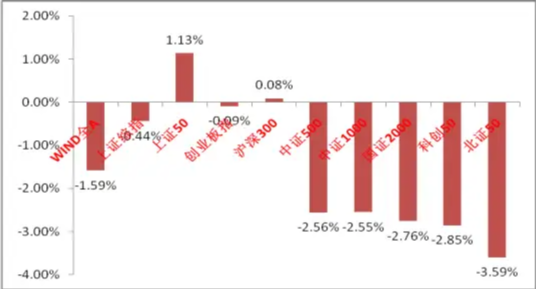
Market Overview - A-shares showed mixed performance last week with a marginal decline in trading volume [1][10] Macro Data Analysis - In December 2025, the profit growth rate of industrial enterprises turned positive, with an annual cumulative growth rate of 0.6%, breaking a three-year trend of negative growth [4][20] - The improvement in profits is attributed to supply-side management policies like "anti-involution" [4][20] - Foreign and state-owned enterprises performed better, with state-owned enterprises' profit decline narrowing by 0.7 percentage points compared to 2024 [4][20] - Private enterprises saw profit growth stagnate, contrasting with the previous year's positive growth, which negatively impacted overall industrial profit growth [4][20] - Manufacturing benefited from "anti-involution" and overseas expansion, with a growth rate of 5.0%, rebounding by 8.9 percentage points from 2024 [4][20] - The equipment manufacturing sector contributed 2.8 percentage points to the overall industrial profit growth, while upstream raw material manufacturing showed marginal recovery [4][20] Short-term Market Strategy - The market is experiencing a significant adjustment in weak dollar-related sectors due to liquidity issues in the commodity market [11][25] - The market's sensitivity to macro liquidity shocks has increased, leading to a demand for certainty and risk aversion in investments [11][25] - Despite the current market challenges, there are still structural opportunities, and new leading sectors may emerge with macro changes [11][25] Mid-term Outlook - Technology growth remains a favored direction, with expectations of improving economic fundamentals gradually accumulating [12][26] - The market is expected to continue generating thematic opportunities supported by a loose monetary policy and low-interest environment [12][26] Long-term Perspective - The long-term dynamics of the US-China struggle are becoming clearer, with increasing skepticism about the US government's governance capabilities [13][27] - The potential for foreign capital inflow into China's equity market may provide support, especially with the current favorable conditions for the RMB against the USD [13][27] Industry Insights - Defensive dividend sectors are entering an observation phase, while aggressive sectors may face pressure [28][29] - Continued focus on technology sectors, particularly in AI and domestic technology advancements, is recommended [28][29] - There is potential for investment in domestic demand-related sectors, especially those showing signs of recovery amid inflation expectations [28][29]

有色ETF基金(159880)上涨近2%,铜价连续上涨五日
Xin Lang Cai Jing· 2025-06-27 02:08
Group 1 - The core viewpoint is that the copper price is expected to rise due to macroeconomic factors, including a weakening US dollar and anticipated interest rate cuts, alongside supply constraints and low inventory levels [1][2]. - The US macro data released indicates a downward revision of Q1 GDP to -0.5% and a rise in unemployment claims to the highest level since November 2021, which may enhance expectations for monetary easing [1]. - The LME copper inventory has been declining since the beginning of the year, currently below 100,000 tons, which could trigger a short squeeze and support copper prices [2]. Group 2 - The National Securities Nonferrous Metals Industry Index (399395) has shown a strong increase of 1.45%, with notable gains in stocks such as Northern Copper Industry (000737) up 6.08% and Yahua Group (002497) up 5.12% [1]. - Goldman Sachs predicts that copper prices will reach a high of $10,050 per ton in August 2025, with an upward revision of the average copper price forecast for the second half of the year to $9,890 per ton, an increase of 8.2% from previous estimates [2]. - The top ten weighted stocks in the National Securities Nonferrous Metals Industry Index account for 51.92% of the index, with significant companies including Zijin Mining (601899) and Northern Rare Earth (600111) [3].