情绪价值经济

Search documents
视频丨4.5万亿元新蓝海!情绪消费赛道崛起
Xin Lang Cai Jing· 2026-01-06 18:32
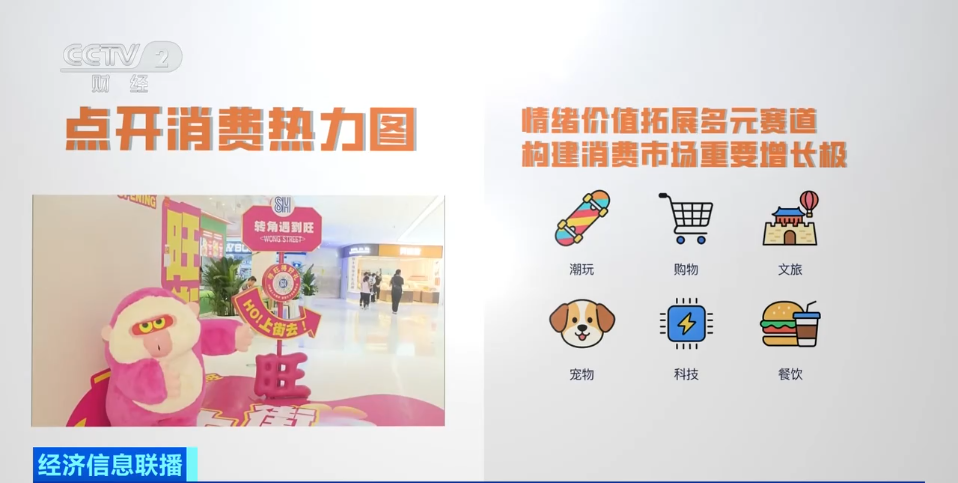
Group 1 - The core viewpoint is that emotional consumption is rapidly emerging as a significant growth driver in the consumer market, with a market size expected to exceed 4.5 trillion yuan by 2029, up from 1.63 trillion yuan in 2022 and projected to reach 2.72 trillion yuan by 2025 [3] - Emotional consumption is shifting from a focus on "cost-performance" to "emotional value," with over 90% of young people recognizing the importance of emotional value and nearly 60% willing to pay for it [1][3] - The emotional consumption market encompasses various sectors including toys, shopping, cultural tourism, pets, technology, and dining, with young consumers being the primary drivers [1][3] Group 2 - Experts highlight that Chinese products have unique advantages in the emotional consumption sector, attributed to a positive transformation in the image of "Made in China" and the country's creative capabilities that resonate with young consumers [8] - Emotional consumption serves as a connector between supply and demand, maximizing consumer potential and offering businesses opportunities to tap into local cultural elements and heritage as emotional consumption objects [9] - The dual nature of emotional consumption encompasses both material and spiritual aspects, contributing to market vitality and social psychology, with expectations for further growth as regulatory frameworks and market supply improve [9]

零售行业发力元旦消费季 消费活力持续释放
Zheng Quan Ri Bao Wang· 2026-01-04 13:53
Group 1 - The retail industry is focusing on consumer demand pain points during the New Year's holiday, implementing precise marketing, experiential scenarios, and diverse benefits to stimulate consumption [1] - Companies are enhancing promotional efforts during the peak consumption period from New Year's to Spring Festival, launching targeted live streaming activities and offering various consumer benefits [1] - Local life platforms are providing convenient shopping options through discount vouchers and subsidies to encourage in-store consumption [1] Group 2 - Retail enterprises are utilizing experiential activities and interactive engagement to attract customer traffic, with significant increases in foot traffic and sales during the holiday period [2] - On New Year's Eve, a shopping mall recorded over 400,000 visitors, setting a new single-day foot traffic record in Beijing, while membership consumption increased by 45% during the holiday [2] - Retail companies are focusing on enhancing service quality and creating new consumer experiences to attract investment attention [2] Group 3 - The future development of the retail industry requires a dual-driven approach, balancing macro policy guidance with micro model innovation [3] - It is suggested that fiscal subsidy models shift from broad-based to targeted approaches, focusing on service consumption and green consumption to enhance residents' purchasing power [3] - Companies need to adapt to the consumption characteristics of Generation Z, emphasizing experiential consumption and restructuring supply chains to meet the demand for quality and cost-effective private brands [3]
今年第一个flag:别再“越努力越焦虑”
3 6 Ke· 2026-01-04 00:44
Core Insights - The future belongs not to those with the most resources, but to those who can adjust their pace and find direction amidst chaos [1][38] - The world is entering a "three-speed world," characterized by different speeds of development across regions and individuals [3][12] Group 1: Economic Dynamics - China remains one of the fastest and most efficient economies globally, driven by AI infrastructure, a complete supply chain, and urbanization [4] - The rapid pace in China comes with high levels of internal competition and stress, leading to a culture of overwork and anxiety [4] - The U.S. maintains a strong innovation pace, particularly in technology sectors, but faces social instability and political discord [5][7] Group 2: Corporate Survival Strategies - Companies must adopt a "dual accounting" approach to navigate global markets, adhering to different regulations and standards in various regions [14] - Businesses are evolving from mere software providers to integral components of national governance systems, enhancing efficiency in public services [15][16] - The integration of AI into organizational structures is transforming how companies operate, with AI becoming a critical component of productivity rather than just a tool [17][18] Group 3: Consumer Behavior and Family Stability - The new consumer economy emphasizes emotional value over mere functionality, with products designed to alleviate anxiety and stress [19] - Family stability is crucial for resilience in a turbulent world, with a focus on building a defensive asset structure to ensure long-term security [20][21] - The perception of assets is shifting from maximizing returns to ensuring peace of mind and stability for families [21][23] Group 4: Education and Personal Development - The educational focus is shifting from rote learning to fostering skills that enable children to thrive in a complex world, including AI literacy and psychological resilience [24] - A "dual-residence" lifestyle is emerging, where individuals balance high-intensity work in urban settings with slower-paced living in rural areas [25][26] Group 5: Future Workforce and Skills - The most valuable individuals in the future will be those who can connect disparate fields and leverage AI as an integral part of their work [27][30] - The ability to adapt and switch between different speeds will be essential for success in the evolving landscape [38]
奥雅股份:加速发力IP业务补全商业版图核心拼图
Zhong Guo Zheng Quan Bao· 2025-07-18 20:59
Core Insights - The company views IP as the most critical piece of its business strategy, aiming to leverage the emotional value economy for a sustained content creation boom over the next 10-20 years [1][2][3] - The strategic framework focuses on "Creative Design + Family Tourism" as dual main businesses and "AI + IP" as dual engines for growth, with a goal to become a leading asset value service provider and family tourism brand operator in China by 2025 [1][2] Business Transformation - The company has completed an initial phase of business transformation, with the landscape design business's share decreasing from 83.85% in 2020 to 52.16% in 2024, while the family tourism and creative design sectors have risen to 40.37% [1] - The transformation is driven by a keen awareness of consumer trends and customer experiences, aiming to expand opportunities through continuous upgrades [2] IP Development - The company is actively promoting independent IP operations, having established a subsidiary, Yueqi Culture, focused on IP and derivative product incubation, development, authorization, and commercialization [3] - The launch of the Luo Jia Sen Park in collaboration with Henan Aviation Port marks the first external authorization of the "Luo Jia" brand, indicating a significant step in IP independent operations [3]