成本加成定价模式

Search documents
伟星股份(002003) - 2026年3月4日投资者关系活动记录表
2026-03-06 09:02
Group 1: Industry Outlook - The company maintains a cautious outlook on industry recovery in the short term due to the current international trade environment and consumer sentiment, despite recent improvements in order intake [1] - In the long term, the company is optimistic about its development prospects and will continue to focus on its core business of apparel accessories, enhancing brand influence and product competitiveness [1] Group 2: Customer Base and Growth - Incremental growth is expected to primarily come from existing customers, as establishing new brand partnerships typically requires years of effort [1] - The company aims to deepen cooperation with existing clients while actively seeking new brand customers to ensure stable long-term development [1] Group 3: Product Segments - There is significant market potential for both buttons and zippers, with zippers having broader application scenarios beyond clothing, including sports, outdoor, and home textiles [1] - The company is more optimistic about the long-term growth of the zipper segment [1] Group 4: Financial Performance - The company reported a notable increase in foreign exchange losses due to currency fluctuations, which, combined with rising fixed costs, led to a decline in profit metrics despite slight revenue growth [2] - The pricing model is based on a cost-plus approach, allowing for reasonable pricing adjustments in response to raw material cost increases [3] Group 5: Competitive Landscape - The apparel accessories industry is highly competitive, with price competition being a normal business practice; however, mid-to-high-end brand clients prioritize product development capabilities, delivery times, and service over price [4] Group 6: Profitability and Expenses - The company's gross margin is influenced by various factors, including raw material costs and product structure, with a commitment to sustainable development rather than solely pursuing high margins [5] - Sales expenses have increased due to expanded international market efforts, and while total sales expenses are expected to grow, the sales expense ratio is anticipated to remain stable [6] Group 7: Employee Incentives - The company has established a comprehensive performance evaluation and compensation management system, adhering to principles of merit-based pay and implementing a phased equity incentive plan to enhance employee motivation [7] Group 8: Dividend Policy - The company follows a sustainable development and win-win philosophy in its dividend policy, considering annual profit conditions, future development needs, and shareholder preferences when formulating profit distribution plans [9]

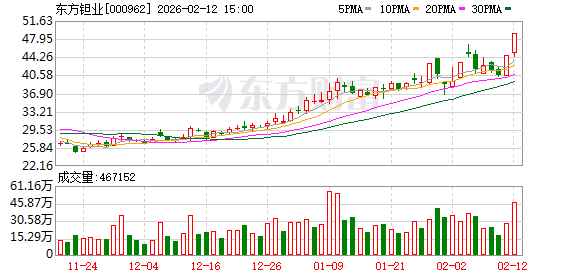
东方钽业:产品的销售价格主要采用成本加成的模式确定
Zheng Quan Ri Bao· 2026-02-12 08:37
Core Viewpoint - The company emphasizes that its production and operations must consider various factors such as market demand, inventory structure, customer orders, customized requirements, resource endowment, and long-term development [2] Pricing Strategy - The company's product pricing is primarily based on fluctuations in raw material prices, taking into account customer demand, its own cost structure, production cycles, and market conditions during negotiations with clients [2] - The sales price of the company's products is mainly determined using a cost-plus model, where prices, order quantities, and technical specifications are negotiated on a one-on-one basis with major customers [2] - Customers reference the average raw material prices from a period prior to contract signing to determine pricing levels [2] Market Dynamics - There is a certain lag in the transmission of raw material price changes to the sales prices of finished products due to factors such as pricing models, market competition, and coordination of customer relationships [2]


中国银河证券:纺织原料价格上行 龙头盈利有望修复改善
智通财经网· 2026-02-09 07:50
Core Viewpoint - The report from China Galaxy Securities indicates that the rising cycle of upstream raw material prices presents clear profit recovery opportunities for leading textile yarn companies due to a contraction in wool supply and a rebound in demand, alongside fluctuating cotton prices supported by inventory consumption ratios [1][2]. Group 1: Upstream Raw Material Market Dynamics - The upstream raw material market for the textile and apparel industry is undergoing a restructuring of supply and demand dynamics, with Australian wool supply entering a contraction phase since 2025, while downstream apparel demand recovery is driving replenishment intentions, leading to an increase in wool prices [2][3]. - Global cotton production and consumption have remained stable, with the 2025/26 production expected to reach 26 million tons, reflecting a modest year-on-year growth of 0.81%, while consumption is projected to remain steady at 25.89 million tons [4]. Group 2: Wool and Cotton Price Trends - Wool prices have entered a new upward cycle since July 2025, rising from 1208 AUD cents per kilogram to 1665 AUD cents per kilogram by January 29, 2026, marking a year-on-year increase of 39.7% [3]. - The inventory-to-consumption ratio for cotton in 2025/26 is projected to be 62.64%, which is at a lower level compared to the past decade, indicating that strong replenishment intentions and resilient consumption are key drivers supporting domestic cotton prices [4]. Group 3: Impact on Company Profitability - The rising wool price cycle typically corresponds with an increase in profit margins for wool spinning companies, as they adopt a cost-plus pricing model, allowing for higher product prices during periods of rising wool prices [5]. - Cotton constitutes approximately 70% of the raw material costs for yarn companies, and leading companies like Huafu Fashion and Bailong Oriental exhibit a positive correlation between their yarn business profit margins and cotton prices, performing better during periods of rising or high cotton prices [5].

英思特:采用成本加成定价模式,存储涨价对公司毛利率影响可控
2 1 Shi Ji Jing Ji Bao Dao· 2026-02-02 01:23
Core Viewpoint - The company, 英思特, indicates that while storage prices are rising along the supply chain, the impact on its gross margin is manageable due to the low unit value of magnetic material applications in consumer electronics and its cost-plus pricing model [1] Group 1 - The company has established a mature and flexible pricing negotiation mechanism with its customers to address the pressure from rising storage prices [1] - The company continues to optimize its cost structure through internal lean management to mitigate potential market risks [1]
东方钽业:公司产品的销售价格主要采用成本加成的模式确定
Zheng Quan Ri Bao Zhi Sheng· 2025-12-11 12:40
Core Viewpoint - The company emphasizes that its production and operations must consider multiple factors, including market demand, inventory structure, customer orders, resource endowment, and long-term development [1] Pricing Mechanism - The sales price of the company's products is primarily determined using a cost-plus pricing model [1] - Prices, order quantities, and technical specifications are negotiated on a one-on-one basis with major customers, typically on an annual, semi-annual, or quarterly basis [1] - Customers reference the average price of raw materials over a period prior to contract signing to determine pricing levels [1] Price Transmission - There is a certain lag in the transmission of raw material price changes to the sales prices of finished products due to factors such as pricing models, market competition, and customer relationship management [1]
英思特:公司采用“成本加成”定价模式
Zheng Quan Ri Bao Wang· 2025-09-12 09:42
Core Viewpoint - The company employs a "cost-plus" pricing model, which may experience temporary impacts on gross margins due to rapid fluctuations in raw material prices, but can maintain stability through gradual price adjustments over time [1] Pricing Strategy - The company utilizes a "cost-plus" pricing model, which allows for gradual price transmission to stabilize gross margins in response to long-term trends in raw material prices [1] Supplier Relationships - The company has established long-term stable partnerships with various types of raw material suppliers, ensuring a steady supply of materials from its headquarters in Baotou, Inner Mongolia, a major source of rare earth materials in China [1] Procurement and Inventory Management - The company has signed long-term agreements with suppliers to guarantee stable raw material supply and closely monitors market dynamics and policy changes to predict raw material price trends [1] Operational Measures - The company implements several measures to mitigate the adverse effects of raw material price fluctuations on its operational performance, including advance procurement of rare earth materials based on existing orders, establishing price adjustment mechanisms with customers, optimizing formulations, and improving processes [1]
A股半年报揭示产业链分化:上游企业涨价获利,中下游承压应对成本冲击
Sou Hu Cai Jing· 2025-08-06 03:47
Group 1: Upstream Companies Performance - Upstream companies in the non-ferrous metals industry showed strong performance in the first half of 2025, driven by rising product prices [3] - Xibu Mining achieved operating revenue of 31.619 billion yuan, a year-on-year increase of 27%, with net profit attributable to shareholders reaching 1.869 billion yuan, up 15% [3] - Cangge Mining reported operating revenue of 1.678 billion yuan and net profit of 1.8 billion yuan, a year-on-year growth of 38.8%, with potassium chloride average selling price increasing by 25.57% to 2845 yuan/ton [3] - Lead prices surpassed 17,100 yuan/ton due to rising demand from the battery sector, benefiting upstream mining companies [3] Group 2: Downstream Companies Challenges - Downstream companies are facing cost pressures due to rising raw material prices, leading to a decline in profit margins for some [4] - Hanwei Technology reported a net profit drop of 87.86% year-on-year, primarily due to significant increases in production costs from raw material price hikes [4] - Instech adopted a cost-plus pricing model to manage raw material price fluctuations, facing challenges from the lag in price adjustments [4] - Xizi Clean Energy implemented a diversification strategy to mitigate raw material price risks, including traditional measures and futures hedging [4] Group 3: Global Expansion Strategies - Huagong Technology is actively advancing its global business strategy, establishing over 60 offices across major regions in China and setting up four overseas R&D centers [5] - The company has seen significant growth in export orders in Europe, North America, and the Middle East, with new overseas production bases and subsidiaries [5]