投机性空头头寸

Search documents
特朗普施压俄罗斯,油价一度升破70大关,势创以伊冲突以来最大单周涨幅
Hua Er Jie Jian Wen· 2025-09-27 02:20
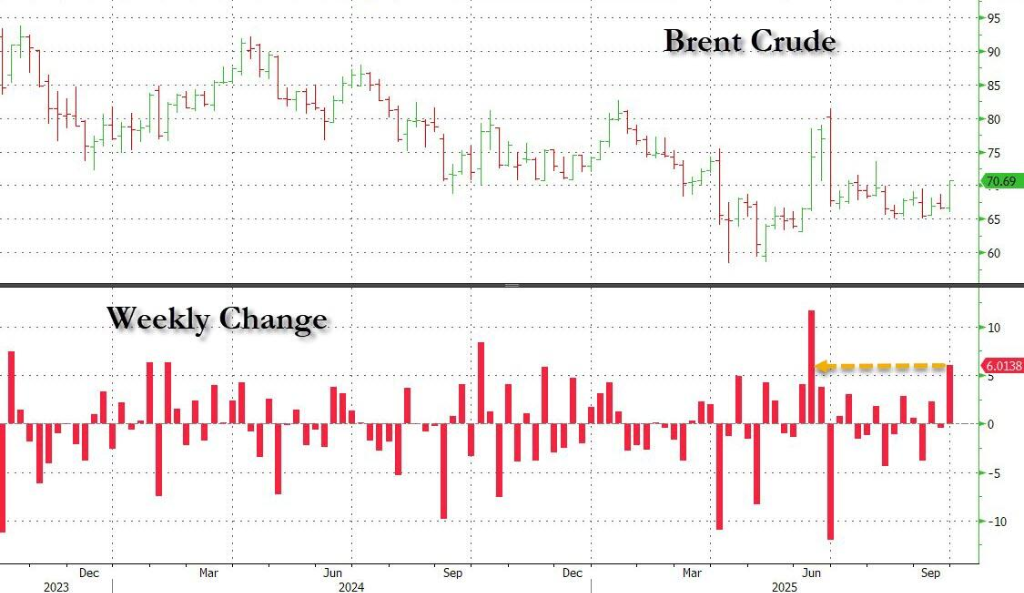
Core Viewpoint - The article highlights the significant rise in international oil prices due to escalating geopolitical tensions, with Brent crude surpassing the $70 mark for the first time since late July, driven by U.S. pressure on Turkey regarding Russian oil purchases and other geopolitical factors [1][4]. Geopolitical Factors - U.S. President Trump urged Turkey to stop purchasing oil from Russia, contributing to market concerns [1]. - Ukraine has intensified drone attacks on Russian energy infrastructure, threatening supply capabilities [4]. - NATO has warned Russia against further incursions, indicating a potential military response [4]. - The UN is set to reimpose extensive sanctions on Iran, tightening global oil supply further [4]. Market Dynamics - Strong U.S. inflation data and a weakening dollar have supported oil prices, alleviating short-term demand concerns [5]. - Commodity Trading Advisors (CTAs) have shifted to a net long position for the first time since early August, indicating a technical market shift [3][4]. Supply Outlook - Despite rising prices, the supply outlook remains complex, with predictions of oversupply later this year due to increased production from OPEC+ and non-OPEC countries [7]. - OPEC+ is expected to approve a new round of production increases in November to regain market share [7][8]. - Iraq's Kurdish region is set to resume oil exports after a two-year hiatus, initially at 230,000 barrels per day, potentially rising to 500,000 barrels per day [8]. Market Reactions - The market has reacted cautiously to news of increased supply, with traders speculating that previously halted oil may have been redirected for domestic use or neighboring exports [9].

美元难逃下行命运,任何反弹都是“死猫跳”?
Jin Shi Shu Ju· 2025-08-12 09:58
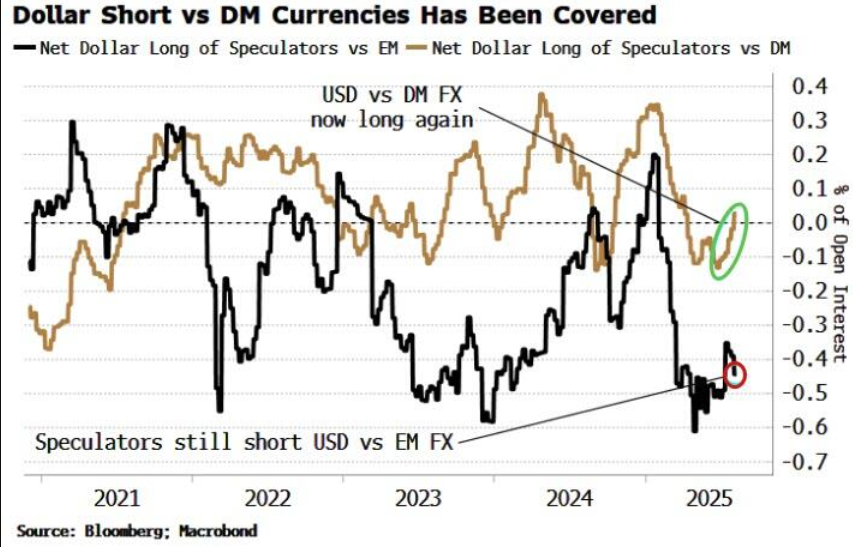
Group 1 - The core view is that the US dollar is on a long-term weakening trend due to closed speculative short positions and deteriorating fiscal prospects amid an economic slowdown [1][4] - The dollar index has faced another failed rebound, attempting to recover from the low in early July but facing resistance, indicating a potential continuation of this pattern [1][4] - Speculative short positions in dollar futures were extremely crowded, making a rebound a matter of time rather than certainty, with the Commodity Futures Trading Commission (CFTC) data showing extreme short positions [1][4] Group 2 - Positions in the dollar against developed market currencies have returned to a net long status, while short positions against emerging market currencies remain and are expanding [3][1] - Macro hedge funds and Commodity Trading Advisors (CTAs) have also seemingly closed their dollar shorts, with their sensitivity to dollar performance returning to neutral levels after previously hitting a three-year low [4][1] - The US fiscal balance is under increasing pressure, with an annual deficit of approximately $2 trillion, which could double to double-digit percentages if the economy enters a recession [5][4] Group 3 - The risk of an economic recession in the US is rising, with tax revenue expected to decline, leading to greater pressure on government budgets [4][5] - Market movements are not linear, especially in the foreign exchange market, but the prevailing downward trend for the dollar suggests that any upward movements may become increasingly short-lived [7][1]