改善型购房需求

Search documents
网签突破1.5万套 北京1月二手房市场站稳“小阳春”前哨
Bei Jing Shang Bao· 2026-02-01 15:12
Core Viewpoint - The Beijing second-hand housing market has shown signs of stabilization at the beginning of 2026, with a net signing volume of 15,082 units in January, maintaining a steady level above 14,000 units for three consecutive months, indicating a solid market recovery [1][2]. Market Performance - The net signing volume of second-hand homes in Beijing has been consistently above 14,000 units since November 2025, with figures of 14,446, 17,200, and 15,082 units recorded from November 2025 to January 2026 [2]. - The market has experienced a significant increase in transaction volume, with a 33% rise in transactions following the introduction of new real estate policies in December 2025 [3]. Demand Factors - The release of educational demand has shifted buyer sentiment, leading to an increase in transactions in certain areas, particularly those with quality educational resources and living facilities [6]. - The demand for improvement-type housing has risen, with a notable increase in transaction volume in areas previously dominated by first-time buyers [8]. Supply Dynamics - The number of second-hand housing listings has decreased from approximately 150,000 units to around 130,000 units, contributing to a more balanced supply-demand relationship [3]. - Owners are now pricing their properties more rationally, aligning with market conditions, which has facilitated smoother transactions [3][4]. Buyer Preferences - There is a noticeable shift in buyer preferences towards newer properties, with an increased focus on property services, product quality, and living experience rather than just price [7]. - The demand for improvement-type housing is no longer limited to outer districts, as even areas traditionally focused on first-time buyers are seeing a rise in improvement-type transactions [8]. Policy Impact - Recent policy changes, including adjustments to down payment ratios and mortgage rates, have significantly lowered the barriers to homeownership, encouraging more buyers to enter the market [9]. - The current mortgage standards and transaction costs are at historically low levels, creating a favorable environment for potential buyers [9][10].
全国二手楼市缓过来了吗?
3 6 Ke· 2025-06-24 05:43
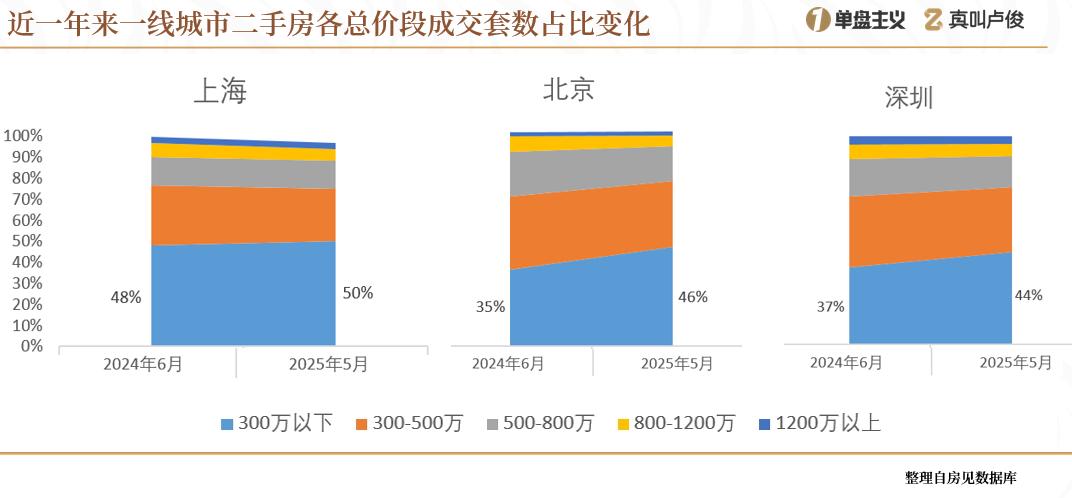
Core Insights - The current real estate market is experiencing a shift, with a focus on the second-hand housing market and its transaction structure, particularly in major cities like Shanghai, Beijing, and Shenzhen [2][24][32] Group 1: Transaction Trends - The proportion of transactions under 3 million yuan is increasing, with Beijing seeing the most significant rise from 35% to 46% over the past year, while Shanghai and Shenzhen increased by 2% and 7% respectively [6][8] - The average transaction price for second-hand homes has decreased, with Shanghai dropping from 2.1 million yuan to 1.96 million yuan, and similar declines observed in Beijing and Shenzhen [8][9] - In second-tier cities, the 2 million yuan price point is critical, with cities like Chengdu and Nanjing seeing significant increases in transactions below this threshold [11][14] Group 2: Demand for Larger Units - There is a notable increase in the transaction volume of larger units (over 130 square meters) in cities like Shenzhen, where the proportion of such transactions has reached a five-year high [15][19] - The demand for larger homes is driven by changing family structures and lifestyle upgrades, particularly among families with multiple children [23][31] Group 3: Inventory and Pricing Pressure - The inventory of second-hand homes is rising, with cities like Chengdu seeing a 45.9% increase in listings over six months, leading to increased competition and downward pressure on prices [24][27] - The average price of second-hand homes across 100 cities has dropped by 7.24% year-on-year, indicating a continued decline in the market [28][30] Group 4: Market Outlook - The overall second-hand market is in a phase of weak recovery, with demand entering a new adjustment period, characterized by buyer hesitation and a tug-of-war between buyers and sellers [32][33] - Some cities are showing signs of improvement, with stable transaction volumes and manageable inventory levels, which could help restore buyer confidence [32][33]