
政务大模型

Search documents
政府数智化转型发展研究报告:数智驱动创新发展范式,绘就新时点治理新蓝图
中国信通院· 2026-03-12 02:26
Group 1: Global Trends in Government Digital Transformation - Global government digital transformation is characterized by strategic leadership, deep technological empowerment, and collaborative governance systems[10] - The transition has evolved through three stages: basic informatization, digital service proliferation, and smart governance exploration, now entering a phase of comprehensive digital collaborative governance[10] - Major economies are implementing long-term strategic roadmaps, with the EU focusing on AI application and cross-border data integration, while the US mandates at least 8% of IT budgets for AI projects[14][15] Group 2: China's Government Digital Transformation - China's digital transformation is guided by the "Five Modernizations" framework: systematic digital governance, integrated digital infrastructure, large-scale AI application, standardized data practices, and enhanced security capabilities[29][30] - The government aims to activate data potential and improve public service efficiency, transitioning from experience-driven to data-driven governance[29] - By 2024, China's government cloud market is projected to reach ¥1189.4 billion, with a steady growth trajectory expected[43][45] Group 3: AI and Data Utilization - AI applications in government are expanding, with 100% coverage of provincial administrative regions, focusing on tailored models for specific industry needs[54] - Data resource expansion and quality control are prioritized, with initiatives like Zhejiang's comprehensive data cataloging and Guangdong's integration of over 10 billion data entries[60][62] - The implementation of a full-process quality governance mechanism ensures data accuracy remains above 99% in major cities like Beijing[62]
1899 万、政务大模型大单
Xin Lang Cai Jing· 2026-02-06 11:20
Core Insights - The Shanghai Putuo District Urban Operation Management Center has announced a tender for the construction of a comprehensive management service platform for government models, with a total budget of 18,990,000 yuan [1][3]. Procurement Requirements - **Item One: Software Development** - Quantity: 2 - Budget: 5,730,000 yuan - The project includes the development of application software, which encompasses a government model capability service platform, a gateway service platform, a document indexing and annotation service platform, a technical service portal, and general intelligent application development [2][4]. - **Item Two: Hardware Procurement** - Quantity: 2 - Budget: 13,260,000 yuan - This includes the procurement and installation of AI servers and switch equipment [3][5][6].
青岛数据集团“四位一体”体系领跑全国政务大模型建设
Xin Lang Cai Jing· 2025-12-28 07:00
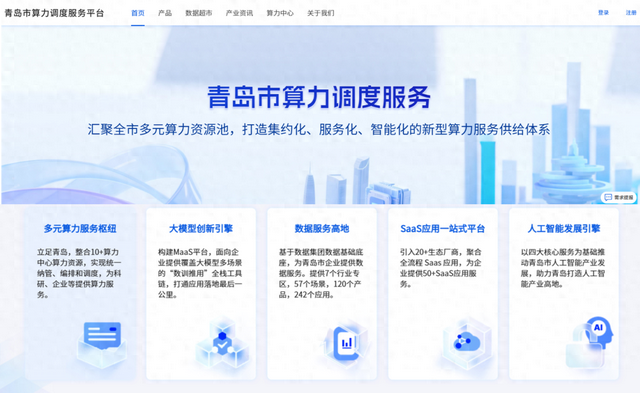
Core Insights - Qingdao Data Group, a subsidiary of Huatuo Group, is a key player in the digital economy development of Qingdao, creating a replicable model for national government AI initiatives through its "computing power-data-model-service" integrated operational system [1][9] Group 1: Computing Power - The company has established a computing power scheduling service platform that integrates diverse national computing resources, creating a one-stop platform and a full-stack empowerment system [1] - Currently, it has connected 13 computing centers with over 24,000 PFlops of computing resources, serving more than 300 enterprises, significantly lowering the innovation threshold and application costs for AI companies [1] Group 2: Data Activation - Qingdao Data Group has developed a public data operation platform that collects 5,201 public data directories, covering social data from 50 million enterprises nationwide [3] - The platform has launched nine scenario zones and 157 data products, enabling 247 application scenarios such as financial risk control and rapid claims processing, creating a sustainable data circulation ecosystem [3] Group 3: Model Development - The company has independently developed the "Tongcheng Government Large Model" to meet concentrated demands in the government sector, achieving a 93% accuracy rate in knowledge-based intelligent Q&A and a 70% efficiency improvement in rapid model construction [5] - This model supports over 50 practical scenarios, including "similar case judgment," leading the nation in government intelligence [5] Group 4: Service Implementation - Based on the government large model, Qingdao Data Group has created over 160 practical application scenarios, enhancing urban event handling efficiency by over 30% through collaborative analysis of "small algorithms + large models" [7] - The results have been promoted to over 30 cities nationwide, transforming technical capabilities into urban governance effectiveness, benefiting urban development and improving people's livelihoods [7] Group 5: Recognition and Future Plans - The company has achieved notable recognition, including four software copyrights, two patent applications, and awards such as the third prize in the 2025 National Data Element × Competition [9] - Future plans include further refining the "four-in-one" system, enhancing data supply, technical support, and scenario empowerment capabilities, aiming to be a pioneer in data value and a facilitator of urban upgrades [9]

“彭小捷”成长记
Xin Lang Cai Jing· 2025-12-25 22:30
Core Insights - The article highlights the implementation of an AI-driven intelligent customer service agent named "Peng Xiaojie" in the Pengshan District of Meishan City, which has significantly improved the efficiency of government services [2][3]. Group 1: AI Implementation and Impact - "Peng Xiaojie" has led to a 400% increase in the usage of intelligent customer service and a 50% reduction in the number of service items that need to be resubmitted [2]. - The AI system has achieved a 95% online resolution rate for simple inquiries, alleviating the pressure on human consultants at service windows [3]. Group 2: Knowledge Base and Service Navigation - The AI operates on a dual-core system of "data intelligence hub + industry think tank engine," covering high-frequency matters such as business approvals and social security, with a 99% accuracy in identifying user intent and extracting key policy clauses [3]. - The system provides personalized guidance by generating clear and structured steps for users based on their inquiries [3]. Group 3: Human-AI Collaboration - A mechanism of "AI pre-review + human verification" has been established to ensure the accuracy of responses, allowing for seamless transitions to human agents when complex issues arise [4]. - The collaboration between AI and human staff creates a feedback loop where experiences from complex cases enhance the AI knowledge base, leading to continuous training and optimization of the system [4].

华为云AI CITY战略落地,武汉、石家庄等成智慧城市典范
Guan Cha Zhe Wang· 2025-11-17 15:04
Core Insights - The 27th China International High-Tech Achievements Fair was successfully held in Shenzhen, focusing on the transformation of smart cities through AI and computing power [1] - Huawei Cloud received multiple awards, including "2025 Leading Solution Provider for Smart Cities in China" and "2025 Leading AI CITY Solution Provider" [1][3] - The development of smart cities in China is transitioning from "cloud as the norm" to "AI as the standard" [3] Huawei Cloud's Contributions - Huawei Cloud's AI CITY concept aims to drive urban modernization by integrating AI technology with infrastructure and data resources [3] - The company has partnered with various cities to implement smart city solutions, resulting in numerous awards for cities like Wuhan, Shijiazhuang, and others [1][3] Case Studies of Smart City Initiatives - Wuhan has developed a digital public infrastructure called "Wuhan Cloud," serving 124 units and integrating over 400 business systems [4] - Shijiazhuang's "Kunpeng Government Cloud" has been operational for over 1,000 days with zero incidents, providing services to over 30 units [5] - Xiangyang has implemented an AI traffic light system, improving traffic efficiency by over 15% [5] - Yancheng has created a city management platform that enhances governance efficiency through AI and data integration [6] - Karamay has achieved 95% of its government systems on the cloud, introducing a digital government assistant named "Xiao Ke" [7] - Bao'an and Qianhai are establishing an innovation center for embodied intelligence robotics, focusing on cutting-edge technology [8] - Huadu District in Guangzhou is leveraging "digital twin" technology to enhance governance and public services [9] - Changping District in Beijing is developing a deep-thinking AI governance model, integrating various AI capabilities [10] Market Position - Huawei Cloud has served over 800 government cloud projects in China since 2012 and holds a 23.3% market share, ranking first in the government cloud market [10][11]

思特奇:公司积极参与政务大模型统一服务平台建设与部署
Zheng Quan Ri Bao Zhi Sheng· 2025-11-11 10:13
Core Viewpoint - The company is actively engaging in the construction and deployment of a unified service platform for government large models, focusing on core needs such as government services and social governance [1] Group 1 - The company is concentrating on intelligent Q&A, assisted processing, and direct policy services to enhance government service efficiency [1] - The initiative aims to promote resource reuse across different levels and regions, contributing to inclusive and shared government services [1] - The company emphasizes its role in supporting government governance through technological advancements [1]

致远互联签约政务大模型平台及应用场景建设项目
Zheng Quan Shi Bao Wang· 2025-10-31 06:20
Core Insights - Zhiyuan Huitong has signed a project for the construction of a government large model platform and application scenarios in a certain district, aiming to create the first nationwide "government large model service platform + application scenario ecological co-construction" innovative paradigm [1] Group 1 - The project is a benchmark initiative for government large models [1] - The goal is to establish a comprehensive service platform and ecosystem for government applications [1]

浪潮科技一项目入选国家级政务大模型标杆案例
Qi Lu Wan Bao· 2025-06-30 08:09
Core Insights - The "Shanxi Provincial Taxation Bureau Tax and Fee Analysis Model Project" was recognized as a typical case of government large models by the China Academy of Information and Communications Technology, supported by Inspur Technology [1] - This project is the only solution focused on tax governance among the 22 benchmark cases, demonstrating a successful transition from laboratory to practical application in government services [1] - The project utilizes Inspur's "Yanyu" industry large model as its technical foundation, achieving a semantic conversion accuracy rate exceeding 95%, significantly enhancing response efficiency to taxpayer inquiries [1] Data Integration and Efficiency - The project addresses the issue of fragmented tax inquiry information across multiple channels, creating the first provincial-level tax "data lake" in China for real-time aggregation of all inquiry information [2] - The system can transcribe voice calls into structured text and automatically label key emotional tags, reducing manual review and data entry workload [2] - A dynamic heat map monitors inquiry distribution in real-time, and a trend prediction engine can identify potential issues seven days in advance, improving taxpayer satisfaction in Taiyuan [2] Competitive Advantage and Policy Optimization - The project's core competitiveness lies in the deep collaboration between industry knowledge and AI reasoning capabilities, addressing potential issues with general models in specialized fields [3] - A comprehensive knowledge service platform incorporates a vast amount of tax regulations and judicial precedents, enhancing the model's professional capabilities [3] - The project has identified 15 ambiguous policy clauses, leading to optimized regulations and a reduction in inquiry repetition and case transfer rates, while promoting a shift from passive response to proactive governance [3]