政府停摆对股市的影响

Search documents
今夜,直线拉升!特朗普,改口了!
中国基金报· 2025-11-05 16:20
Core Viewpoint - Trump emphasizes the need to reopen the government quickly, stating that the government shutdown is negatively impacting the stock market, which has seen multiple highs in the past nine months and is expected to reach new highs again soon [4][6]. Group 1: Market Performance - On November 5, U.S. stock indices opened lower but ended the day higher, with the Nasdaq rising approximately 0.7% and the S&P 500 increasing about 0.4% [2]. - Trump noted that the stock market has been performing well despite the government shutdown, which has lasted for 36 days, marking the longest in U.S. history [6]. Group 2: Political Context - The recent election results in Virginia and New Jersey showed Democratic victories, which Trump attributed to the government shutdown affecting voter sentiment against the Republican Party [6][7]. - Polls indicate that around 60% of voters expressed anger or dissatisfaction with the current state of the nation, suggesting a potential shift in political control for the Democrats in the upcoming midterm elections [7]. Group 3: Employment Data - The ADP report revealed that private sector employment increased by 42,000 in October, following a revised decrease of 29,000 in September, indicating some stabilization in the job market [9][10]. - Despite the slight increase in employment, the overall trend shows a weakening labor market, which may influence the Federal Reserve's decision on future interest rate cuts [11].


3 Things Investors Need to Know About the Stock Market During a Government Shutdown
Yahoo Finance· 2025-10-27 13:21
Group 1 - The S&P 500 has historically shown minimal negative impact during government shutdowns, with only three out of the last ten shutdowns resulting in a decline [4][5][6] - Since the current government shutdown began on October 1, the S&P 500 has only decreased by approximately 0.2% as of October 22, aligning with historical trends [5][6] - Key federal economic data, such as inflation and unemployment reports, are often delayed during shutdowns due to the closure of agencies like the Bureau of Labor Statistics [7][8] Group 2 - The U.S. Securities and Exchange Commission (SEC) halts its operations during government shutdowns, leading to delays in the review and approval of initial public offerings (IPOs) and other corporate filings [9][10] - Companies planning to go public or make significant filings will face postponements as there will be no personnel available to review necessary documents [10]
How the S&P 500 performed after 10 previous government shutdowns
CNBC· 2025-10-07 18:00
Core Insights - The U.S. government shutdown is approaching one week, yet the stock market remains resilient, with the S&P 500 showing a 0.80% increase from October 1 to October 6, despite a slight decline on Tuesday [1] - Historical data indicates that government shutdowns typically do not have a significant negative impact on equity markets, as noted by financial experts [2] Market Performance - The S&P 500 index has achieved several new highs during the shutdown period, indicating strong investor confidence [1] - The market's ability to maintain gains during a government shutdown suggests a trend where such political stalemates do not derail stock performance [2]
美政府停摆或至少持续10天?美股不慌:接着奏乐接着舞!
Jin Shi Shu Ju· 2025-10-03 08:33
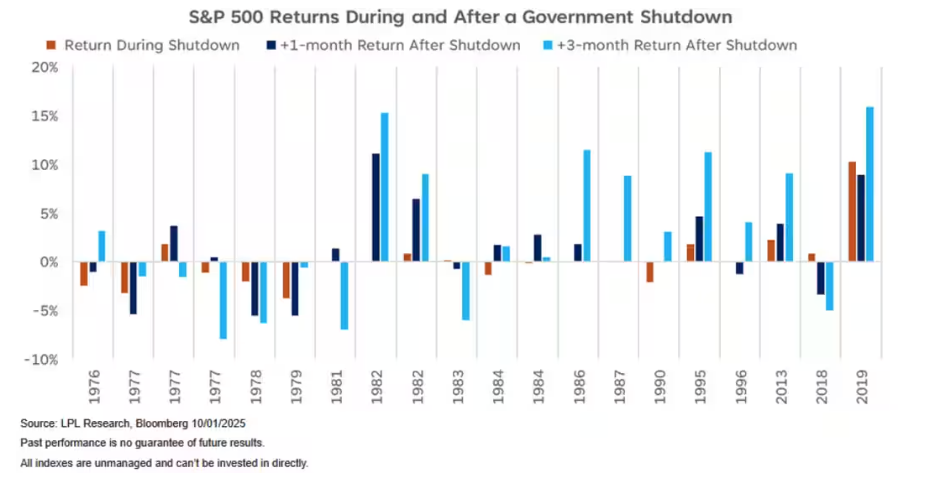
Core Insights - The U.S. stock market is currently experiencing record highs despite the government shutdown, indicating investor confidence in corporate earnings and macroeconomic trends over political uncertainties [1][4]. Group 1: Government Shutdown Impact - Historically, government shutdowns have averaged 8 days, with the stock market showing positive returns one month and three months post-shutdown [2][4]. - Current market predictions suggest a 63% probability that the shutdown will last over 10 days, and a 40% chance it will extend beyond 15 days [4]. - The longest shutdown in U.S. history lasted 34 days, during which the S&P 500 rose by 10%, highlighting that macroeconomic factors can outweigh short-term political disruptions [4]. Group 2: Market Reactions and Federal Reserve Expectations - Investors are increasingly anticipating two rate cuts from the Federal Reserve by the end of the year, with a 95% probability of a 25 basis point cut this month [5]. - The average decline in the stock market during government shutdowns is only 1.6%, with the most significant drop being 6.1% during a 1979 shutdown [5]. - The current bullish trend in the stock market at the onset of the shutdown suggests that it is likely to continue rising, as historical patterns indicate that strong market momentum can persist despite political uncertainties [5].
Government Shutdown Starts: Here's What Investors Need to Know Now
Yahoo Finance· 2025-10-01 21:17
Group 1 - The federal government shutdown began on October 1 due to Congress's failure to agree on funding, primarily over Obamacare subsidies [1] - Over half a million federal employees were furloughed, with the Defense Department's civilian workforce being the most affected [2] - Services such as the monthly unemployment report from the Bureau of Labor Statistics will be impacted, and government properties like national parks will face restrictions [2] Group 2 - The shutdown has both near-term and long-term impacts on the economy, potentially exacerbating an already weak labor market and dampening consumer spending, particularly in the Washington, D.C. area [3] - Historically, government shutdowns have not significantly affected the stock market, with the S&P 500 averaging a gain of just 0.05% during past shutdowns [5] - The current shutdown occurs amid a rapidly weakening labor market, raising concerns about the potential for a recession if it extends [7][8]
几天后,又一颗美国“市场大雷”将引爆
华尔街见闻· 2025-03-09 12:39
Core Viewpoint - The article discusses the impending risk of a U.S. government shutdown due to funding issues, highlighting the political tensions between the Republican and Democratic parties and the potential economic impacts of such a shutdown on investors and the market [2][3][4]. Political Dynamics - The House Republicans have proposed a spending bill that needs majority support to pass, but the Democrats largely oppose it, potentially to shift the blame for a government shutdown onto the Republicans [3][5]. - President Trump has called for Republican unity to support a spending bill that maintains current spending levels while increasing defense and veterans' healthcare funding [5][6]. - The bill faces challenges in the House due to narrow Republican control and requires at least 60 votes in the Senate, where Republicans hold only 53 seats [7][8]. Economic Implications - A government shutdown could lead to significant disruptions, including the suspension of pay for federal employees and delays in key economic reports, which may impact GDP growth by reducing it by 0.4 percentage points in the first quarter [11][12]. - Approximately 850,000 federal employees may be forced to take unpaid leave, and inflation could temporarily rise due to the absence of these workers from the economic output [12][13]. Historical Context and Market Reactions - Historically, government shutdowns have led to increased market volatility in the short term, but the S&P 500 has shown resilience, averaging a 12.7% increase in the 12 months following a shutdown [15][16]. - The current market context is complicated by existing trade tensions, with the S&P 500 down nearly 2% and the Nasdaq down about 6% this year, alongside a 35% increase in the VIX index, indicating rising investor anxiety [4][17]. - Analysts suggest that while the political situation is tense, the focus should remain on corporate earnings growth rather than the noise from Washington [20].