
数字人民币2.0版

Search documents
“2.0版”数字人民币上新!如何影响你我生活?
Bei Jing Ri Bao Ke Hu Duan· 2026-01-13 00:29
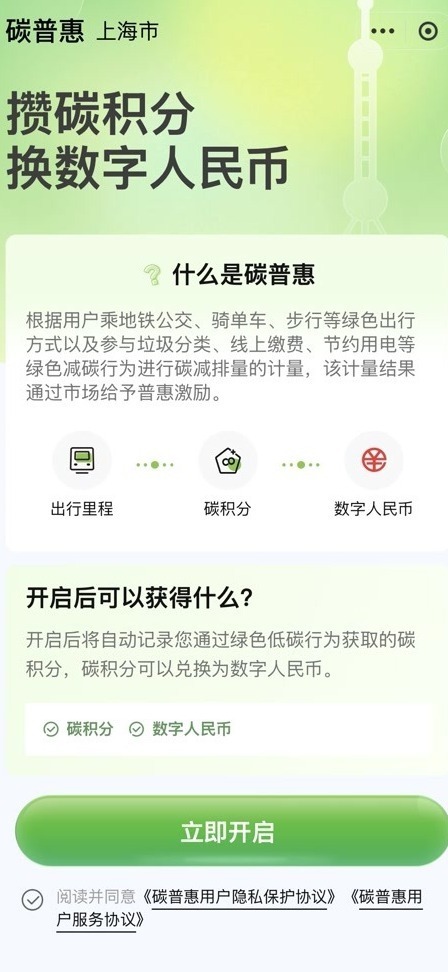
Core Insights - The digital RMB has undergone significant updates with the launch of version 2.0, introducing features like interest on wallet balances and the "Carbon Benefit" program, enhancing its role in the financial system [1][5][9] Group 1: Digital RMB 2.0 Features - The upgraded digital RMB App now includes a wallet balance interest feature, allowing users to earn interest on their balances starting January 1, 2026, at a rate of 0.05% [5][9] - The "Carbon Benefit" program has been launched, enabling users to earn carbon credits through low-carbon activities, which can be converted into digital RMB [2][4] Group 2: Financial Integration and User Benefits - The digital RMB is being integrated into the banking deposit system, becoming a crucial infrastructure in the financial ecosystem [1][9] - Users can now benefit from a "money-making" feature, where idle funds in their digital RMB wallets can generate interest, providing a new avenue for value growth [5][10] Group 3: Future Developments and Recommendations - The digital RMB management center plans to expand low-carbon scenarios and increase participation across multiple cities, aiming to build a collaborative service network [4][10] - Analysts suggest that the transition to a "deposit currency" will facilitate easier access to global banking payment systems, enhancing its use in cross-border trade and investment [11]


当数字人民币开始计息
Jing Ji Guan Cha Bao· 2026-01-10 07:17
Core Viewpoint - The digital renminbi (e-CNY) will start accruing interest on wallet balances as of January 1, 2026, marking a significant shift from a cash-like payment tool to a deposit currency model, which aligns with economic growth and financial intermediation mechanisms [1][2][3] Digital Renminbi Transition - The People's Bank of China (PBOC) will implement a new measurement framework and management system for digital renminbi on January 1, 2026, transitioning from a cash-type model to a deposit currency model [2] - Major state-owned banks will begin to pay interest on digital renminbi wallet balances at the same rate as regular savings accounts [2] Systemic Upgrade - The ability to earn interest signifies a systemic upgrade, transforming digital renminbi from a mere tool to a comprehensive monetary system, responding to global trends in digital currencies [3][4] - The PBOC aims to redefine how money exists, circulates, and is governed, moving towards a more sustainable and operationally integrated digital currency [3][4] Cross-Border Payment Enhancements - The PBOC is focusing on enhancing cross-border payment systems, including expanding the use of the renminbi in international transactions and improving the efficiency of cross-border financial flows [5][6] - The digital renminbi is expected to become a core engine for cross-border payments, facilitating smoother transactions and reducing costs for businesses [5][6] Infrastructure Development - Recent policies indicate a strategic alignment between digital renminbi development and cross-border payment infrastructure, aiming for a cohesive system that supports both domestic and international financial activities [7][8] - The revised rules for the renminbi cross-border payment system will enhance governance and scalability, ensuring a robust framework for financial transactions [8][9] Future Implications - The transition to a deposit currency model is anticipated to significantly increase liquidity within the banking system and encourage more financial services around digital renminbi [13][14] - The internationalization of the renminbi will depend on clear rules, risk management, and compliance, which are essential for building trust among global financial institutions [14][15] Conclusion - The digital renminbi's evolution into a deposit currency represents a fundamental shift in China's monetary policy, with implications for both domestic financial stability and international currency dynamics [1][3][14]




可计付利息!数字人民币升级2.0版影响几何?
Guo Ji Jin Rong Bao· 2026-01-09 10:00
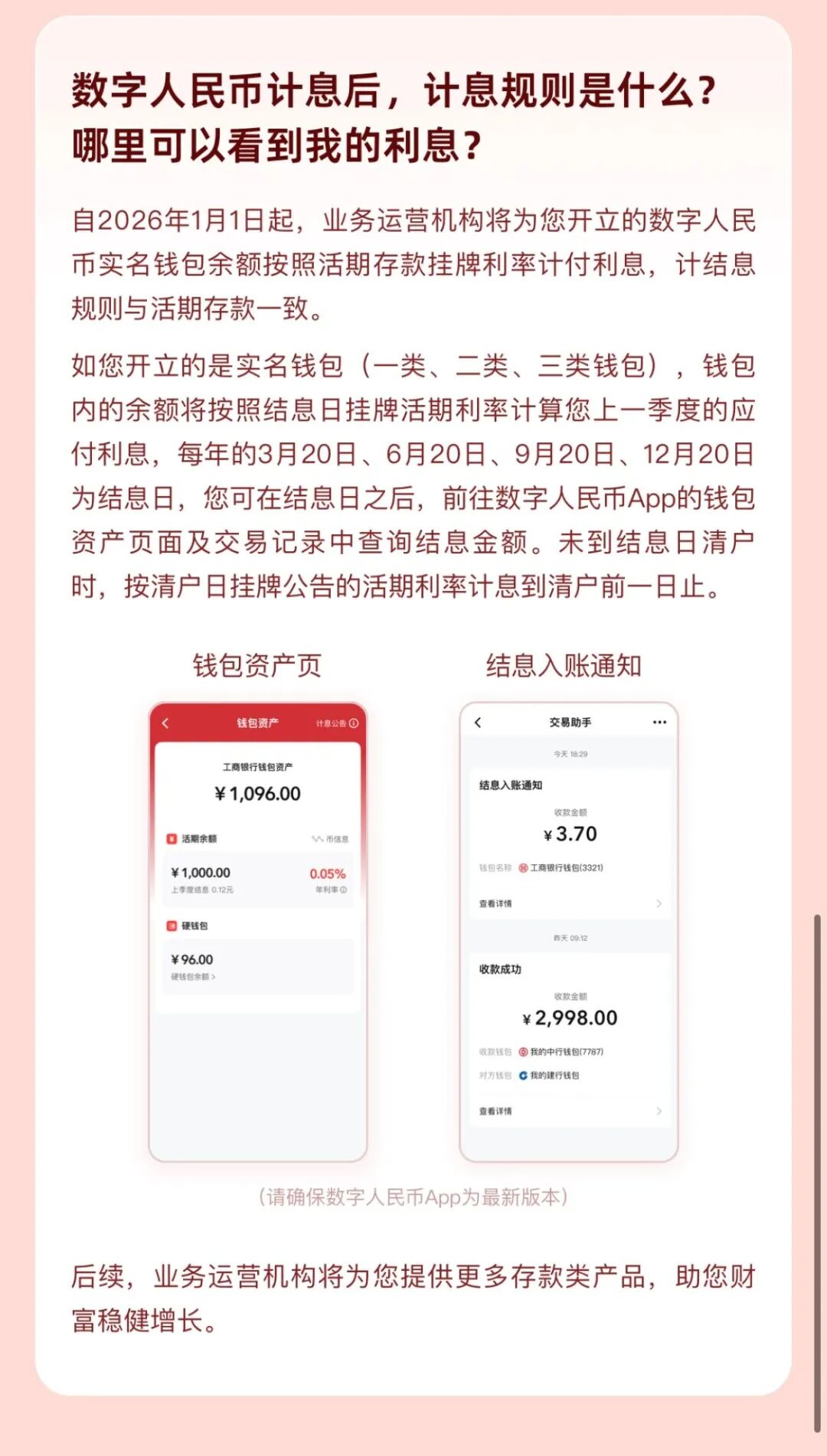
Core Viewpoint - The transition of digital renminbi from cash-type 1.0 version to deposit currency-type 2.0 version will allow for interest payments on real-name digital renminbi wallet balances, aligning with bank demand deposit rates, thus enhancing its appeal and functionality in the financial system [1][8][12]. Group 1: Changes in Digital Renminbi - Starting January 1, 2026, real-name digital renminbi wallet balances will earn interest based on the bank's demand deposit rates, with interest calculated quarterly [1][8]. - The new deposit currency-type 2.0 version will include a "safety net" where commercial banks will manage digital renminbi wallets, ensuring customer security and compliance with regulations [8][9]. - The People's Bank of China has introduced a digital management service framework that emphasizes an "account system + currency string + smart contracts" approach to enhance the digital renminbi ecosystem [9][10]. Group 2: Impacts of the Transition - The shift to deposit currency-type 2.0 version positions China as a leader in central bank digital currency (CBDC) by allowing digital renminbi to integrate more easily into global interbank payment systems [12][13]. - The digital renminbi will improve data flow and information exchange, enhancing the precision and effectiveness of monetary policy transmission [12]. - The transition will provide users with cash-like convenience, such as offline payments and real-time settlements, while banks will gain asset-liability management rights, stimulating participation in the digital renminbi ecosystem [12][13]. Group 3: Recommendations for Future Development - It is suggested to expand the regulatory framework for digital renminbi, clarify its legal status, and broaden the pilot scope nationwide to encourage public participation [13]. - There is a call for accelerating the coverage of all scenarios and enhancing functional innovations to optimize the digital renminbi ecosystem [13].
数字人民币2.0版2026年上线,六大行钱包余额正式计息
Sou Hu Cai Jing· 2026-01-08 04:40
Group 1 - The core upgrade of digital RMB to version 2.0 will take effect from January 1, 2026, allowing major state-owned banks to pay interest on digital RMB wallet balances at the same rate as demand deposits [1] - The upgrade is based on a recent action plan by the People's Bank of China, which states that digital RMB in commercial bank wallets will be treated as bank liabilities, marking a shift from cash-type to deposit currency-type [1] - The liquidity of digital RMB in the banking system is expected to significantly increase with this transition to a deposit currency, encouraging banks to offer more financial services related to digital RMB [1][2] Group 2 - As of November 2025, the digital RMB pilot program has expanded to 26 regions across 17 provinces, processing a total of 3.48 billion transactions amounting to 16.7 trillion yuan [2] - The number of personal wallets opened through the digital RMB app reached 230 million, while corporate wallets totaled 18.84 million [2] - In the cross-border payment sector, the mBridge initiative has processed 4,868 transactions with a total value of approximately 477.8 billion yuan, with digital RMB accounting for about 96% of the transaction volume [2]
数字人民币进入2.0版将带来哪些改变?一文深解
Yang Shi Xin Wen· 2026-01-08 03:31
Core Viewpoint - The introduction of interest on digital renminbi marks its transition from a cash-like currency to a deposit currency, enhancing its functionality and potential for widespread adoption [3][4][5]. Group 1: Digital Renminbi Overview - Digital renminbi is a digital form of legal currency issued by the People's Bank of China, equivalent to physical renminbi, characterized by low cost and fast transaction times [1]. - The digital renminbi can be stored in digital wallets, which are categorized based on user identification levels, allowing for varying transaction limits [2]. Group 2: Transition to Deposit Currency - The new framework for digital renminbi, effective January 1, 2026, establishes it as a commercial bank liability, indicating a shift from cash to deposit currency [3][5]. - This transition allows digital renminbi to earn interest, enabling it to be used for loans and deposits, thus increasing its utility in the banking system [4][6]. Group 3: Banking System Implications - With digital renminbi classified as a bank liability, commercial banks are incentivized to offer more financial services, transforming their role from cost centers to profit centers [5][6]. - The ability to manage digital renminbi as an asset will enhance banks' motivation to promote its use, benefiting both users and banks [6]. Group 4: Adoption and Usage - As of November 2025, digital renminbi trials have successfully processed 34.8 billion transactions, amounting to 16.7 trillion yuan, indicating significant adoption across various sectors [7]. - The digital renminbi is being integrated into cross-border payment systems, with a notable 96% of transactions processed through the mBridge platform involving digital renminbi [8][10]. Group 5: Internationalization Efforts - The year 2025 is pivotal for the internationalization of digital renminbi, with initiatives aimed at enhancing its role in cross-border payments and financial services [10][13]. - Various cross-border applications have emerged, including partnerships with banks in Hong Kong and Singapore, facilitating the use of digital renminbi for overseas transactions [12][13].
数字人民币进入2.0版将带来哪些改变?一文深解→
Yang Shi Xin Wen Ke Hu Duan· 2026-01-08 03:24
Core Insights - Digital Renminbi (RMB) will start accruing interest from January 1, 2026, marking its transition from a cash-like currency to a deposit currency [2][4][5] - The People's Bank of China (PBOC) has established a new management framework for digital RMB, enhancing its integration into the banking system and allowing it to be treated as a bank liability [4][6][7] - The digital RMB is expected to facilitate cross-border payments, reducing costs and transaction times significantly compared to traditional methods [11][12][14] Group 1: Digital RMB Features - Digital RMB is a digital form of legal tender issued by the PBOC, equivalent to physical RMB, with characteristics of value and legal tender [2] - It offers low-cost transactions and quick settlement, especially for small payments, and can be held without a bank account [2][3] - Digital wallets serve as the medium for holding digital RMB, categorized into personal and corporate wallets, and can be either software or hardware-based [3] Group 2: Transition to Deposit Currency - The transition to a deposit currency allows digital RMB to be deposited in banks, enabling it to generate interest, thus enhancing its utility [5][6] - This shift is expected to increase liquidity within the banking system and incentivize banks to offer more financial services related to digital RMB [6][7] - The new framework allows banks to manage digital RMB as an asset-liability, transforming their role from cost centers to profit centers [7] Group 3: Cross-Border Payment Advantages - Digital RMB aims to address the inefficiencies of traditional cross-border payment systems, which are often costly and slow [11] - The use of digital RMB can reduce transaction fees to less than 1/10 of traditional methods and enable near-instantaneous settlement [11] - The establishment of cross-border payment platforms and infrastructure supports the internationalization of digital RMB, enhancing its global reach [13][14] Group 4: Implementation and Adoption - As of November 2025, digital RMB trials have expanded to 26 regions, processing 34.8 billion transactions worth 16.7 trillion RMB [8] - The digital RMB has been successfully integrated into various sectors, including retail, healthcare, and public services, demonstrating its practical application [8] - The digital RMB's international operations are gaining momentum, with successful cross-border payment cases emerging, particularly in Hong Kong and Singapore [13][14]
21社论丨加快推进数字人民币发展
21世纪经济报道· 2026-01-05 00:35
Core Viewpoint - The article discusses the significant transformation of China's digital currency from a cash-based model (1.0 version) to a deposit currency model (2.0 version), which will allow digital yuan wallet balances to earn interest, enhancing its appeal and usability in various financial contexts [1][2]. Group 1: Transition to Deposit Currency - The People's Bank of China (PBOC) has initiated a shift in the digital yuan's framework, allowing wallet balances to earn interest based on the bank's current deposit rates, marking a revolutionary change in its functionality [1][2]. - This transition signifies a change in the legal status of funds in digital yuan wallets from being a liability of the PBOC to a liability of commercial banks, indicating a profound institutional reform [2]. Group 2: Implications for Users and Banks - For individual and corporate users, the ability to earn interest on digital yuan balances will significantly increase their willingness to hold these funds, leading to a broader acceptance among merchants and richer payment scenarios [3]. - Commercial banks will benefit from the digital yuan as a source of usable funds, enhancing their promotional efforts and enabling the development of new financial products, such as exclusive wealth management offerings tied to digital yuan [3]. Group 3: Global Positioning and Future Development - China is positioned as the first major economy to classify central bank digital currency as an interest-bearing deposit currency, strengthening its leadership and influence in global digital currency governance [4]. - The digital yuan's transition to a deposit currency will facilitate its integration into global interbank payment systems, enhancing its utility in cross-border trade and investment [4]. - Future improvements for the digital yuan include establishing a comprehensive regulatory framework, expanding pilot programs nationwide, accelerating multi-scenario coverage, and enhancing user data protection [4].

2026,房地产要下猛药了!辽宁新年第一会今日召开!|栋察楼市早报(1.4)
Sou Hu Cai Jing· 2026-01-04 17:06
Market Insights - The article emphasizes that in 2026, significant measures will be taken to stabilize the real estate market, moving away from incremental policies to more decisive actions [6][10][12] - The commentary from the authoritative publication indicates a major shift in the government's stance on real estate, recognizing its financial attributes and importance to the national economy [3][6] Policy Changes - The article outlines three key points that reflect a reversal of negative perceptions about the real estate sector: acknowledgment of real estate as a financial asset, its role in the national economy, and the need for effective management of market expectations [5][6] - The government recognizes that housing is the most significant asset for ordinary families, and further declines in housing prices could impact social stability [9] Financial Implications - The article mentions that the concentration of household wealth in real estate ranges from 59.1% to 77.2%, significantly higher than the 20% in financial assets [7] - It is anticipated that interest rates on housing loans will decrease, with the latest rates potentially dropping to 3.05% for first-time homebuyers [18][19] Economic Initiatives - The article discusses the launch of a consumption subsidy program in Liaoning, with over 12 million yuan allocated on the first day, aimed at stimulating consumer spending through various categories including home appliances and vehicles [28][29] - The program is expected to benefit over 20,000 consumers, with a total subsidy fund of 1,223 million yuan on the first day [28] Digital Currency Developments - Starting January 1, 2026, digital yuan wallets will earn interest, marking a transition from a cash-based system to a deposit currency model [33][34] - This change is expected to enhance user engagement with digital yuan and expand its application scenarios, solidifying China's leadership in central bank digital currency initiatives [34][41]
2026年起数字人民币余额生息,实名钱包享活期利息
Sou Hu Cai Jing· 2025-12-31 10:02
Core Viewpoint - Starting from January 1, 2026, interest will be paid on the balances of real-name digital RMB wallets, as announced by six major state-owned commercial banks in China [1][3]. Group 1: Interest Payment Arrangement - Customers with real-name digital RMB wallets at the specified banks will receive interest based on the banks' published demand deposit rates, with interest calculation rules consistent with traditional demand deposits [3]. - For example, Industrial and Commercial Bank of China (ICBC) will settle interest quarterly, with the interest credited on the 21st of each quarter's last month [3]. - The interest payment arrangement applies only to real-name wallets, while anonymous wallets will not earn interest [3]. Group 2: Regulatory Framework - This adjustment is part of the People's Bank of China's recent action plan aimed at enhancing the management and service system for digital RMB, which will officially launch on January 1, 2026 [3]. - The plan stipulates that banks must pay interest on real-name digital RMB wallet balances and adhere to self-discipline agreements on deposit interest rate pricing [3]. Group 3: Transition to Deposit Currency - The new system marks a transition of digital RMB from a cash-like version 1.0 to a deposit currency version 2.0, allowing banks to manage digital RMB wallet balances as liabilities [4]. - Digital RMB wallets will be insured similarly to traditional deposits, providing customers with equivalent safety guarantees [4]. - Currently, there are ten designated operating institutions for digital RMB, including the six major state-owned banks and several other commercial and internet banks [4].

数字人民币迎来2.0版
Jing Ji Ri Bao· 2025-12-30 22:07
Core Insights - The People's Bank of China will officially implement a new digital RMB measurement framework, management system, operational mechanism, and ecosystem starting January 1, 2026, marking a significant transition from digital cash to digital deposit currency [1][2] Group 1: Digital RMB Development - The new action plan allows banks to pay interest on customer-held digital RMB wallet balances, enhancing the appeal of digital RMB for users [1][2] - As of November 2025, digital RMB has processed 3.48 billion transactions, amounting to 16.7 trillion yuan, with 230 million personal wallets opened [1] Group 2: Institutional Changes - The digital RMB will transition from a cash-based model to a deposit currency model, with wallets classified as bank liabilities, thus incentivizing banks to promote digital RMB [2][3] - The action plan integrates digital RMB into the reserve requirement framework, ensuring its safety and stability, which is expected to encourage more merchants to accept digital RMB [2][3] Group 3: Ecosystem and Market Impact - The new framework is designed to create a win-win situation for users, banks, and non-bank payment institutions, promoting deeper integration of digital RMB into the existing payment system [4] - The establishment of a standardized operational framework for digital RMB is expected to provide clarity for banks and payment institutions, facilitating commercial implementation [4]