数字化运营管理

Search documents
工业互联网产业联盟:2025年高标准数字园区建设研究报告
Sou Hu Cai Jing· 2025-12-15 06:12
Core Insights - The report emphasizes the necessity of digital transformation in industrial parks to enhance core competitiveness in the context of the digital economy reshaping global competition [12][17] - It distinguishes high-standard digital parks from traditional digital parks, focusing on large-scale industrial transformation, precise services, and refined governance through cross-enterprise collaboration and intelligent management [12][19] Group 1: Digital Transformation in Industrial Parks - The digital transformation of industrial parks is essential for adapting to global industrial structure adjustments and technological revolutions, enabling resource optimization and innovation [12][18] - The report outlines the current status, trends, and challenges of digital transformation in industrial parks, providing a comprehensive framework for high-standard digital parks [12][18] Group 2: Characteristics of High-Standard Digital Parks - High-standard digital parks aim for large-scale industrial transformation, promoting collaborative innovation across multiple enterprises rather than focusing solely on individual enterprise upgrades [19][20] - They offer customized digital services and emphasize precise governance, utilizing digital technologies for intelligent management of park operations [20][21] Group 3: Key Tasks and Models for Transformation - The report identifies four typical models to address the digital transformation challenges faced by small and medium-sized enterprises (SMEs), including leading enterprises driving collaborative transformation and parks providing inclusive public services [23][24] - It highlights the importance of integrating digital platforms to facilitate efficient supply-demand matching and support SMEs in their transformation processes [29][30] Group 4: Infrastructure and Management Framework - High-standard digital parks adopt a three-layer architecture consisting of infrastructure, platform, and application layers, focusing on advanced networks, smart terminals, and integrated data services [2][14] - The report suggests overcoming technical, managerial, and resource integration challenges to build a new generation of infrastructure and enhance data governance [2][21]


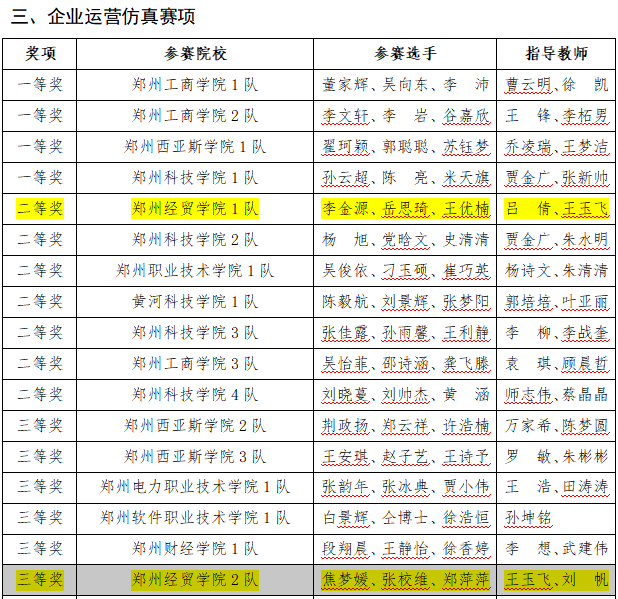
郑州经贸学院:学子在第九届郑州地方高校职业技能竞赛企业运营仿真赛荣获佳绩
Sou Hu Cai Jing· 2025-12-13 05:19
Core Insights - The 9th Zhengzhou Local University Vocational Skills Competition in Enterprise Operation Simulation concluded successfully, showcasing the strong professional skills and innovative capabilities of students from Zhengzhou University of Economics and Trade [1][5] - A total of 19 teams participated in the competition, with 4 first prizes, 7 second prizes, and 10 third prizes awarded [1][3] Awards Summary - First Prize Winners: Zhengzhou Business College (2 teams), Zhengzhou Sias University (1 team), Zhengzhou Technology College (1 team) [2] - Second Prize Winners: Zhengzhou University of Economics and Trade (1 team), Zhengzhou Technology College (2 teams), Zhengzhou Vocational Technical College (1 team), Huanghe Science and Technology College (1 team), Zhengzhou Sias University (1 team), Zhengzhou Business College (2 teams), Zhengzhou Technology College (1 team) [2] - Third Prize Winners: Zhengzhou Sias University (2 teams), Zhengzhou Electric Power Vocational Technical College (1 team), Zhengzhou Software Vocational Technical College (1 team), Zhengzhou Finance College (1 team), Zhengzhou University of Economics and Trade (1 team) [2] Competition Focus - The competition emphasized the integration of multiple disciplines and collaborative innovation, aiming to enhance digital operation levels and strengthen sustainable development awareness [3] - Students engaged in practical operations that involved reshaping business processes using enterprise data resources and digital tools, thereby deepening their understanding of professional knowledge and improving practical skills [3]
北汽福田与东南亚矿业大客户签署125台重卡订单
Zheng Quan Ri Bao Wang· 2025-09-23 12:49
Group 1 - Beiqi Foton Motor Co., Ltd. has signed an important cooperation agreement with a major Southeast Asian mining client, involving an order of 125 AUMAN C vehicles, with the first batch of 20 vehicles successfully delivered [1][2] - The cooperation marks a new phase in efficient, stable, and energy-saving mining transportation equipment in the Southeast Asian market, where the client has high demands for vehicle stability and uptime under complex working conditions [1][2] - The local team of Beiqi Foton utilized prior route testing, comprehensive fuel consumption analysis, and emergency maintenance drills to transition from prototype testing to small batch deployment, culminating in this bulk order [1][2] Group 2 - To achieve the goal of "delivery and immediate operation," Beiqi Foton has introduced three service assurance measures, including a 24/7 technical support team and customized maintenance plans to minimize unplanned downtime [2] - Beiqi Foton will launch two enhanced configuration models in batches to meet varying mining conditions and transport intensity, including a model designed for heavy loads and harsh terrains, and another equipped with a hydraulic retarder to address heat fade issues during long downhill driving [2] - A digital operation management system has been developed to focus on key metrics such as "ton-kilometer cost" and "fleet turnover efficiency," providing real-time monitoring and preventive maintenance suggestions [2][3] Group 3 - The collaboration between Beiqi Foton and the mining client has entered an accelerated phase, with reliable product performance, agile service response, and data-driven management capabilities aimed at converting transportation and fuel usage into tangible benefits [3]

数字化运营管理构建企业数字化运营新体系
Sou Hu Cai Jing· 2025-05-10 05:38
Group 1 - The core viewpoint emphasizes the urgent need for enterprises to innovate their operational models in the context of deepening industrial internet, with digital operation management becoming a key driver for digital transformation [1][3] - Digital operation platforms serve as crucial support for enterprises, enabling new dynamics in organizational management, business collaboration, and customer engagement, thus promoting the evolution of management logic and supply chain structure [1][3] Group 2 - The industrial internet provides a technological foundation for data perception, system integration, and process optimization, making it an important basis for implementing digital operation management [3][4] - Digital operation platforms connect production processes with management centers, facilitating a closed-loop operation from data collection to decision execution, enhancing flexibility and controllability in response to market changes and customer demands [3][4] - In practical applications, digital operation management demonstrates a high degree of integration, allowing manufacturing enterprises to monitor key indicators like equipment status and energy consumption in real-time through a unified management interface [3][4] Group 3 - Digital operation platforms not only aggregate information but also support strategic collaboration by creating a unified organizational management framework, breaking down hierarchical barriers, and enabling data interconnectivity across the supply chain [3][4] - The platforms enhance efficient collaboration among business units through task boards, process engines, and performance management modules, leading to a more orderly overall operation [3][4] Group 4 - Enterprises can integrate sensors and control systems with digital operation platforms to establish an industrial-grade data collection system, allowing for more granular control in digital operation management [4] - This deep integration enables intelligent responses to material consumption, quality traceability, and predictive maintenance, enhancing the ability of enterprises to manage risks and changes [4] Group 5 - Building scalable digital operation platforms is essential for enterprise development, utilizing microservices, data middle platforms, and low-code tools to achieve multi-system collaboration and flexible deployment [4] - The modular design allows enterprises to deploy systems as needed at different stages, avoiding redundancy and improving the effectiveness of digital operation management [4] Group 6 - User connectivity is a vital component of digital operation, with platforms capturing user behavior across touchpoints to create user profiles, facilitating personalized services [4] - This user-centric digital operation management model enhances overall customer experience and repurchase rates through customized product recommendations and content delivery [4] Group 7 - In the future, enterprises will continue to deepen their understanding and practice of digital operation management, driven by the industrial internet and digital technologies [4] - The evolution of digital operation platforms will increasingly feature intelligent characteristics, incorporating new technologies like artificial intelligence and edge computing to enhance responsiveness to business changes [4]