
新型储能容量电价机制

Search documents
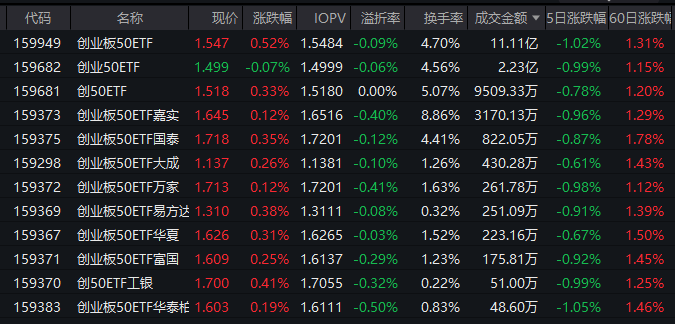
储能迎来全国性容量电价机制,创业板50ETF(159949)半日成交超11亿元领跑同类
Xin Lang Cai Jing· 2026-02-03 04:27
Core Viewpoint - The latest quarterly report indicates a mixed performance among the top ten holdings of the ChiNext 50 ETF (159949), with significant fluctuations in stock prices and a new national capacity pricing mechanism for energy storage expected to boost investment in the sector [1][2][8]. Group 1: Stock Performance - The top ten holdings of the ChiNext 50 ETF showed varied performance, with notable declines in stocks like Ningde Times (down 1.04%) and Xinyi Technology (down 4.13%), while Tianfu Communication surged by 9.14% [1][4]. - The total market value of the top ten holdings is approximately 21.08 billion yuan, accounting for 69.05% of the ETF's net value [2][8]. Group 2: Policy Impact - The National Development and Reform Commission and the National Energy Administration have introduced a national capacity pricing mechanism for new energy storage, which is expected to shift the revenue model from solely energy trading to a combination of capacity pricing and spot trading [2][8]. - The internal rate of return (IRR) for projects is projected to increase from 6%-8% to 12%-15% following the implementation of this mechanism, which is anticipated to accelerate investment in energy storage projects [2][8]. Group 3: Industry Trends - Sodium batteries are gaining traction due to their advantages in low-temperature performance, safety, and cost potential, with predictions that they will replace or supplement lead-acid and some lithium batteries by 2026 [3][9]. - The market is expected to see a recovery in performance as policy catalysts emerge, particularly with the upcoming Two Sessions, while the semiconductor and AI industry chains remain key areas of focus for growth [3][9]. Group 4: ETF Overview - The ChiNext 50 ETF tracks the ChiNext 50 Index, which consists of 50 stocks selected for their large scale, good liquidity, and technology growth characteristics, achieving a return rate of 34.36% over the past three years [10]. - Investors can trade the ETF directly or through linked funds, with recommendations for dollar-cost averaging to mitigate short-term volatility [10].


科创新能源ETF(588830)涨超3.2%,行业需求有望爆发
Xin Lang Cai Jing· 2026-02-03 02:42
Group 1 - The National Development and Reform Commission has issued a notice to establish an independent new energy storage capacity pricing mechanism based on coal power capacity pricing standards, which is a significant strategic move [1] - The capacity pricing calculation will be based on local coal power capacity pricing standards (RMB 165-330 per kW per year), adjusted by peak capacity and other factors, with project lists to be determined by provincial energy authorities [1] - The introduction of this mechanism is expected to accelerate the construction progress of some previously paused energy storage projects [1] Group 2 - Multiple provinces are expected to introduce corresponding energy storage capacity pricing policies, leading to a surge in demand [2] - The subsidy standard for energy storage is projected to be RMB 193 per kW for a 4-hour storage duration, with an internal rate of return (IRR) of 8-9%, meeting the return requirements of funding parties [2] - The new energy storage capacity is expected to grow from 183 GWh in 2025 to 275 GWh in 2026, driven by a potential stabilization of lithium carbonate prices [2] Group 3 - As of January 30, 2026, the top ten weighted stocks in the Sci-Tech Innovation Board New Energy Index account for 46.03% of the index, including major companies like Trina Solar and JinkoSolar [3] - The Sci-Tech Innovation New Energy ETF closely tracks the performance of the Sci-Tech Innovation Board New Energy Index, which includes 50 large-cap stocks in solar, wind, and electric vehicle sectors [2][4]
首次被纳入容量电价机制 新型储能商业回报模式有望获得制度性保障
Zheng Quan Ri Bao Zhi Sheng· 2026-02-01 16:05
Group 1 - The National Development and Reform Commission and the National Energy Administration issued a notice to improve the capacity pricing mechanism for power generation, which includes coal, natural gas, pumped storage, and new energy storage [1] - The notice establishes a capacity pricing mechanism for independent new energy storage on the grid side, providing stable revenue expectations for energy storage stations, which is expected to attract more capital and promote the marketization and scaling of new energy storage [1][2] - The new policy framework allows for a dual profit model of "capacity revenue + energy revenue," breaking the previous single revenue model based solely on energy trading [2] Group 2 - By the end of 2025, the installed capacity of new energy storage in China is expected to grow by 84% compared to the end of 2024, with an average storage duration of 2.58 hours, an increase of 0.30 hours [3] - The capacity pricing mechanism is anticipated to significantly expand investment in new energy storage projects, driving demand across the entire supply chain, including upstream materials, midstream equipment, and downstream operations [3] - Companies in the new energy storage industry are accelerating their business layouts, focusing on new product development and project implementation to seize market opportunities [3][4] Group 3 - Southern Power Grid Storage Co., Ltd. is actively promoting the high-quality development of its new energy storage business and is involved in projects in Malaysia and Saudi Arabia [4] - Hunan YN Energy Battery Material Co., Ltd. has seen a rapid increase in the shipment proportion of its new products that align with market trends in energy storage batteries [4] - CATL has introduced a specialized energy storage cell with a capacity of 587Ah, focusing on energy density, safety, and longevity, and is accelerating its mass production to meet market demand [5]
两部门发布通知要求 建立电网侧独立新型储能容量电价机制
Zheng Quan Ri Bao· 2026-01-30 16:08
Core Viewpoint - The National Development and Reform Commission and the National Energy Administration have issued a notice to establish an independent capacity pricing mechanism for grid-side new energy storage, aiming to enhance the current capacity pricing mechanisms for coal, gas, and pumped storage power generation to adapt to new market conditions [1][2]. Group 1: Capacity Pricing Mechanism - The notice proposes that local governments can provide capacity pricing for grid-side independent new energy storage power stations that contribute to the safe operation of the power system [1]. - The proportion of fixed cost recovery for coal power units will be increased to no less than 50%, equating to 165 yuan per kilowatt annually [1]. - A gas power capacity pricing mechanism will be established based on the pricing method of coal power capacity [1]. Group 2: Pumped Storage - The notice refines the capacity pricing mechanism for pumped storage, maintaining the existing pricing for projects started before the 2021 guidelines, while new projects will adopt a "one province, one price" approach [2]. - Local governments will set a unified capacity price based on average cost recovery principles, allowing power stations to participate in the electricity market and share the revenue with users [2]. Group 3: Grid-Side Independent New Energy Storage - Local governments can establish a capacity pricing mechanism for grid-side independent new energy storage based on local coal power capacity pricing standards, considering discharge duration and peak contribution [2]. - The new energy storage capacity pricing will reflect the actual contribution to peak load support, linking the pricing to continuous discharge hours and the duration of peak load periods [2][3]. - The commercial model for grid-side independent new energy storage focuses on serving the power system without specific beneficiaries, generating revenue through participation in the electricity spot market and ancillary service market [3].
新型储能容量电价机制破局:各省政策盘点与发展趋势前瞻
中关村储能产业技术联盟· 2025-11-27 08:36
Core Viewpoint - The article emphasizes the urgent need to establish a new capacity pricing mechanism for energy storage in China to support the growing demand for renewable energy and ensure grid stability [2][8]. Group 1: New Energy Storage Capacity Support - The construction of a new power system in China is accelerating under the "dual carbon" goals, with significant increases in installed capacity for wind and solar energy. However, the intermittent and volatile nature of these energy sources poses challenges for grid capacity during peak load periods [6][8]. - In 2023, the State Grid's summer peak demand for new energy storage reached a maximum discharge capacity of 44.53 GW, equivalent to nearly three Three Gorges hydropower stations, providing substantial support during evening peak electricity usage [7]. Group 2: Need for Capacity Mechanism - The previous revenue models for independent energy storage included energy market revenue, ancillary service market revenue, capacity leasing revenue, and compensation revenue in some regions. However, recent policy changes have significantly impacted the demand and pricing space for capacity leasing, making it difficult for independent storage projects to cover their investment and operational costs [9]. - The current market rules do not fully reflect the value of new energy storage capacity, which could deter social capital investment and affect the stability of electricity supply and grid operations [9]. Group 3: Provincial Capacity Compensation Policies - Multiple provinces in China have begun to implement capacity compensation policies for new energy storage to address the lack of revenue mechanisms. These policies primarily adopt capacity compensation mechanisms, transitioning towards capacity market mechanisms in the future [12]. - Compensation methods vary across provinces, including: 1. **Discharge Volume Compensation**: Inner Mongolia has set a compensation standard of 0.35 CNY/kWh for 2025, while Xinjiang's compensation starts at 0.2 CNY/kWh in 2023, decreasing annually [13][14]. 2. **Capacity Compensation**: Hebei has established a capacity price of 100 CNY/kW for projects connected to the grid by May 31, 2024, with a gradual reduction thereafter [14]. 3. **Mixed Compensation**: Shandong and Gansu have implemented compensation mechanisms that consider both discharge and capacity [15][16]. Group 4: Summary and Outlook - The ongoing exploration of capacity compensation policies across various provinces is accumulating valuable practical experience for establishing a unified national capacity pricing mechanism. However, significant differences in compensation forms and fee structures exist, and many provinces have yet to implement such policies [17]. - It is recommended to adopt a phased and regional approach to policy implementation, considering local power supply and demand characteristics, to lay the groundwork for future market-based capacity trading [17].

《关于促进新能源消纳和调控的指导意见》政策解读
2025-11-11 01:01
Summary of Key Points from the Conference Call Industry Overview - The discussion revolves around the **new energy sector**, specifically focusing on the **capacity pricing mechanism** and its implications for **energy storage** and **renewable energy** consumption. Core Insights and Arguments 1. **Capacity Pricing Mechanism Implementation** The national policy promotes a capacity pricing mechanism aimed at effectively transmitting market price signals to end users, with provinces allowed to set their own prices based on local conditions [2][4][18] 2. **Impact on Residential Electricity Prices** The introduction of a time-of-use pricing mechanism will not directly lead to an overall increase in residential electricity prices, although adjustments to peak and valley pricing systems may occur [3][18] 3. **Revenue Sources for Energy Storage** Capacity subsidies or energy consumption subsidies have a relatively minor impact on the revenue of energy storage stations, with independent storage primarily relying on spot market arbitrage rather than capacity price subsidies [1][6] 4. **Optimization of Energy Storage Utilization** To enhance the utilization rate of energy storage paired with renewable energy, it is necessary to optimize scheduling mechanisms, allowing renewable energy plants to autonomously declare output curves [1][7] 5. **Long-term Sustainability of Independent Storage** The capacity market mechanism will provide long-term sustainable revenue guarantees for independent storage, similar to the treatment of thermal power plants, offering investors more certainty [11] 6. **Expected Growth in New Energy Installations** It is anticipated that new energy installations will grow by approximately 50% by 2026, necessitating a solution to the consumption issue to meet the national target of 3,600 GW installed capacity by 2035 [3][19] 7. **Adjustments to Existing Capacity Compensation Policies** Existing capacity compensation policies in various provinces will be adjusted to align with the new national guidelines, transitioning from generation-side to consumption-side transmission [4][5] 8. **Differences in Revenue Models Across Provinces** The capacity subsidy policies will vary by province, with regions like Jiangsu and Zhejiang requiring higher subsidies to stimulate independent storage development due to lower spot market income [10] 9. **Challenges in Current Policy Environment** Current scheduling regulations limit the autonomous adjustment capabilities of renewable energy sources, but new policies aim to revise these management systems to enhance consumption efficiency [13] 10. **Quality Improvement of Energy Storage Stations** The quality of energy storage stations has significantly improved since 2023, particularly in western provinces, addressing previous issues of low availability and operational inefficiency [14][15] Other Important Insights - **Market Dynamics** The introduction of independent storage is not expected to significantly squeeze the market capacity for independent storage, as the economic viability of integrated storage projects remains limited [16] - **Impact of Coal Power Pricing** The increase in coal power capacity pricing is leading to a decline in the competitiveness of coal power, with new electricity demand being met primarily by renewable sources [21] - **Future Policy Developments** Many provinces are expected to release detailed policies regarding the capacity pricing mechanism in the coming months, with a focus on ensuring that the costs are shared among commercial and residential users [18]