
新能源购置税退坡

Search documents
一月重卡销量解读
数说新能源· 2026-02-03 02:57
Summary of Key Points Core Viewpoint - The automotive market in China is expected to experience a strong start in 2026, with wholesale sales in January reaching 100,000 units, a year-on-year increase of 39%, while terminal sales are projected to decline by 5%-10% [1] Group 1: Market Overview - In January 2026, domestic wholesale sales reached 100,000 units, showing a year-on-year growth of 39% and remaining stable compared to the previous month [1] - Terminal sales are estimated to be between 30,000 to 31,000 units, reflecting a decrease of 5%-10% year-on-year [1] - Export sales exceeded 26,000 units, marking a year-on-year growth of over 20% [1] - The high growth in wholesale sales is partially attributed to differences in sales settlement cycles among various manufacturers [1] - The continuation of the vehicle trade-in policy and expected subsidies post-Chinese New Year are anticipated to support domestic sales in Q1 2026 [1] - The low base in overseas markets, combined with high demand in Asia and Africa, is expected to sustain high growth in exports [1] Group 2: Structural Changes - The new energy vehicle (NEV) segment has seen a significant decline, while natural gas vehicle sales have shown some recovery [2] - By the end of 2025, the vehicle trade-in policy and the reduction of NEV purchase tax led to a substantial drop in new energy heavy truck sales, with January 2026 sales around 7,000 units and a penetration rate of approximately 22% [2] - Following the implementation of subsidies after the holiday, the NEV penetration rate is expected to return to a stable rate of over 28% in the second half of 2025, with an annual target of 33% for 2026 [2]


9月造车新势力放榜:零跑破6万辆领跑,蔚来、小鹏创新高
Ge Long Hui A P P· 2025-10-01 09:48
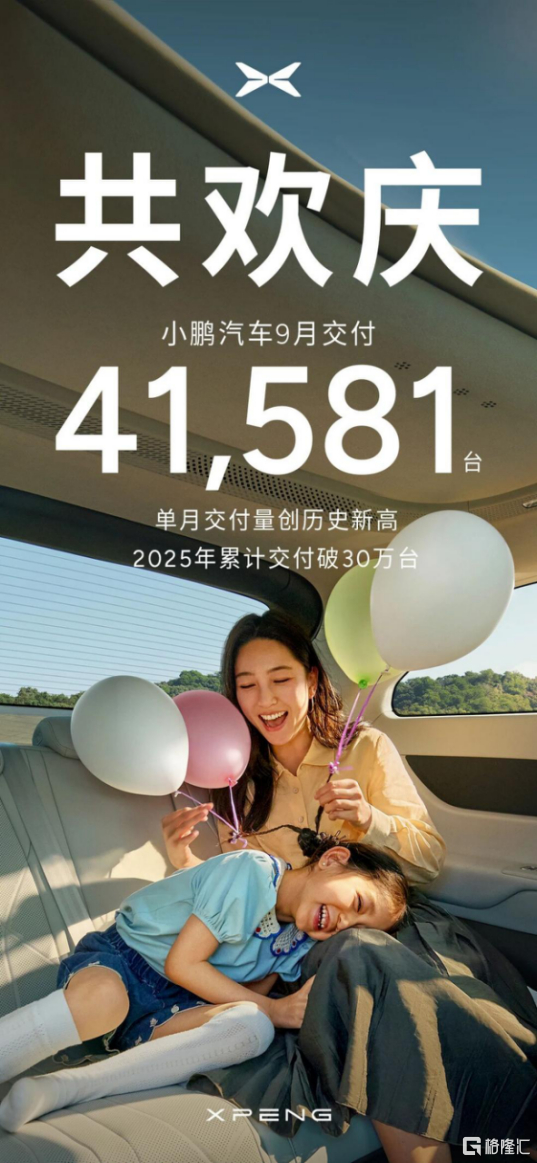
Group 1: Industry Overview - The automotive market in September is a critical period for sales, with over 30 brands launching more than 40 new models, intensifying competition [30][31] - The release of new models is driven by multiple factors, including the upcoming reduction of new energy vehicle purchase tax in 2026, prompting companies to compete for market share in the fourth quarter [32] - Government policies, such as personal consumption loan interest subsidies and local incentives, are influencing consumer purchasing behavior [33][34] Group 2: Company Performance - Xiaopeng Motors delivered 41,581 vehicles in September, marking a 95% year-on-year increase and a 10% month-on-month increase, with total deliveries for the year reaching 313,196 units, up 218% [2][5] - Leap Motor achieved a record delivery of 66,657 vehicles in September, the highest monthly delivery for any new energy vehicle brand in China [6][10] - Li Auto delivered 33,951 vehicles in September, a 19% increase from August, with total deliveries surpassing 1.43 million units [11][14] - NIO delivered 34,749 vehicles in September, a 64% year-on-year increase, with cumulative deliveries reaching 872,785 units [16][18] - Lantu Motors delivered 15,224 vehicles in September, a 52% year-on-year increase, with total deliveries for the year reaching 96,992 units [20][23] - Xiaomi Motors reported over 40,000 vehicle deliveries in September, marking its first month surpassing this threshold [24][26] - Zeekr Technology sold 51,159 vehicles in September, an 8.5% year-on-year increase, maintaining over 40,000 monthly sales for seven consecutive months [28][29]


港股异动 | 汽车股今日普跌 市场预期明年新能源购置税退坡 机构称或刺激四季度额外需求增量
Zhi Tong Cai Jing· 2025-09-18 07:52
Core Viewpoint - The automotive sector is experiencing a decline, particularly in electric vehicle stocks, as the exemption from vehicle purchase tax for new energy vehicles in China is set to end this year, leading to potential increased demand in the fourth quarter [1] Group 1: Stock Performance - Xpeng Motors (09868) fell by 3.95%, trading at HKD 81.55 [1] - GAC Group (02238) decreased by 2.57%, trading at HKD 3.41 [1] - Li Auto (02015) dropped by 2.49%, trading at HKD 101.9 [1] - Great Wall Motors (02333) declined by 1.26%, trading at HKD 17.26 [1] Group 2: Policy Changes - 2023 is the last year for the exemption of vehicle purchase tax on new energy vehicles in China, with the tax set to be reinstated next year [1] - From January 1, 2026, to December 31, 2027, new energy vehicles will be subject to a 50% reduction in vehicle purchase tax [1] Group 3: Market Outlook - A report from Galaxy Futures indicates that the "Automotive Industry Stability Growth Work Plan (2025-2026)" aims for new energy vehicle sales to reach approximately 15.5 million units in 2025, representing a year-on-year growth of about 20%, which is below the initial forecast of 16 million units by the China Association of Automobile Manufacturers [1] - The expectation of increased demand in the fourth quarter may exceed the outlined targets due to the last year of full exemption from the purchase tax [1] - CITIC Construction Investment suggests that the industry may experience a "golden September and silver October" trend, supported by the implementation of national subsidies and the anticipation of a decline in new energy vehicle purchase tax [1]