
新质生产力企业

Search documents
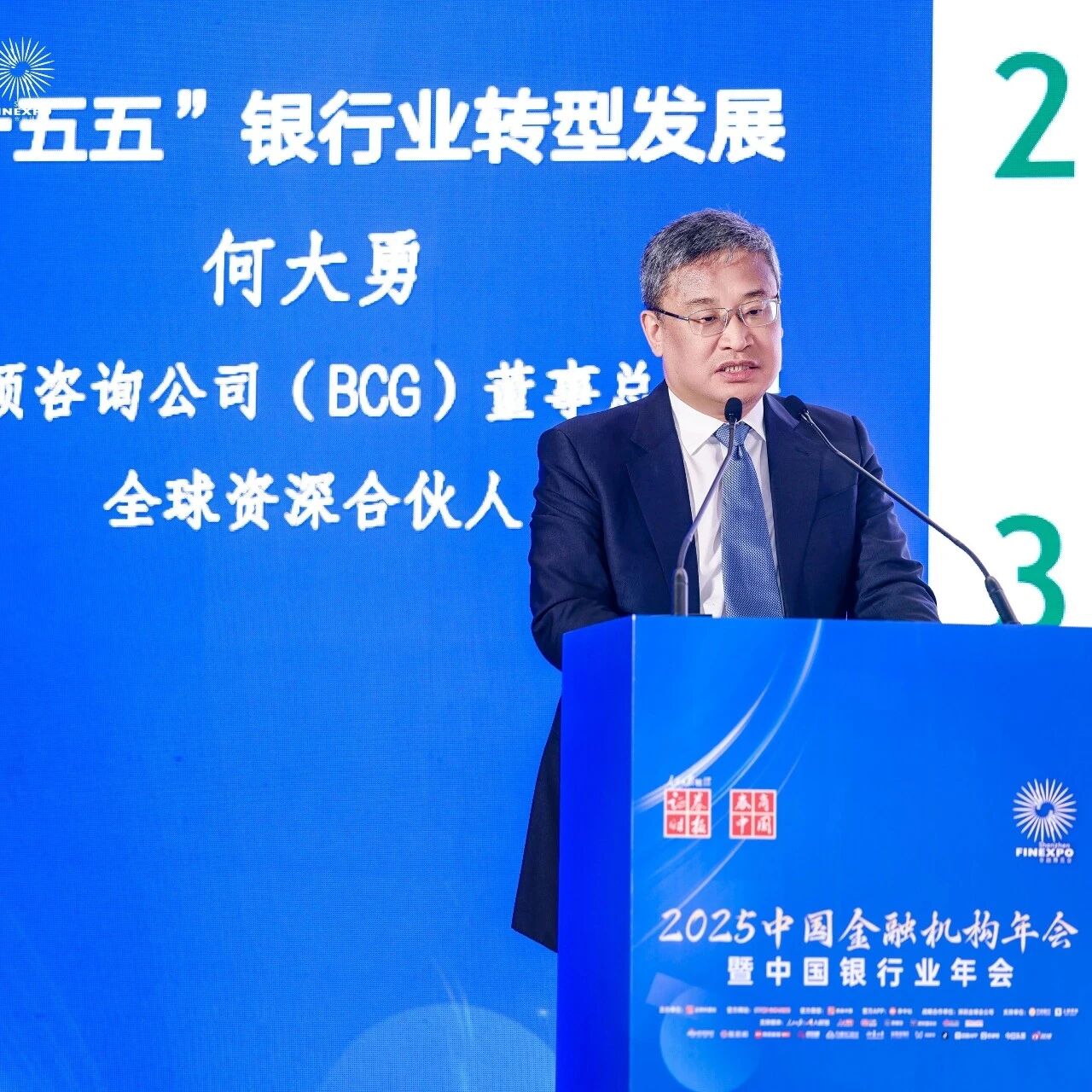
BCG董事总经理、全球资深合伙人何大勇: 两大业务决定银行未来站位
Zheng Quan Shi Bao· 2025-12-04 18:01
Core Insights - The "19th Shenzhen International Financial Expo and 2025 China Financial Institutions Annual Conference" highlighted challenges and opportunities in the banking sector during the "14th Five-Year Plan" period, particularly focusing on declining Return on Equity (ROE) and increasing Matthew Effect [1] Group 1: Industry Challenges - The banking industry is expected to face continuous decline in ROE and intensified competition during the "14th Five-Year Plan" period [1] - The major challenges include the need to adapt to changing market conditions and the pressure to maintain profitability [1] Group 2: Growth Opportunities - Significant growth opportunities are identified in two main areas: corporate business focusing on industrial finance and the digital transformation of retail banking [1] - Industrial finance clients are characterized by long supply chains, high transaction volumes, and substantial deposit retention, making them a crucial growth point for banks [1] Group 3: Strategic Recommendations - Banks are advised to focus on "strong headquarters and strong brain," emphasizing the need for headquarters to take the lead in industry insights, operational strategy design, process supervision, marketing support, and tool development [1] - The ability to seize industrial finance opportunities and achieve a qualitative transformation in retail digital operations will determine banks' positioning in a differentiated market over the next five years [1]
波士顿咨询何大勇:产业金融、数字化经营是“十五五”银行业转型两大突破口
券商中国· 2025-11-27 03:26
Core Viewpoint - The banking industry will face challenges such as declining ROE and intensified Matthew effect during the "14th Five-Year Plan" period, with significant growth opportunities in corporate business focusing on industrial finance and digital transformation of retail business [3][4]. Corporate Business Focus on Industrial Finance - The banking sector's external environment will present both challenges and opportunities, influenced by trade conflicts, real estate price trends, and advancements in AI infrastructure investment [4]. - Industrial finance is identified as the primary growth area for corporate business, as traditional financial markets and retail banking have reached their peak [4][5]. - The transformation of traditional manufacturing industries will be a major source of growth, with over 50% of the modern industrial system comprising traditional industries that require technological upgrades [5]. - Approximately 30,000 new quality productivity enterprises are becoming key targets for government and capital market funding, covering 300 sectors, which will shape the banking sector's client base for the next decade [5][6]. Retail Business Digital Transformation - Although revenue growth in retail banking is limited, there is significant potential for efficiency improvements through digital transformation [7]. - Retail banking is undergoing three major shifts: from experience-driven to data-driven, from a branch-centric model to a hybrid model incorporating mobile banking, and from branch-led marketing to a combination of top-down and bottom-up management [7][8]. - Leading banks are transforming mobile banking into a marketing and advisory platform, with some banks reporting that mobile banking contributes up to one-third of their AUM growth [7][8]. - The need for a robust digital marketing strategy is emphasized, with significant disparities in automation levels among banks, affecting their marketing effectiveness [8]. Strategic Recommendations - Future reforms should treat mobile banking sections as independent branches, with clear operational metrics and strategies [8]. - The establishment of agile mechanisms within technology departments is crucial for the success of retail digital transformation [8]. - The "ROE defense battle" is highlighted as a pressing challenge for the banking industry over the next five years, with the ability to seize industrial finance opportunities and achieve a qualitative leap in retail digital operations being critical for competitive positioning [8].

清华大学五道口金融学院副院长张晓燕:构建中小企业全生命周期服务生态
Zhong Guo Zheng Quan Bao· 2025-11-15 01:40
Core Viewpoint - The Beijing Stock Exchange (BSE) has played a crucial role in the healthy, stable, and sustainable development of China's capital market over the past four years, particularly in serving innovative small and medium-sized enterprises (SMEs) [1] Group 1: BSE's Impact on SMEs - The BSE has established a system that directly links technological innovation capabilities with capital market access, effectively guiding social capital towards the technology innovation sector [2] - The BSE provides valuable and efficient direct financing channels for innovative SMEs, alleviating their funding bottlenecks and supporting their technological research, capacity expansion, and market development [2] - The differentiated listing standards designed by the BSE fundamentally change the evaluation system for innovative SMEs, considering multiple dimensions such as growth potential, R&D investment, and market value, rather than solely focusing on profits [3] Group 2: Financing Efficiency and Innovation - The "small and fast" review process effectively addresses the urgent financing efficiency needs of innovative SMEs, significantly shortening the time from application to listing and reducing costs [3] - The BSE's institutional innovations have alleviated the financing bottlenecks faced by technology innovation enterprises during the results transformation phase, improving the traditional financial evaluation system's time and value mismatches [3] - BSE-listed companies have increased their R&D investment for three consecutive years, with total R&D investment exceeding 9.1 billion yuan in 2024 and nearly 7,000 invention patents by year-end [3] Group 3: Quality and Governance - The BSE's high-quality expansion and enhancement of listed company quality are interrelated, emphasizing the need for a multi-dimensional listing standard focused on specialized and innovative attributes [4] - Improving corporate governance and enhancing investment value are key to raising the quality of listed companies, which includes fostering a culture of respect and return to investors and establishing clear dividend policies [4] Group 4: AI and Technological Empowerment - AI technology is providing new pathways for financing innovative SMEs by improving financing efficiency through assistance in preparing financing materials and matching investors [4] - AI can replace real estate collateral with data credit, transforming business activities and technological potential into quantifiable capital, thus addressing the financing challenges faced by innovative SMEs [4] - The BSE can utilize AI to establish a technology innovation assessment system for listing reviews and ongoing supervision, enhancing the precision of regulatory resources [5] Group 5: Risk Monitoring and System Optimization - A dynamic risk monitoring and early warning system based on multi-source data integration can be developed to identify potential operational anomalies and risks early [6] - The BSE aims to create a comprehensive, digital service system that enhances the functions of the New Third Board and focuses on key areas such as refinancing and mergers and acquisitions [6] Group 6: Dual-Drive Reform - The BSE has significant room for development, and during the 14th Five-Year Plan period, it should focus on introducing long-term capital and optimizing institutional supply as dual drivers for systematic optimization [7] - The introduction of cross-market authoritative indices and the development of ETF products can provide low-cost, high-liquidity allocation channels for institutional capital [7] - The BSE should implement more inclusive and adaptive issuance and refinancing systems to facilitate the gradual growth of enterprises from foundational to innovative layers [7]
北京金融法院答本报记者问: 鼓励并创造条件支持被执行企业全力回血自救
Zhong Guo Zheng Quan Bao· 2025-09-14 20:22
Core Viewpoint - The Beijing Financial Court is actively enhancing the business environment through legal reforms and collaborative initiatives, focusing on supporting enterprises in distress and fostering a "entrepreneur-friendly" financial ecosystem [1][2][3]. Group 1: Legal Reforms and Initiatives - The Beijing Financial Court has developed eight versions of legal business environment reform plans, issuing 45 documents and implementing 102 reform measures [1]. - The "Optimization of Business Environment Workstation" was established in July 2022, involving 19 expert mediators from various industries to create a collaborative legal platform [2]. - As of August 2025, 212 cases have utilized this mechanism, involving a total amount of 31.1 billion, with 19.2 billion successfully executed [2]. Group 2: Support for Distressed Enterprises - The court encourages distressed enterprises to recover and self-rescue, facilitating the disposal of low-value assets to restore trust between parties [1][5]. - A new mechanism has been introduced to support temporarily distressed but salvageable enterprises, focusing on financial recovery and stability within the industrial chain [3][4]. - The court aims to match financial support with the growth cycles of new quality productivity enterprises, ensuring judicial protection for investments in green and innovative sectors [3]. Group 3: Specific Practices in Execution - The court employs a five-pronged approach to optimize the execution process, including precise selection of cases suitable for the workstation mechanism and expert evaluation of enterprises' core competitiveness [4][5]. - The approach includes allowing seized assets to be used for business operations, thus supporting the survival and development of distressed enterprises [4]. - The court actively seeks to introduce investment resources and facilitate debt restructuring for struggling enterprises, promoting their recovery [5].
当前中国股市估值合理 投资者对后市普遍乐观
Zhong Guo Xin Wen Wang· 2025-09-05 10:23
Group 1 - Current valuations of the Chinese stock market are considered reasonable, with a general optimistic outlook from investors for the future [1] - A-shares have risen 25% since the low in April, while H-shares have increased over 35% since January, but these figures are not high compared to historical performance [1] - The expected price-to-earnings ratios for the Hang Seng Index and CSI 300 Index are 11 times and 14 times respectively, significantly lower than previous peaks [1] Group 2 - Foreign capital is expected to show a net inflow into A-shares by mid-2025, with foreign investors holding A-shares amounting to 3.07 trillion RMB by June 2025 [2] - The Hong Kong stock market is viewed positively due to its connection with many excellent Chinese companies and its higher degree of international integration [2] - There is a growing demand for global asset allocation among residents as China's economic development progresses, making the Hong Kong market a preferred destination for controlled international investments [2]
外资金融机构:当前中国股市估值合理 投资者对后市普遍乐观
Zhong Guo Xin Wen Wang· 2025-09-04 08:07
Group 1 - Foreign financial institutions believe that the current valuation of the Chinese stock market is reasonable, with investors generally expressing optimism about future performance [1] - A-shares have risen 25% since the low in April, while H-shares have increased over 35% since January, but these figures are not high compared to historical performance [1] - The expected price-to-earnings ratios for the Hang Seng Index and the CSI 300 Index are 11 times and 14 times, respectively, significantly lower than previous peaks [1] Group 2 - There has been an increase in the fundraising scale of domestic public and private hedge funds, although subscription volumes are lower than in previous years, indicating further potential for increasing allocations to A-shares [1] - Foreign investors are expected to have a net inflow into A-shares by mid-2025, with holdings reaching 3.07 trillion yuan by June 2025 [2] - Fidelity Fund expresses a positive outlook on the Hong Kong stock market, highlighting its strong economic and social resilience amid complex geopolitical trends [2] Group 3 - The Hong Kong stock market is seen as a preferred destination for international capital seeking rebalancing, due to its higher degree of international integration [2] - There is a growing demand for global asset allocation among residents as China's economic development progresses, positioning the Hong Kong market as a key area for controlled international investments [2] - The focus is particularly on new productivity enterprises in the Hong Kong market, which, despite being in high investment phases, are expected to perform beyond expectations due to policy support [2]
金融|人行开封市分行辖区跨境人民币业务实现新突破
Sou Hu Cai Jing· 2025-09-03 07:10
Core Insights - The People's Bank of China Kaifeng Branch has established a four-dimensional mechanism to promote cross-border RMB business, focusing on enhancing the city's cross-border RMB settlement ratio [1] - The bank aims to activate market dynamics by setting differentiated development goals and ensuring policy alignment with market needs [1] - A comprehensive policy promotion network has been created, involving collaboration with various government departments and banks to enhance awareness and implementation of cross-border RMB policies [2] Group 1: Policy Implementation - The bank has developed a policy promotion system that includes online and offline training to ensure timely policy transmission [2] - A series of policy promotion events have been held, covering 128 foreign trade enterprises and over 380 participants, effectively increasing the awareness and reach of cross-border RMB business [2] Group 2: Business Expansion - The bank has identified key enterprises and sectors for targeted expansion of cross-border RMB business, focusing on head enterprises and small to medium-sized enterprises in specific industries [3] - A dynamic list of priority enterprises for cross-border RMB business has been created, leading to 19 new enterprises achieving their first cross-border RMB transactions [3] Group 3: Risk Management and Service Enhancement - The bank emphasizes both development and compliance, implementing a closed-loop management system for monitoring cross-border RMB transactions [3] - Service quality has improved significantly, with rapid responses to policy inquiries and technical issues, enhancing the overall effectiveness of cross-border RMB services [3] Group 4: Business Metrics - As of the end of July, Kaifeng's cross-border RMB business has expanded to cover 51 countries and regions, with 121 enterprises involved and a transaction volume of 2.432 billion yuan, accounting for 21.05% of foreign-related income and expenditure [4] - The volume of goods trade settlements reached 2.103 billion yuan, representing 85.74% of the total, with 54 new cross-border RMB "first-time" enterprises established, a year-on-year increase of 145% [4]