
日元汇率干预

Search documents
日本前汇率掌门人警告:仅靠干预救不了日元,必须配合央行加息
Jin Shi Shu Ju· 2026-02-06 05:41
Group 1 - The core viewpoint is that while Japan's foreign exchange reserve interventions can have immediate market impacts, a commitment to steady interest rate hikes by the Bank of Japan (BOJ) would yield more lasting effects [1][2] - The weakening of the yen is attributed to the BOJ's continued accommodative stance, with slow rate hikes resulting in negative real interest rates adjusted for inflation, and a significant gap between US and Japanese interest rates [2] - There is a warning that if the BOJ's rate hike actions are delayed, the yen may weaken further, especially in light of potential changes in US monetary policy under the nomination of Kevin Warsh as the next Federal Reserve Chair [2] Group 2 - The comments from BOJ board member Kazuyuki Masu emphasize the necessity of further increasing the benchmark interest rate to complete the normalization of monetary policy, which could align Japan's policy direction with other countries [2][3] - Masu's statements have reinforced hawkish signals from the BOJ since January, raising market expectations for a potential rate hike before April, contrary to earlier predictions that anticipated the next action in June or July [3] - This marks Masu's first public speech since joining the nine-member policy board in July, indicating a shift towards a more aggressive monetary policy stance [3]
美袖手旁观,日孤掌难鸣!交易员押注“单边干预”难阻日元颓势
智通财经网· 2026-01-29 07:06
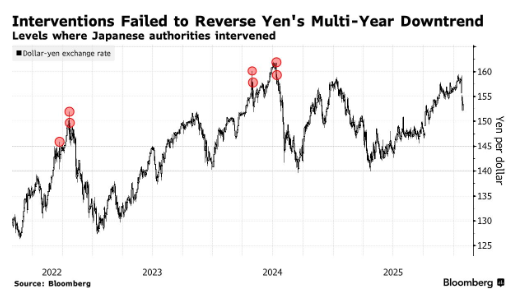
Core Viewpoint - The potential for coordinated intervention in the Japanese yen by the U.S. and Japan has diminished, leading to a significant drop in the yen's value and raising questions about the effectiveness of unilateral interventions by Japan [1][3]. Group 1: Market Reactions - Following U.S. Treasury Secretary Yellen's comments dismissing the likelihood of U.S. intervention, the yen fell by 1.2%, marking its largest single-day decline in over five weeks [1]. - Traders are reassessing the potential responses from the Japanese government if the yen depreciates significantly before the upcoming House of Representatives election on February 8 [1]. Group 2: Economic Fundamentals - Japan's real interest rates remain negative, and inflation continues to exceed 2%, with market expectations indicating only two rate hikes from the Bank of Japan this year, reinforcing views that Japan's monetary policy lags behind economic conditions [3]. - Concerns are growing regarding Japan's fiscal risks, particularly with expectations that the ruling Liberal Democratic Party will maintain a majority in the upcoming election, potentially leading to large-scale fiscal stimulus that could further pressure the yen [3]. Group 3: Intervention Effectiveness - Analysts suggest that without a shift in Japan's monetary policy, any unilateral intervention by the Japanese government would likely have limited long-term success in stabilizing the yen [4][5]. - Historical data indicates that Japan's unilateral interventions have only provided short-term support for the yen, failing to reverse its long-term depreciation trend [5]. Group 4: U.S. Position - The U.S. stance complicates the situation, as any Japanese intervention would involve selling dollars to support the yen, which could exert downward pressure on the dollar; thus, U.S. approval is crucial for Japan's intervention efforts [3][4].

日本财务大臣口头干预显效 日元走强
Jin Rong Jie· 2026-01-16 04:34
Core Viewpoint - The Japanese government is prepared to take action against excessive fluctuations in the yen, which has strengthened against other G10 and Asian currencies following comments from Finance Minister Shunichi Suzuki [1] Group 1: Government Actions - Finance Minister Shunichi Suzuki indicated readiness to intervene if the yen's volatility continues to rise, suggesting that intervention risks are becoming more significant [1] - The comments come as the yen approaches levels that could trigger government intervention [1] Group 2: Market Reactions - Following the minister's remarks, the yen has strengthened against other G10 and Asian currencies [1] - Chang Wei, a strategist at DBS Group, noted that sustained high volatility in the yen could compel authorities to act to maintain credibility [1] Group 3: Economic Context - There is an acknowledgment of increased political uncertainty and potential policy shifts, which may lead to a temporary continuation of the yen's weakness [1]
法兴、Eurizon押注日元绝地反击:干预风险隐现 急涨修正或一触即发
智通财经网· 2026-01-14 04:19
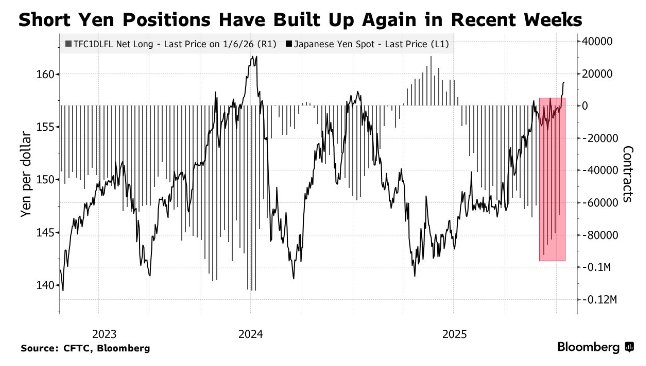
Core Viewpoint - The recent decline of the Japanese yen has increased the likelihood of government intervention in the currency market, suggesting a potential sharp correction in the exchange rate [1] Group 1: Currency Market Dynamics - The yen has depreciated significantly, reaching a low of 159 yen per US dollar, the lowest since July 2024, driven by speculation around potential early elections in Japan [1] - Investors believe that the political changes may solidify the ruling Liberal Democratic Party's position, paving the way for further fiscal stimulus, which is seen as negative for the yen and Japanese government bonds [1] - Eurizon's CEO Stephen Jen indicated that the risk for the USD/JPY exchange rate is "clearly skewed to the downside," and timely government intervention could trigger a correction [1] - Societe Generale's foreign exchange strategist Kit Juckes noted that a sudden surge in the yen could present an excellent opportunity to short the USD/JPY [1] Group 2: Intervention Thresholds and Market Sentiment - Market experts consider 160 yen per dollar as a potential intervention threshold, although Japanese officials emphasize their focus on excessive volatility rather than specific levels [1] - There is no unified standard for determining "exchange rate anomalies," but a Japanese official indicated that fluctuations of 10 yen per dollar in a month or over 4% in two weeks are considered abnormal [1] - The Bank of Japan acts as the operational body for currency intervention, executing measures through the Ministry of Finance [2] - Current market sentiment is characterized by significant positioning in options products, as traders attempt to interpret price movements ahead of potential official responses [2] Group 3: Speculative Positions and Market Indicators - Since Prime Minister Kishi's tenure began in October last year, there has been speculation that his support for reflation policies may hinder short-term interest rate hikes by the Bank of Japan, contributing to downward pressure on the yen [5] - Despite the ruling party's majority, Juckes believes that concerns over debt sustainability will prevent aggressive fiscal expansion in the short term, supporting a "buy on dips" strategy for Japanese government bonds and the yen [5] - Data indicates a risk of a short squeeze in the yen, with speculative net short positions having surged in mid-2024, pushing the USD/JPY above 160, followed by a rapid reversal [5] - The latest data from the Commodity Futures Trading Commission shows that while short positions have recently decreased, they remain at elevated levels [5] - Citigroup's yen pain index, which tracks overall trader sentiment, remains in negative territory, highlighting the crowded nature of current short positions on the yen [6]
日元干预警报利差博弈升温
Jin Tou Wang· 2025-11-21 03:03
Core Viewpoint - The USD/JPY exchange rate is experiencing strong fluctuations, with the current trading price at 157.37, reflecting a 0.56% increase from the previous day, driven by the divergence in monetary policy between the US and Japan [1][2]. Group 1: Monetary Policy Divergence - The Bank of Japan has maintained its benchmark interest rate at 0.5% for the sixth consecutive time, while the Federal Reserve remains cautious about potential interest rate cuts, supporting a hawkish stance [2]. - Japan's core CPI rose by 2.9% year-on-year in September, exceeding the target for 18 consecutive months, but internal divisions regarding potential rate hikes persist within the Bank of Japan [2]. Group 2: Yen Performance and Market Sentiment - The yen has depreciated over 3% since October, making it the weakest currency among G10 currencies, and is approaching intervention thresholds set by the Japanese Ministry of Finance [3]. - US Treasury Secretary Janet Yellen's comments respecting Japan's monetary policy autonomy have fueled speculation about potential market interventions by Japanese authorities [3]. Group 3: Technical Analysis - The USD/JPY has established a clear upward channel, with current prices near the upper boundary, focusing on the 157.00-157.50 range for short-term trading [4]. - Key resistance is identified between 157.80-158.00, while support levels are at 156.80 and 156.50; a breach of these levels could indicate further price movements [4]. - Technical indicators show bullish signals, with the MACD indicating accumulating bullish momentum and the RSI at 62, suggesting a strong market condition [4].