日元汇率走势

Search documents
在中美日之间,超级资金正在转向
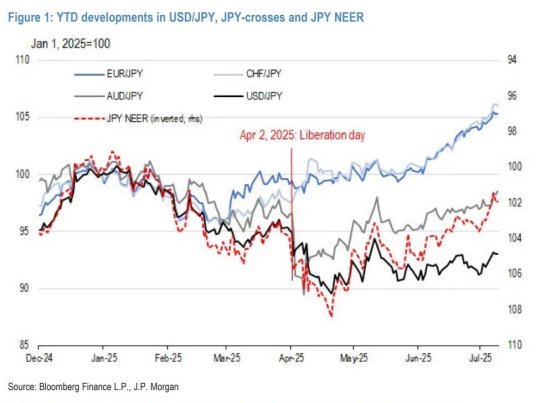
Xin Lang Cai Jing· 2026-02-26 10:22
Group 1 - The recent trend of RMB appreciation has accelerated, starting from around 7.1 in November last year and breaking through key levels of 7, 6.9, and now 6.85, with a cumulative appreciation of about 5% [1][11] - The nominal interest rate difference between the US and China is approximately 2.5%, with the US benchmark rate around 3.5% and China's around 1% [3][13] - The recent appreciation of RMB has significantly impacted the attractiveness of USD-denominated high-yield investments, leading to potential losses for those holding USD [3][13] Group 2 - The RMB's appreciation can be viewed as a corrective phase, as the global currencies appreciated against the USD by about 10% to 13% last year, while RMB only appreciated by about 3% during that period [5][14] - There is still potential for RMB to appreciate further, with estimates suggesting a reasonable range of 6.3 to 6.7 [5][16] - The trend of capital flow is reversing, with significant funds moving back from the US to East Asia, indicating a shift in global financial dynamics [6][16] Group 3 - The Japanese yen has experienced significant depreciation, moving from below 150 to a critical range of 155-160, reflecting market pessimism towards Japan [17][19] - Japan's 10-year government bond yield has surpassed the 2% threshold, posing risks to its large debt scale, and the country is attempting to boost its stock market to stabilize expectations [21] - The current financial environment suggests that the time window for risk-hedging strategies is closing, with Chinese assets emerging as a potentially favorable option amidst these dynamics [22]


日元短期承压下行 日本央行政策会议美国数据
Jin Tou Wang· 2025-12-17 12:56
Core Viewpoint - The Japanese yen is experiencing slight weakness ahead of the Bank of Japan's policy meeting, with market expectations leaning towards an interest rate hike, while the US labor market data shows signs of weakness, leading to a bearish outlook for USD/JPY [1] Group 1: Market Expectations - There is a growing expectation that the Bank of Japan will initiate an interest rate hike, which is providing support for the yen [1] - The Bank of Japan Governor indicated that the likelihood of achieving economic and price expectations is increasing, with Japan's inflation target nearing fulfillment [1] Group 2: US Economic Indicators - Recent non-farm employment data from the US shows a mixed trend, indicating a gradual slowdown in labor market growth, which has intensified expectations for further rate cuts by the Federal Reserve [1] - This trend is limiting the short-term rebound potential for the US dollar, indirectly applying pressure on the USD/JPY pair [1] Group 3: Technical Analysis - The daily chart indicates that the USD/JPY has been declining from recent highs, forming a short-term bearish consolidation structure, with oscillators showing negative signals [2] - The current price is near monthly lows, and a break below this support level would signal the start of a new downtrend [2] - Key resistance levels are being tested, and a breakthrough could trigger a short-term bullish correction, with targets set at recent key round numbers [2]
日本央行加息预期削弱 美元/日元跌破心理关口
Jin Tou Wang· 2025-11-18 06:32
Core Viewpoint - The Japanese yen has recently depreciated significantly against the US dollar, prompting concerns from Japanese officials and speculation about potential government intervention in the currency market [1][2]. Group 1: Economic Indicators - Japan's economy contracted for the first time in six quarters during the July-September period, raising doubts about the Bank of Japan's ability to raise interest rates in the near term [1]. - The Japanese government is planning a new round of tax reforms aimed at stimulating consumption and investment, which may create a fiscal gap of approximately 1.5 trillion yen [1]. Group 2: Currency Market Dynamics - The USD/JPY exchange rate briefly fell below the psychological level of 155.00, influenced by a lack of sustained buying interest in the dollar and rising risk aversion [1][2]. - The recent decline in the yen has led to verbal interventions from Japan's Finance Minister, which, along with general risk aversion, provided slight support for the yen [2]. Group 3: Technical Analysis - From a technical perspective, the closing above the 155.00 psychological level is seen as a new trigger point for bullish sentiment in the USD/JPY pair [3]. - The potential for the USD/JPY to break through the resistance levels of 155.60-155.65 and reach the 156.00 level is significant, while any downward correction below 155.00 may find support in the 154.50-154.45 range [3].
日本自民党总裁选举明日来袭!对冲基金加紧布局:避险、赌日元升值……
智通财经网· 2025-10-03 08:58
Core Viewpoint - The upcoming leadership election of Japan's ruling Liberal Democratic Party (LDP) on October 4 is expected to significantly influence the country's economic policies and market dynamics, with hedge funds preparing various strategies to capitalize on potential outcomes [1][3]. Group 1: Candidates' Economic Policies - The leading candidates, Sanae Takaichi and Shinjiro Koizumi, have distinct economic approaches, with Takaichi favoring aggressive fiscal expansion and Koizumi focusing on wage growth and investment through tax surplus [1][3]. - Takaichi's victory could lead to a slowdown in interest rate hikes, while Koizumi is seen as more inclined towards gradual reforms aimed at increasing wages and productivity [3]. Group 2: Hedge Fund Strategies - Hedge funds like Epic Partners Investments are poised to buy stocks once market leaders are identified, anticipating significant price movements based on the election outcome [1]. - K2 Asset Management is preparing to profit from a potential appreciation of the yen post-election, adjusting their strategies to align with Japan's unique political landscape [3]. - Orbis Investment Management is closely monitoring market volatility that may arise from Takaichi's potential victory, viewing it as an opportunity to increase holdings in local market stocks [3][4]. Group 3: Market Sentiment and Positioning - There is a notable divergence in market positioning, with asset managers bullish on the yen contrasting with hedge funds that are shorting it, reaching the highest level of disagreement since 2007 [5]. - Some investors, like Calvin Yeoh from Blue Edge Advisors, are opting for gold as a hedge against various risks, moving to a neutral stance on the yen ahead of the election results [7]. - Others, such as Atsuko Tsuchiya from Atom Capital Management, are focusing on the timing of the Bank of Japan's next interest rate hike, indicating that bank stocks have already priced in the likelihood of an October rate increase [9].

小摩:日元弱势格局料持续 年底美元兑日元目标维持140
智通财经网· 2025-07-14 07:05
Core Viewpoint - Morgan Stanley's report indicates that since the U.S. announced reciprocal tariffs on April 2, the Japanese yen has appreciated slightly against the U.S. dollar but weakened against other G10 currencies, with a declining trend in the nominal effective exchange rate (NEER) [1][3]. Group 1: Factors Influencing Yen Movements - Factors driving the unwinding of long yen positions include improved risk sentiment from rising global stock markets, cooling expectations for Bank of Japan interest rate hikes, domestic political uncertainties in Japan raising fiscal concerns, weakened expectations for U.S.-Japan currency agreements, and stagnation in Japan's "de-dollarization" process [3]. - Following President Trump's statement on April 22 regarding not planning to dismiss Federal Reserve Chairman Powell and softening his stance on China, global stock markets rebounded, with the S&P 500 and TOPIX indices returning to pre-tariff levels. The correlation between stock market rises and yen depreciation was noted from late April to late June [3]. Group 2: Future Outlook and Projections - Morgan Stanley maintains its forecast for USD/JPY at 140 by the end of 2025 and 139 by mid-2026, emphasizing that any rebound in the yen may be more a result of a weakening dollar rather than a strengthening yen [5]. - The direct impact of the 25% reciprocal tariffs on the Japanese economy, central bank monetary policy, and yen exchange rate is considered limited, but there may be indirect effects through stock market volatility. If tariffs lead to a decline in Japanese corporate earnings (with an estimated 9% reduction in earnings per share for the TOPIX index), a stock market downturn could temporarily increase demand for the yen as a safe haven. However, the market generally expects the final tariff rate to be lower than 25%, suggesting a milder actual impact [5].