
末位淘汰

Search documents
野识推介368:华人首富黄仁勋剑桥大学重磅观点——“末位淘汰”是错的!不敢犯错才是最大的“错”
Sou Hu Cai Jing· 2025-11-30 02:53
Group 1: Innovation - Innovation does not arise from fear [5] - A safe environment that allows for mistakes is essential for true innovation, rather than a pressure-filled atmosphere of fear [5] - Innovators often possess the traits of persistence in trial and error, rather than a focus on short-term perfection [5] Group 2: Last Place Elimination - Last place elimination can train employees to adapt to rules but does not cultivate innovative talent for the future [7] - In the AI era, the only competitive edge for humans is creativity, not the ability to avoid mistakes [7] - The driving force behind progress in human civilization is the spirit of exploration through trial and error [7] Group 3: Qualities of Future Individuals - Innovation is the primary quality for future individuals, which AI cannot replace [9] - Future enterprises need individuals who are willing to take risks and are not afraid of failure [9] - Resilience and the ability to handle pressure are essential, as innovation will inevitably involve failures [9] Group 4: How to Embrace Trial and Error - Establish a framework for trial and error to replace the obsession with zero risk [11] - Allow for slower processes, moving away from the mindset that speed equates to efficiency [11] - Break down tasks into smaller steps within controllable boundaries to minimize risks and costs associated with trial and error [11]


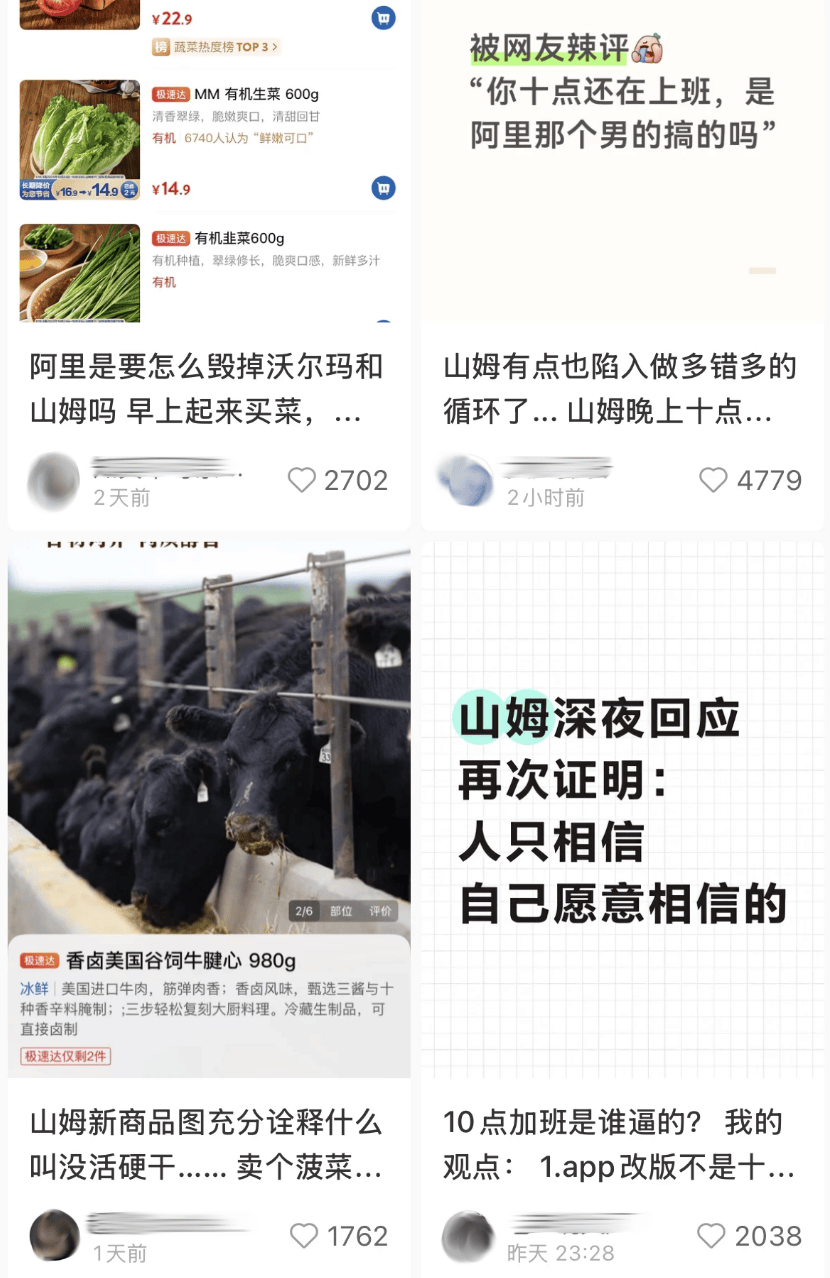
山姆商品图改版成“精修照”,全赖有“阿里味儿”的新高管?
Sou Hu Cai Jing· 2025-11-06 02:33
Core Viewpoint - The recent appointment of Liu Peng, a former Alibaba executive, as the new president of Sam's Club China has sparked significant backlash from members due to changes in the app's product display, which many perceive as adopting an "Alibaba flavor" [1][19][27] Group 1: Leadership Changes - Liu Peng is the first Chinese national to hold the position of president for Sam's Club China, reporting directly to Walmart China's CEO [1][19] - His appointment coincided with a controversial redesign of the Sam's Club app, leading to member dissatisfaction [1][19] Group 2: App Redesign and Member Reactions - The app's product images have been altered to include more promotional content and stylized presentations, moving away from the previous simple white-background images [3][5][10] - Members expressed confusion and frustration over the new design, which they feel complicates the shopping experience and increases selection time [5][10][13] - The redesign has been criticized for resembling tactics commonly used by e-commerce platforms, leading to concerns about transparency and product information [10][18][19] Group 3: Business Strategy and Market Position - Sam's Club is undergoing a digital transformation, with a focus on enhancing member experience and operational efficiency, as indicated by Liu Peng's background in e-commerce [19][21] - Walmart China reported a significant increase in net sales, with Sam's Club's transaction volume growing at a double-digit rate, highlighting the importance of maintaining member satisfaction [18][19] - The company aims to balance its traditional membership model with evolving digital strategies to retain its core customer base [19][27]

中国军人出身企业家的12条管理铁律
Hu Xiu· 2025-04-22 00:46
Core Concepts - The article discusses the military-inspired management strategies implemented by companies like Huawei, China National Chemical Corporation (Sinochem), and Vanke, emphasizing the importance of power balance, results-oriented assessments, and agile organizational structures [1][4][9]. Group 1: Power Balance and Management Structures - Huawei's "three powers separation" system (nominating, reviewing, and impeaching rights) is designed to prevent personal biases from harming the company, similar to military management mechanisms [1]. - Vanke's "weak relationship culture" utilizes digital approval processes to eliminate personal interference, ensuring accountability through automated monitoring [2][3]. Group 2: Results-Oriented Assessment - Sinochem's balanced scorecard approach breaks down strategic goals into four dimensions, including financial growth and customer satisfaction, akin to a military operations map [4][5]. - The implementation of military-style KPIs has led to significant operational improvements, such as a 15% profit growth target and a customer complaint rate of less than 0.3% [5][6]. Group 3: Focused Strategies - Huawei's "needle-point strategy" concentrates resources on key areas like 5G and chip development, with 70% of R&D budget allocated to these sectors, resulting in a 16% share of global 5G patents [6][8]. - Sinochem's "full industry chain" model controls every aspect of the food supply chain, achieving over 90% self-control in critical processes [7][8]. Group 4: Agile Organizational Structures - Huawei has established multiple "legion" teams that operate like special forces, allowing for rapid decision-making and project execution, significantly reducing project initiation times [9][10]. - The "heavy-duty brigade + marine corps" model at China Resources enables quick integration of acquired companies, reducing the average integration period from nine months to about three [10]. Group 5: Performance and Accountability - Huawei's "bottom-line elimination" policy, inspired by Jack Welch's "721 vitality rule," ensures that underperforming employees are removed to maintain organizational vigor [11][12]. - The company employs a rigorous self-criticism mechanism within its executive management team to ensure high standards and accountability [21][23]. Group 6: Strategic Resilience - Huawei's "backup plan" during the global supply chain crisis exemplifies a robust risk management system, with significant investments in technology and supply chain redundancy [14][15]. - The company has achieved a fourfold increase in its share of the global semiconductor market, demonstrating the effectiveness of its strategic resilience [16]. Group 7: Talent Development and Promotion - The "merit-based promotion" system at Huawei ties executive advancement to battlefield performance, with nearly half of its executives coming from challenging markets [17][18]. - China Resources employs a "merit point system" for promotions, fostering a closed-loop ecosystem of acquisition, integration, and advancement [18]. Group 8: Cultural and Philosophical Integration - Huawei's "striver agreement" aligns individual interests with corporate goals, fostering a collective mindset among employees [19][20]. - The military-inspired management practices of these companies reflect a blend of Eastern wisdom and military philosophy, contributing to a new commercial civilization [34][35].
