本地生活服务生态

Search documents
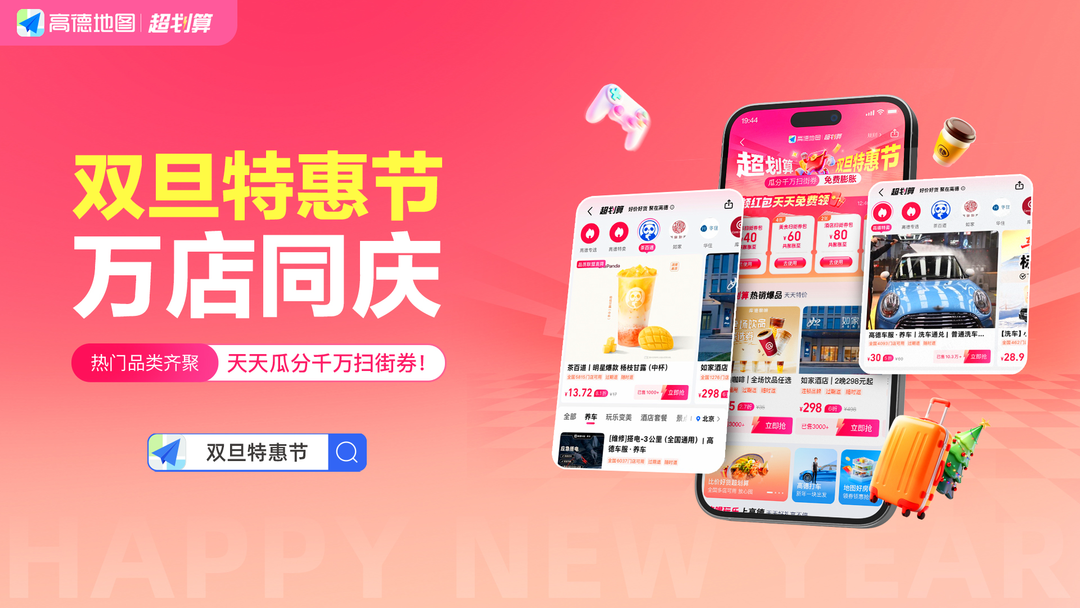
千万级消费补贴、亿级流量扶持,高德开启年末大促
Yang Zi Wan Bao Wang· 2025-12-25 08:06
Core Insights - Alibaba's Gaode has launched a year-end promotion to boost local business sales during the upcoming New Year holiday, investing significant resources in traffic support and consumer subsidies [1][4] - The promotion will run until January 4, featuring partnerships with various businesses to distribute millions in coupons across multiple local service categories [1][4] Group 1 - The platform will provide substantial traffic support and consumer subsidies, including large discount coupons and cross-scenario promotions to stimulate user spending [1][4] - The promotion includes partnerships with businesses such as Purple Light Garden, Domino's, and Universal Studios, covering a wide range of local services [1] - Users can receive up to 80 yuan in street coupons daily for food-related services during the promotion [1] Group 2 - Gaode aims to convert traffic and subsidies into actual orders and growth for merchants, especially during this peak consumption period [4] - The platform will utilize over a billion in traffic support through various promotional methods to enhance merchant visibility [4] - Gaode has seen rapid growth in its local service ecosystem, with over 400 million users engaging with its new street coupon feature within a month of its launch [4]

30元订单市占超70%!美团Q3财报:拒绝价格战,守住高价值用户,海外Keeta提前盈利
Xin Lang Cai Jing· 2025-12-01 11:18
Core Insights - Meituan reported Q3 2025 revenue of 95.5 billion yuan, a 2% year-on-year increase, demonstrating resilience in its core local commerce segment despite intense industry competition [2] - The number of annual transacting users surpassed 800 million, indicating a broad consumer base and enhanced network effects on the platform [3] - CEO Wang Xing emphasized the unsustainability of the food delivery price war, asserting that it does not create value for the industry [2][3] User Growth and Engagement - The milestone of over 800 million annual transacting users reflects Meituan's extensive market coverage and improved user engagement, with monthly transaction users reaching a historical high [3] - The user structure is continuously optimizing, with more low-frequency users transitioning to high-frequency users, significantly increasing consumption frequency and user stickiness [3] Competitive Positioning - Meituan maintained a strong competitive position in the food delivery market, with a market share recovery, especially in the mid-to-high price order segment, where it holds over 70% of orders above 30 yuan [6] - The company achieved a favorable "battle loss ratio" of 1:2 to 1:3 compared to competitors, showcasing its operational efficiency and resource management [3] Instant Retail Performance - Meituan's instant retail segment, Meituan Flash, continues to lead the industry, with new user growth and increased transaction frequency among core users [4] - The peak daily order volume for instant retail exceeded 150 million in July, with an average delivery time of just 34 minutes, highlighting its competitive fulfillment capabilities [5] International Expansion - Meituan's international strategy has made significant strides, with the Keeta business in Hong Kong achieving profitability ahead of schedule and expanding into new markets like Qatar, Kuwait, UAE, and Brazil [6][7] - The company remains focused on long-term strategic investments to enhance user value and maintain customer loyalty amid competition [7] Ecosystem and Merchant Support - Meituan has increased its investment in rider welfare and merchant support, launching initiatives like the "Prosperity Plan" with 2.8 billion yuan allocated to assist merchants [8] - The company is also enhancing food safety measures through initiatives like the "Bright Kitchen" program, encouraging transparency and consumer trust [9] Technological Advancements - Meituan's R&D investment reached 6.9 billion yuan, a 31% year-on-year increase, with significant advancements in AI applications and logistics technology, including drone delivery services [11] - The company is leveraging technology to improve operational efficiency and enhance service offerings for both merchants and consumers [11] Future Outlook - As industry competition stabilizes, Meituan's long-term investments in user scale, technology, and ecosystem development are expected to translate into sustained competitive advantages [10]


“要全面开战了”,阿里美团激战升级
Di Yi Cai Jing Zi Xun· 2025-09-10 08:51
Core Viewpoint - Alibaba is intensifying its competition with Meituan in the local lifestyle service sector, launching the "Gaode Street Ranking" to enhance its presence in the "to-store" business, while Meituan is reviving its quality takeaway service [2][8]. Group 1: Alibaba's Strategy - Alibaba's "Gaode Street Ranking" is based on real user behavior, focusing on repeat customers and is not commercialized, aiming to differentiate itself from Meituan's high market share [2][4]. - The "Gaode Street Ranking" project was initiated in June and now covers over 300 cities and 1.6 million offline service providers, including over 870,000 restaurants and 230,000 hotels [3]. - The ranking system utilizes AI to filter out false information and is integrated with the Sesame Credit system to enhance trust [4]. Group 2: Meituan's Response - Meituan announced the revival of its quality takeaway service on the same day as Alibaba's announcement, leveraging its extensive user review data to improve service reliability [8]. - Meituan's second-quarter financial report showed a revenue of 91.84 billion yuan, a year-on-year increase of 11.7%, but a significant drop in net profit by 89% [9]. - Despite the challenges, Meituan's app reached over 500 million monthly active users, with a 40% year-on-year increase in order volume for its to-store business [9]. Group 3: Market Dynamics - The competition between Alibaba and Meituan is heating up, with both companies accelerating the construction of their local lifestyle service ecosystems and extending their subsidy wars from takeaway to in-store services [2][7]. - The market is observing the impact of these new strategies, with both companies announcing substantial subsidies to attract customers, including over 1 billion yuan from Gaode and 25 million takeaway vouchers from Meituan [7][8]. - Analysts suggest that while Gaode's new ranking may disrupt Dazhong Dianping (Meituan's review platform), it will take time to build user trust and recognition [7].

“要全面开战了”,阿里美团激战升级
第一财经· 2025-09-10 08:42
Core Viewpoint - The competition between Alibaba and Meituan in the local lifestyle service sector is intensifying, with Alibaba launching the "Gaode Street Ranking" to challenge Meituan's dominance in the dining and takeaway markets [3][4][5]. Group 1: Alibaba's Strategy - Alibaba has launched the "Gaode Street Ranking," which is based on user behavior rather than traditional metrics like likes or collections, focusing on repeat customers and avoiding commercialization [3][4]. - The "Gaode Street Ranking" covers over 300 cities and 1.6 million offline service providers, including more than 870,000 restaurants and 230,000 hotels [7]. - The initiative aims to leverage a differentiated credit system to penetrate Meituan's market share, utilizing AI to filter out false information and enhance user trust [7][10]. Group 2: Meituan's Response - On the same day, Meituan announced the "restart" of its quality takeaway service, aiming to enhance user engagement and improve merchant quality through AI and real user reviews [4][13]. - Meituan's second-quarter financial report showed a revenue of 91.84 billion yuan, a year-on-year increase of 11.7%, but a significant drop in net profit by 89% [14][15]. - Despite the challenges, Meituan's active user base exceeded 500 million, and its in-store business saw over 40% year-on-year growth in order volume [14]. Group 3: Market Dynamics - Both companies are engaged in a subsidy war, with Gaode announcing over 1 billion yuan in subsidies to attract customers to offline dining and services, while Meituan is offering 25 million quality takeaway vouchers [11][12]. - The competition is expected to evolve as both companies seek to create a closed-loop transaction and decision-making ecosystem in local services [10][11]. - Analysts suggest that while Gaode's new ranking system may disrupt Meituan, it will take time to build user trust and recognition [11].

阿里美团激战升级!高德10亿补贴杀入“到店”榜单,点评“重启”品质外卖
Di Yi Cai Jing Zi Xun· 2025-09-10 08:23
Core Insights - Alibaba is intensifying competition with Meituan in the local services sector, launching the "Gaode Street Ranking" to challenge Meituan's dominance in the dining and service industry [1][2][3] - Meituan has responded by reviving its quality takeaway service, indicating a fierce battle in the local lifestyle market [2][7] Group 1: Alibaba's Strategy - The "Gaode Street Ranking" is based on real user behavior, focusing on repeat customers rather than likes or collections, and aims to differentiate itself from Meituan's offerings [1][3] - The project has been in development since June and currently covers over 300 cities and 1.6 million offline service providers, including over 870,000 restaurants [3][5] - Alibaba aims to leverage its credit system and AI capabilities to filter out false information and enhance user trust in the rankings [3][6] Group 2: Meituan's Response - Meituan announced the revival of its quality takeaway service, utilizing AI and real user reviews to improve decision-making for consumers [7][8] - The company has a history of integrating high-quality dining options into its takeaway service, which has been a significant part of its strategy since 2014 [8] - Meituan's second-quarter financial report showed a revenue of 91.84 billion yuan, with a year-on-year growth of 11.7%, but a significant drop in net profit by 89% [9][10] Group 3: Market Dynamics - Both companies are engaged in a subsidy war, with Gaode announcing over 1 billion yuan in subsidies to attract customers to offline dining and services [6][10] - The competition is expected to evolve as both companies work to enhance their local service ecosystems and improve consumer engagement [2][6] - Analysts suggest that while Meituan has a strong market position, the introduction of Gaode's ranking system could disrupt the existing dynamics due to its unique data advantages [6][10]

美团会员权益再升级:全面覆盖大健康权益,会员可享多项“变美变健康”服务
Xin Lang Cai Jing· 2025-08-08 10:25
Group 1 - Meituan has upgraded its membership services to include comprehensive health and wellness offerings, addressing users' summer needs for beauty and health [1][2] - Black Diamond members can now access a photorejuvenation service provided by renowned medical institutions, marking the first time Meituan has included medical beauty services in its core membership benefits [1] - Black Gold and above members can enjoy a free "instant doctor consultation" service, with an average consultation time of 30 seconds and a service duration of 30 minutes [1] Group 2 - From August 7 to August 14, Meituan will launch a "Summer Beauty" themed event, allowing Black Diamond members to choose from various beauty services [2] - All members will receive a large coupon package applicable to medical beauty, health, and pharmacy services, along with exclusive pricing for consultations and medications [2] - Since its launch, the Meituan membership system has focused on providing tangible benefits across various local life scenarios, gradually building a more comprehensive and sticky multi-service ecosystem [2]

刘强东又杀入新战场
创业家· 2025-06-12 10:03
Core Viewpoint - The article discusses JD's aggressive entry into the hotel and travel (酒旅) sector, aiming to challenge established players like Ctrip and Meituan through high salaries for talent acquisition and a strategy focused on "no bundling, transparent pricing" along with subsidies [4][10][13]. Group 1: JD's Strategy in the Hotel and Travel Sector - JD is reportedly offering three times the salary to recruit talent from competitors such as Ctrip, Meituan, and Fliggy, indicating a strong commitment to enhancing its hotel and travel business [4][10]. - The company has launched various job postings for hotel and travel-related positions, emphasizing the need for experience from competitors [10][11]. - JD's travel platform offers significant customer incentives, including a new user gift package worth 145 yuan and various hotel discount coupons, which are part of its strategy to attract users [13][21]. Group 2: Market Context and Competitive Landscape - The online travel agency (OTA) market is currently dominated by major players like Meituan and Ctrip, creating a challenging environment for new entrants [19][20]. - Meituan's financial performance highlights the profitability of the local services sector, with a reported operating profit margin of 19.7% for its core local business [17]. - Ctrip's core OTA business transaction volume is projected to exceed 1.2 trillion yuan in 2024, showcasing the scale and competition JD faces [18]. Group 3: Historical Context of JD's Travel Business - JD has been involved in the travel sector since 2011, initially launching flight booking services and later acquiring a hotel booking platform, but struggled to achieve significant success due to its e-commerce roots [14][15]. - The company has made several strategic moves over the years, including partnerships with airlines and other OTAs, to enhance its travel offerings [14][15][16]. - JD's travel business has evolved, with the introduction of a dedicated travel channel and collaborations with various suppliers to expand its hotel booking services [15][16]. Group 4: Future Prospects and Challenges - JD's expansion into the hotel and travel sector is seen as a way to complete its local service ecosystem, potentially leading to further developments in group buying and other services [19][21]. - The competitive landscape is intensifying, with new players like Douyin and Xiaohongshu entering the travel market, adding pressure on established OTAs [19][20]. - JD's strategy of "no bundling" aims to capture user attention, reminiscent of its previous price wars in other sectors, but long-term profitability will depend on effective cross-selling and resource accumulation [21][22].