美团闪购

Search documents
美团-W(03690):竞争边际趋缓,UE有望改善
Changjiang Securities· 2026-03-30 23:30
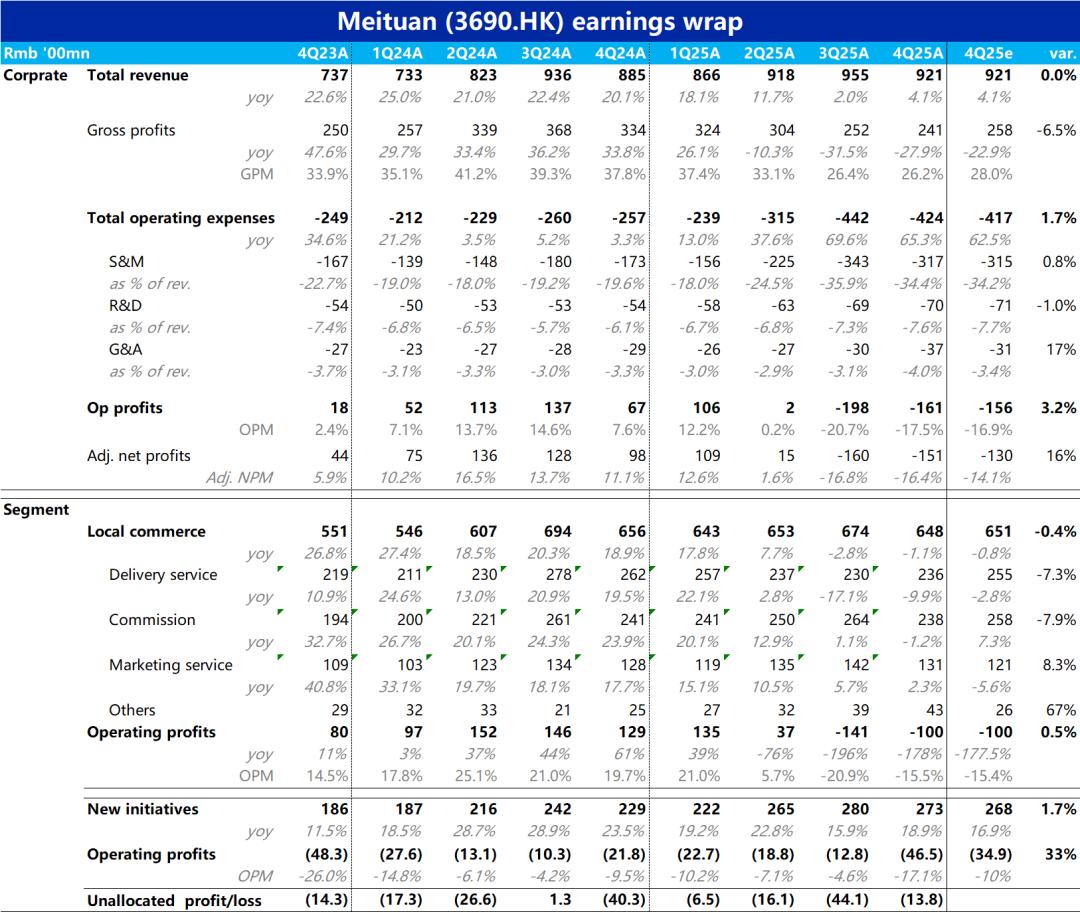
Investment Rating - The report maintains a "Buy" rating for Meituan [2][9]. Core Insights - In Q4 2025, Meituan's revenue reached 921 billion CNY, a year-on-year increase of 4.1%, while the adjusted net loss was 151 billion CNY compared to an adjusted net profit of 98 billion CNY in the same period last year [6][11]. - The report highlights that competition in the food delivery sector has peaked, and as subsidies narrow, user engagement (UE) is expected to improve, potentially returning to the 1 CNY level in the long term [2][11]. - The projected revenues for Meituan from 2026 to 2028 are 4,101.17 billion CNY, 4,569.75 billion CNY, and 5,024.47 billion CNY, with adjusted net profits of -19.15 billion CNY, 352.93 billion CNY, and 449.65 billion CNY respectively [2][11]. Summary by Sections Overall Performance - For FY2025 Q4, Meituan achieved a revenue of 921 billion CNY, with an operating loss of 161 billion CNY and an adjusted net loss of 151 billion CNY, which was higher than the market consensus of approximately 130 billion CNY [6][11]. - The core local business revenue was 648 billion CNY, slightly below the consensus estimate of 651 billion CNY, while new business revenue was 273 billion CNY, exceeding the consensus of 268 billion CNY [11]. Food Delivery and Flash Purchase - The core local business segment, including food delivery and flash purchase, reported an operating loss of approximately 141 billion CNY in Q4, which is an improvement from a loss of 191 billion CNY in Q3 [11]. - The average order value (AOV) for food delivery remains above the industry average, and Meituan holds a strong market share in the mid-to-high price order segment [11]. In-store and Travel Business - The in-store and travel business segment is expected to contribute approximately 160 billion CNY in revenue for Q4, with an operating profit of about 40 billion CNY, reflecting a profit margin of around 25% [11]. New Business Initiatives - Meituan's new business, Keeta, is expanding globally, having entered markets in Brazil, Saudi Arabia, and several Middle Eastern countries, with total revenue expected to reach 1,040 billion CNY in 2025, a year-on-year growth of 19.1% [11]. Profit Forecast and Investment Recommendations - The report suggests that if competition in the food delivery sector stabilizes, Meituan's operational efficiency and market share are likely to improve, with long-term UE expected to recover to the 1 CNY level [2][11].

美团-W(03690):4Q25点评:面对竞争增强长期竞争力,创造用户价值
GF SECURITIES· 2026-03-27 14:27
Investment Rating - The report assigns a "Buy" rating to the company, with a current price of HKD 85.90 and a fair value of HKD 111.37 [3][27]. Core Insights - The company is facing intensified competition but is focused on enhancing its long-term competitiveness and creating user value. The report highlights that the company has strong operational barriers in its food delivery business and is expected to maintain its leading position in the local lifestyle sector [8][27]. - The company reported a revenue of RMB 920.96 billion for Q4 2025, a year-on-year increase of 4.08%, but an adjusted net loss of RMB 150.80 billion, resulting in an adjusted net profit margin of -16.4% [8][21]. - The report anticipates that the company's revenue will reach RMB 4,102.51 billion in 2026, with an adjusted net loss of RMB 248 billion [27][29]. Financial Performance Summary - **Revenue Forecast**: - 2024A: RMB 337,592 million - 2025A: RMB 364,855 million - 2026E: RMB 410,251 million - 2027E: RMB 471,653 million - 2028E: RMB 526,278 million - Growth rates: 22.0% (2024A), 8.1% (2025A), 12.4% (2026E), 15.0% (2027E), 11.6% (2028E) [8][27]. - **Net Profit Forecast**: - 2024A: RMB 43,772 million - 2025A: -RMB 18,648 million - 2026E: -RMB 24,842 million - 2027E: RMB 23,338 million - 2028E: RMB 35,578 million - Growth rates: 88.2% (2024A), -142.6% (2025A), 33.2% (2026E), -193.9% (2027E), 52.4% (2028E) [8][27]. - **Earnings Per Share (EPS)**: - 2024A: RMB 7.24 - 2025A: -RMB 3.07 - 2026E: -RMB 4.09 - 2027E: RMB 3.84 - 2028E: RMB 5.85 [8][27]. - **Price-to-Earnings Ratio (P/E)**: - 2024A: 18.5 - 2027E: 19.7 - 2028E: 12.9 [8][27]. Business Segment Analysis - **Core Local Business**: - Q4 2025 revenue: RMB 648.35 billion, a year-on-year decrease of 1.12%, with an operating loss of RMB 140.71 billion [8][14]. - **New Business**: - Q4 2025 revenue: RMB 272.62 billion, a year-on-year increase of 18.94%, with an operating loss of RMB 46.50 billion [8][20]. - **Cost Structure**: - Q4 2025 sales expenses: RMB 317.26 billion, R&D expenses: RMB 70.29 billion, and management expenses: RMB 36.53 billion [8][10].
2026年中国闪电仓模式深度解析:即时零售赛道新变量,分钟级消费时代来临
Qin Ce Xiao Fei Yan Jiu· 2026-03-27 12:35
Investment Rating - The report indicates a positive investment outlook for the lightning warehouse model in the instant retail sector, highlighting significant growth potential and market opportunities [3][4]. Core Insights - The lightning warehouse model is reshaping China's instant retail infrastructure, with Meituan's lightning warehouses expected to exceed 50,000 by 2025 and reach over 100,000 by 2027, generating a GMV of over 200 billion yuan [3][4]. - The industry is characterized by a "one strong, many strong" pattern, with Meituan's lightning purchase holding a 70% market share, followed by Taobao and JD [3][4]. - The report emphasizes the shift from emergency consumption to daily consumption, driven by a 30-minute delivery experience [3][4]. Summary by Sections Industry Overview and Current Development - The instant retail market is entering a "minute-level" era, supported by over 50,000 lightning warehouses, contributing to a market size exceeding 1 trillion yuan [8][14]. - The lightning warehouse model, launched by Meituan in 2020, operates purely online with flexible site selection, 24-hour service, and a wide range of SKUs [9][10]. Key Data Overview - As of 2023, the instant retail market is valued at 650 billion yuan, with lightning warehouses contributing 60 billion yuan, representing 9.2% of the market [15]. Investment Logic - Short-term focus on leading brands like Huiyixuan and Xiaochai Purchase, which benefit from supply chain barriers [7]. - Mid-term potential for vertical sectors (alcohol, maternal and infant, pharmaceuticals) to produce niche leaders, with SKU depth and fulfillment efficiency being critical [7]. - Long-term growth expected in instant retail penetration, with a market size projected to exceed 2 trillion yuan by 2030 [7]. Competitive Landscape - The competitive landscape shows Meituan's lightning purchase leading with 70% market share, followed by Taobao and JD [13][24]. - The report notes a concentration of top brands, with only three brands consistently ranking over the past three years [26][27]. Regional Distribution and Brand Ecosystem - Eastern and Southern regions are mature markets, while Central and Western regions present significant growth opportunities, particularly in county markets [96][97]. - The county market has seen a 54% year-on-year growth in orders, becoming a new growth engine for the industry [100][101]. Future Outlook and Trends - By 2027, the number of lightning warehouses is expected to exceed 100,000, with a GMV of 200 billion yuan, indicating a shift towards refined operations [129][130]. - Key trends include increased concentration among top brands, expansion into high-ticket categories, and the rise of official brand warehouses [134].
开启加速减亏,美团最差的时候过去了?
雷峰网· 2026-03-27 10:47
Core Viewpoint - After a significant loss of 23.4 billion yuan in the previous year, Meituan is expected to substantially reduce its losses in Q1 2026, with improvements in its takeaway business profits compared to Q4 2025, although the average loss per order will still exceed 1 yuan [2][3]. Group 1: Financial Performance and Market Position - Meituan's Q4 2025 financial report indicated a loss of 15.1 billion yuan, with core local business losses amounting to 10 billion yuan and new business losses increasing to 4.6 billion yuan, a rise of 3.3 billion yuan from the previous quarter [3][4]. - The core local business is projected to continue incurring losses in Q1 2026, but the reduction in losses will exceed 50% compared to Q4 2025 [3][4]. - Meituan's market share in the takeaway sector remains strong, with over 60% in GMV and around 70% in high-value orders above 30 yuan [6][8]. Group 2: Competitive Landscape - The profit margin for Meituan's takeaway and in-store services has decreased, with the in-store business profit margin dropping from over 30% to around 25% [7][9]. - The competitive gap in unit economics (UE) between Meituan and its rivals is expected to widen, with a projected difference of about 2 yuan in Q1 2026, primarily due to a faster recovery in average order value (AOV) [6][9]. - Alibaba's strategy may shift resources from food delivery to non-food sectors, potentially leading to a misalignment in competition with Meituan's flash purchase services [6][8]. Group 3: Strategic Initiatives and AI Investment - Meituan is heavily investing in AI, viewing it as a strategic opportunity to reshape local service products, with significant capital expenditure and talent acquisition in this area [11][12]. - The company has made substantial adjustments in its technology department to fully embrace AI, aiming to enhance service efficiency and user experience through AI-driven applications [11][12]. - The AI assistant "Xiaotuan" has been made available to users, providing precise answers regarding merchant locations, operating hours, and store facilities, with plans for deeper integration with the Meituan app [12].


外卖大战可能快结束了,但美团的战争才刚开始
36氪未来消费· 2026-03-27 10:22
Core Viewpoint - The intense competition in the instant retail market is not the only challenge for Meituan, as it faces significant losses and operational hurdles in its core business and emerging sectors like AI and international expansion [2][5]. Financial Performance - In 2025, Meituan's revenue grew by 8.1% to 364.9 billion yuan, but it reported a loss of 23.4 billion yuan, a significant decline from a profit of 35.8 billion yuan the previous year [2]. - The core local business experienced a substantial operating loss of 6.9 billion yuan, indicating a challenging financial environment [2]. - In Q4 2025, the core local business revenue decreased by 1.1% to 64.8 billion yuan, with rising sales costs and marketing expenses attributed to fierce competition [3]. Competitive Landscape - Meituan's management openly acknowledged the competitive pressures during a recent earnings call, emphasizing the need to focus on enhancing core capabilities and reducing losses [4]. - The competition has shifted, with rivals like Alibaba and JD.com adjusting their strategies, leading to a more stable environment for Meituan to operate [4][13]. - Meituan is now prioritizing high-value orders over overall market share, focusing on improving unit economic efficiency [9]. Business Strategy - Meituan's strategy includes expanding its instant retail business, which has seen significant growth, with over 50,000 flash warehouses and double-digit growth in order volume and GTV [10]. - The company is also focusing on international expansion, with its international business Keeta achieving profitability in Hong Kong and expected to do so in Saudi Arabia by 2026 [23]. AI and Future Prospects - Meituan is investing in AI to enhance its service offerings, although it faces challenges in creating widely adopted AI products [26][27]. - The company aims to leverage AI to improve operational efficiency and customer experience in the local services sector [26]. Market Dynamics - The competition in the instant retail space is expected to evolve, with a shift from food delivery to non-food retail sectors, indicating a broader market opportunity [15]. - Meituan's management is committed to reducing inefficient investments in non-core areas while focusing on innovation and operational efficiency [21].

美团:三山压顶,外卖“老登”要长跪不起?
3 6 Ke· 2026-03-27 02:01
Core Viewpoint - Meituan's latest quarterly earnings report reflects a mixed performance, with significant losses in new business segments overshadowing slight improvements in core local commerce operations. The overall results align closely with prior profit warnings, indicating a challenging environment for the company [6][20]. Financial Performance - The core local commerce segment reported an operating loss of approximately 10 billion RMB, consistent with previous warnings. The total loss from the home delivery business exceeded 14 billion RMB, with a reduction in losses of less than 5 billion RMB compared to the previous quarter [20][24]. - The overall operating expenses for the quarter reached about 42 billion RMB, with a year-on-year increase of 65%. Marketing expenses accounted for 31.7 billion RMB, reflecting a reduction in delivery subsidies [4][26]. - The gross profit margin for the quarter was 26.2%, down by approximately 0.2 percentage points from the previous quarter, indicating ongoing pressure on profitability [24][26]. Business Segments - The home delivery business saw a slight improvement in loss per order, decreasing from 2.5 RMB to 2 RMB, while Alibaba's loss per order decreased from over 5 RMB to around 3.5 RMB, narrowing the gap between the two companies [20][24]. - Revenue from the home delivery and flash purchase segments declined by 10% year-on-year, a slight improvement from the previous quarter's 17% decline, suggesting a trend towards reduced investment and losses in the delivery sector [14][18]. - The new initiatives segment, primarily driven by Keeta's expansion in overseas markets, reported a revenue growth rate of 19%, indicating strong performance despite overall losses in this area [18][20]. Competitive Landscape - Meituan faces intensified competition in the dine-in segment, with a slowdown in revenue growth and a decline in commission and advertising revenues. The company is experiencing pressure from Douyin's aggressive entry into the market, which has seen significant growth in gross transaction value [3][12]. - The overall revenue for the core local commerce segment was 64.8 billion RMB, a year-on-year decline of 1.1%, aligning with market expectations despite the challenges faced [3][14]. Future Outlook - The ongoing competition in instant retail suggests that all players are optimizing their subsidies and unit economics, with a general trend towards reduced losses expected to continue. However, the pace and method of achieving these reductions remain uncertain [8][10]. - Regulatory bodies may influence the competitive landscape, but it is unlikely that they will impose strict measures to halt competitive subsidies entirely, allowing for continued competition among major players [9][10].
2026年中国闪电仓模式深度解析——即时零售赛道新变量,分钟级消费时代来临
Qin Ce Xiao Fei Yan Jiu· 2026-03-26 03:15
Investment Rating - The report indicates a positive investment outlook for the lightning warehouse model in the instant retail sector, highlighting significant growth potential and market share concentration among leading brands [3][4]. Core Insights - The lightning warehouse model is reshaping China's instant retail infrastructure, with Meituan's lightning warehouses expected to exceed 50,000 by 2025 and reach over 100,000 by 2027, generating a GMV of over 200 billion yuan [3][4]. - The industry is characterized by a "one strong, many strong" structure, with Meituan's lightning purchase holding a 70% market share, followed by Taobao and JD [3][4]. - The report emphasizes the shift from emergency consumption to daily consumption, driven by a 30-minute delivery experience [3][4]. Summary by Sections Industry Overview and Current Development - The instant retail market is entering a "minute-level" era, supported by over 50,000 lightning warehouses, which are projected to drive a market size exceeding 1 trillion yuan [8][14]. Lightning Warehouse Definition - Lightning warehouses are defined as platform-based front warehouses operated by third-party franchisees, featuring online-only operations, 24-hour service, and a wide range of SKUs [9][10]. Investment Logic - Short-term focus on the scale effects from leading brand expansions, with companies like Huiyixuan and Xiaochai Gouwu benefiting from supply chain barriers [7]. - Mid-term potential for vertical sectors (e.g., alcohol, maternal and infant products) to produce leading players, with SKU depth and fulfillment efficiency being critical [7]. - Long-term growth expected as instant retail penetration increases, with market size projected to exceed 2 trillion yuan by 2030 [7]. Market Size and Growth Drivers - The instant retail market is projected to grow from 650 billion yuan in 2023 to 1.4 trillion yuan by 2027, with lightning warehouses expected to capture a growing share [15][18]. Competitive Landscape - The competitive landscape is dominated by Meituan's lightning purchase (70% market share), followed by Taobao (25%) and JD (<5%) [13][22]. - The report notes a trend of increasing brand concentration, with only three brands consistently ranking in the top tier over the past three years [26][28]. Regional Distribution and Brand Ecosystem - Eastern and Southern regions are leading in market penetration, while the Central and Western regions present significant growth opportunities [96][97]. - The county market is identified as a new growth engine, with a 54% year-on-year increase in order volume [99][100]. Key Brand Analysis - Huiyixuan leads the industry with over 3,220 stores, followed by Xiaochai Gouwu with 750 stores, showcasing strong supply chain advantages and market resilience [28][30]. - The report highlights the importance of digital capabilities and supply chain integration for brand success [40][45]. Future Outlook and Trends - By 2027, the number of lightning warehouses is expected to exceed 100,000, with a GMV target of 200 billion yuan, indicating a shift towards refined operations [129][130]. - The report anticipates a significant increase in market penetration and the emergence of brand flagship stores as a standard practice [134].

淘宝闪购第四季度份额冲至45.2%,与美团差距仅0.2个百分点
Xin Lang Cai Jing· 2026-03-16 04:25
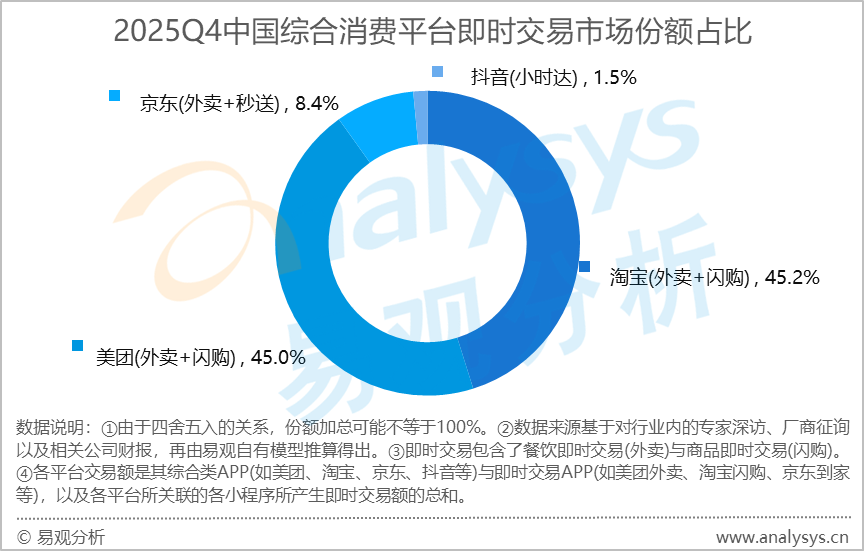
Core Insights - The report by Analysys indicates that in Q4 2025, Taobao Flash Purchase achieved a market share of 45.2%, closely followed by Meituan at 45%, indicating a near tie between the two platforms [1][3] - The overall market size for China's instant retail sector reached 29,852 billion yuan in 2025, reflecting a year-on-year growth of 21.4%, with Q4 alone contributing 8,118 billion yuan, up 15.6% year-on-year [1] Market Share Dynamics - Taobao Flash Purchase and Meituan dominate the instant retail market, with JD Instant Transaction at 8.4% and Douyin's Hourly Delivery at 1.5% [3] - The competitive landscape has shifted from Meituan's previous dominance to a dual leadership between Alibaba and Meituan, following Alibaba's strategic upgrades to its instant retail services [3] Strategic Developments - Alibaba's Taobao Flash Purchase has seen rapid expansion, with peak daily orders reaching 120 million and monthly active buyers surpassing 300 million by August 2025 [3] - Meituan is enhancing its competitive edge through partnerships with major brands and expanding its "Lightning Warehouse" network, aiming for 100,000 warehouses by 2027 [4] Financial Pressures - Both Alibaba and Meituan are experiencing significant pressure on profitability due to high investments in instant retail, leading to a notable decline in core profit metrics in Q3 2025 [4] - Analysts suggest that the aggressive investment strategies by Alibaba and JD in the instant retail sector aim to establish a one-stop shopping platform, although the sustainability of such competitive tactics remains questionable [4][5]

美团市值蒸发2.2万亿港元:外卖市场地位被撼动市场份额滑落至不足50% 首款AI浏览器Tabbit陷抄袭风波
Xin Lang Cai Jing· 2026-03-13 08:26AI Processing
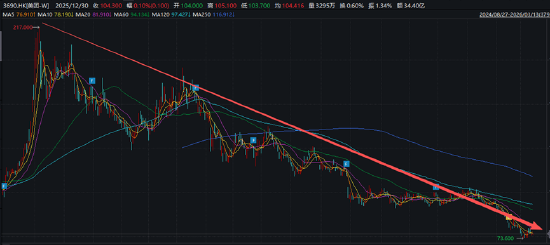
Core Viewpoint - Meituan's stock price has been on a downward trend since October 2024, with a market capitalization dropping from a peak of HKD 2.658 trillion to HKD 468.9 billion by March 2026, reflecting investor concerns about the company's future growth prospects [1][13]. Group 1: Financial Performance - Meituan is expected to report a net loss of between RMB 23.3 billion and RMB 24.3 billion for the year 2025, marking a significant downturn from previous profitability [3][15]. - The core local business segment, once a cash cow, is projected to incur an operating loss of RMB 6.8 billion to RMB 7 billion in 2025, highlighting the intense competition in the instant retail sector [3][16]. - The company's market share in the food delivery sector has fallen from over 70% at its peak to approximately 48%, with Alibaba and JD.com capturing 33% and 19% of the market, respectively [6][18]. Group 2: Competitive Landscape - JD.com has aggressively entered the food delivery market with a "0 commission + RMB 10 billion subsidy" strategy, prompting Meituan and Alibaba to respond with their own competitive measures [4][16]. - The competition in the instant retail space is expected to intensify in 2026, with JD.com aiming for a market share of over 30% and Alibaba prioritizing its "Taobao Flash Sale" initiative as a key strategic focus [20][21]. - The shift from a "burning cash war" to a "sustained consumption" model indicates that competition will only escalate, raising questions about Meituan's ability to maintain its market share [21]. Group 3: AI Strategy and Challenges - Meituan's attempt to enter the AI space with the launch of its first AI-native browser, Tabbit, faced backlash due to allegations of code plagiarism, revealing potential strategic anxieties and technical shortcomings [2][11]. - The incident with Tabbit highlights the challenges Meituan faces in its AI initiatives, as it struggles to keep pace with competitors like Alibaba and Tencent, who are building comprehensive ecosystems around AI and cloud computing [10][22]. - The competitive landscape in AI is becoming increasingly polarized, with Meituan's focus on vertical business scenarios limiting its ability to compete effectively against larger players [22][23].
S26新机开售,三星称即时零售带来惊喜:美团闪购成预售量最高平台之一
Ge Long Hui· 2026-03-11 10:14
Group 1 - Samsung's new flagship smartphone Galaxy S26 series officially launched on March 11, featuring the world's first "privacy screen" anti-peeping function and Galaxy AI in collaboration with Gemini, resulting in high pre-sale demand [1] - In South Korea, the Galaxy S26 set a record for the highest pre-sale figures in the series, with the Galaxy S26 Ultra being the most popular among consumers [1] - In the Chinese market, the rise of instant retail channels has become a significant sales trend for Samsung's new devices, with Meituan Flash Purchase being a key platform for pre-sales and first sales [1][3] Group 2 - Meituan Flash Purchase has over 1,200 authorized Samsung experience stores participating in the pre-sale and first sale, offering a rapid delivery service within 30 minutes [1] - The General Manager of Samsung's Mobile Communications Retail Division in Greater China stated that Meituan Flash Purchase became one of the top platforms for pre-sale sales of the S26 series, highlighting the surprise success of instant retail [1] - Instant retail has gained popularity in China since last year, with consumers increasingly choosing these platforms for purchasing digital appliances, prompting brands to enhance their presence in this channel [3]