机制重塑

Search documents
比2008年更漫长的全球VC/PE寒冬
母基金研究中心· 2026-03-18 08:56
Core Insights - The private equity industry is undergoing a deep adjustment lasting longer than the 2008 financial crisis, with Bain & Company reporting that the industry has returned less profit to investors for four consecutive years while holding $3.8 trillion in unsold assets [2] - In 2025, the allocation of private equity to net asset value remains at 14%, the second lowest level since the peak of the 2008 crisis, despite a 44% increase in transaction value to $904 billion [2] - Fundraising has declined for four consecutive years, dropping to $395 billion in 2025, a 16% year-on-year decrease, as investors demand net internal rates of return exceeding 20% [2] Fundraising and Investment Trends - Private equity firms have sold "gem" assets but struggle to offload less certain assets, with the average holding period for portfolio companies extending from 5-6 years in 2021 to approximately 7 years [3] - In 2025, the total number of transactions decreased by 6% to 3,018, indicating a slowdown in market activity [3] - The Chinese VC/PE industry has entered a cyclical downturn, facing challenges in fundraising, investment, and exit strategies, with many institutions experiencing a "zero action" state [3][4] Market Dynamics and Structural Changes - The industry is experiencing a paradigm shift affecting the entire fundraising, investment, management, and exit chain, transitioning from a quantity-driven to a quality-driven approach [4] - Over 1,000 private fund managers have been voluntarily or involuntarily deregistered in 2025, accelerating the exit of "zombie institutions" from the market [4] - The dominance of state-owned general partners (GPs) in the fundraising landscape has intensified competition for private fund managers, with over 80% of new registrations concentrated among leading institutions and state-owned platforms [5] Development of Patient Capital - State-owned limited partners (LPs) are becoming the main force in developing "patient capital" and long-term capital in China, with measures including extending the duration of existing funds and setting longer terms for new funds [6] - The development of patient capital also implies the need for improved error tolerance mechanisms, encouraging innovation and allowing for flexibility in exit strategies [7] Future Outlook - The year 2025 marks a complete overhaul of the equity investment narrative, moving away from scale-driven models to a new era driven by national strategy, supported by RMB capital and industrial logic [7] - The data recovery in 2025 signals a return of market confidence, with expectations for a structural recovery in the Chinese primary market in 2026, driven by collaboration between state-owned and private GPs [7]


2025年创投市场回暖与变革交织,机制重塑引领高质量发展
Zheng Quan Shi Bao Wang· 2025-12-30 08:34
Group 1 - The core viewpoint of the articles highlights a significant recovery in China's private equity investment market in 2025, with a notable increase in market activity and new fund registrations, particularly in the second and third quarters, where the number of new registered funds grew by over 30% [1] - The industry is experiencing a pronounced differentiation, with over 80% of new registrations concentrated among leading institutions and large state-owned platforms, indicating a deep structural adjustment and transformation within the sector [1] - The transition from quantity to quality in the primary market is emphasized, with many fund managers facing challenges, leading to a situation where numerous small and medium-sized institutions are struggling to secure investments and are shifting focus to fundraising efforts [1] Group 2 - In 2025, the Chinese venture capital industry achieved several key breakthroughs in mechanism restructuring, including the introduction of long-term fund durations, with over half of newly established guiding funds allowing sub-funds to last over 10 years, and some state-owned enterprise venture capital funds permitted to extend up to 15 years [2] - The establishment of a fault-tolerant mechanism is being promoted, shifting the evaluation logic from single project assessments to a full lifecycle evaluation, which aims to enhance investment efficiency and risk management [2] - The core goal of the mechanism restructuring is to create a stable, risk-sharing, transparent, and flexible capital environment that not only aims to mitigate risks but also guides funds towards new productive forces [2] Group 3 - The exit strategies in the venture capital industry are evolving, moving away from a reliance on IPOs to a more diversified approach that includes S fund transactions and mergers and acquisitions, marking a historic shift in exit structures [3] - The industry is actively exploring flexible exit mechanisms that allow for innovative non-standardized exit methods, which help protect LP returns while fostering entrepreneurial growth [3] - The unique value of private GP firms is recognized, with a call for increased attention from large government-guided funds and insurance capital during the selection process, emphasizing the importance of a diverse management structure to avoid homogenization and promote healthy industry development [3]
从“规模扩张”到“机制重塑” 股权投资行业开启变革新周期
Zheng Quan Ri Bao Wang· 2025-12-29 13:09
Core Insights - The forum highlighted the transition of the primary market from "scale expansion" to "mechanism restructuring," emphasizing the need for institutional innovation to overcome bottlenecks in the investment chain [1] - The private equity sector is experiencing a significant shift from "beta-driven" to "alpha-driven" strategies, with a notable increase in the number of private fund managers being deregistered, indicating a market cleanup of "zombie institutions" [1] - The exit paths for private equity funds are diversifying, with S transactions and mergers and acquisitions becoming primary strategies, as traditional IPO exits face congestion [2] Group 1: Industry Trends - The number of private fund managers that have been deregistered from January to November reached 1,118, indicating a rapid industry cleanup [1] - The total transaction volume for S funds in the first half of 2025 exceeded the entire volume of 2024, amounting to approximately 78.4 billion yuan, suggesting a potential record high for the year [2] - The policy environment is becoming more favorable for private equity participation in mergers and acquisitions, with recent regulatory changes aimed at facilitating these activities [2] Group 2: Insurance Capital - Insurance capital is actively positioning itself in the private equity investment sector, leveraging its large scale and long-term investment horizon to create a comprehensive investment strategy across various stages of enterprise development [2] - The chairman of the China Insurance Investment Fund emphasized the need for policy optimization to fully unlock the potential of insurance capital in equity investments, advocating for clearer rules and innovative financial tools [3] - Discussions at the forum included the role of government-guided funds in enhancing quality and the integration of mother funds with industry finance for high-quality development [3]
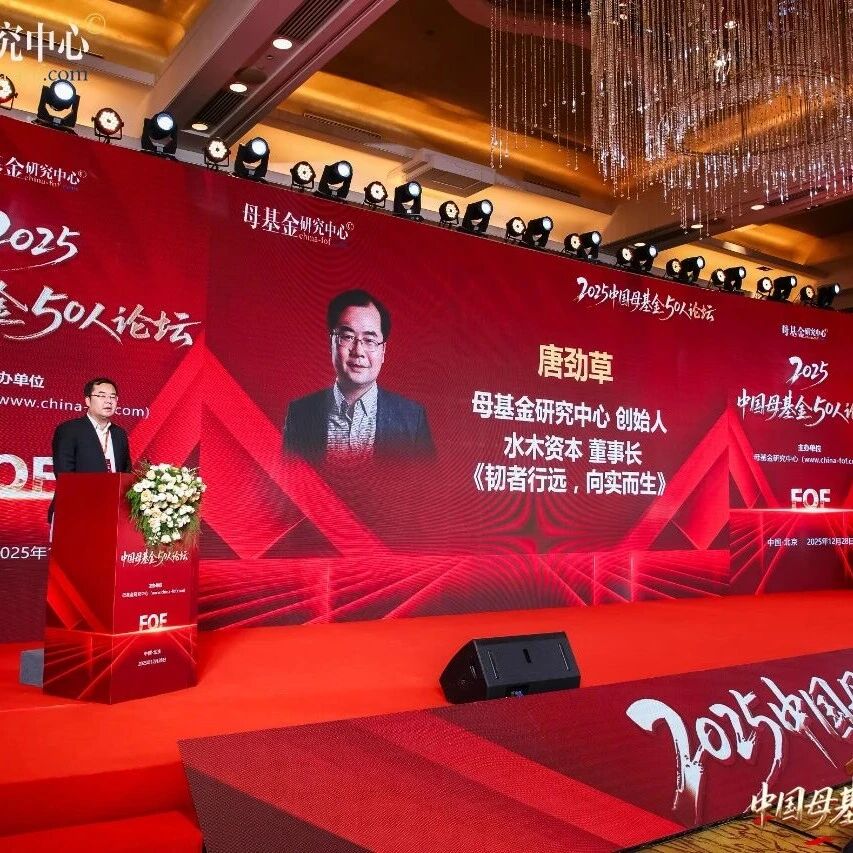
唐劲草:我们正站在从艰难转型向信心回归的关键节点
母基金研究中心· 2025-12-28 10:46
Core Viewpoint - The current primary market in China is transitioning from "scale expansion" to "mechanism restructuring," emphasizing the need for institutional innovation to facilitate capital flow towards new productive forces [1] Group 1: Market Dynamics - In 2025, the Chinese primary market shows a divergence between "statistical data recovery" and "micro individual coldness," with over 30% year-on-year growth in newly registered funds in Q2 and Q3, yet over 80% of new registrations are concentrated in leading institutions and large state-owned platforms [2][3] - The industry is undergoing a paradigm shift affecting the entire fundraising, investment, management, and exit chain, with 1,118 private fund managers either voluntarily or involuntarily deregistering from January to November 2025, indicating accelerated clearance of "zombie institutions" [2][3] - The funding landscape is characterized by a "structural siege," where state-owned general partners (GPs) dominate fundraising, leading to increased competition for private fund managers and a trend where limited partners (LPs) prefer to invest only in state-owned GPs [3] Group 2: Capital Patience and Confidence - The solution to the industry's challenges lies in systematic, top-level design for "mechanism restructuring," focusing on addressing the issues of capital "patience" and "confidence" [4] - The year 2025 marks the beginning of "super long duration" funds, with 53% of newly established guiding funds allowing sub-funds to have a duration of over 10 years, reflecting a shift from "quick returns" to respecting industrial laws [5] - A "high tolerance for loss" policy is being explored, allowing up to 80% investment loss tolerance for seed or future industry projects, marking a significant shift in assessment criteria from "single project evaluation" to "lifecycle evaluation" [6] Group 3: Exit Strategies and Liquidity - The traditional reliance on IPOs for exits is shifting, with over 90% of Chinese venture capital funds previously depending on IPOs, while in 2025, secondary transactions and mergers and acquisitions are becoming primary exit strategies [11] - The total transaction volume of domestic secondary funds reached 1,078 billion yuan in 2024, with a 46% year-on-year increase, and the first half of 2025 has already surpassed the total number of transactions in 2024 [11] - Flexible exit strategies, such as installment buybacks and debt restructuring, are being adopted to mitigate cash flow risks for startups, reflecting a deeper understanding of the high-risk, long-cycle nature of new productive forces [12] Group 4: Future Investment Landscape - In 2026, the investment focus is expected to shift towards "new productive forces," with low-altitude economy, embodied intelligence, and AI+ industries becoming core asset allocations [15] - The unique value of private GPs needs to be re-evaluated, as they possess advantages in early project discovery and flexible investment strategies, which are crucial for amplifying the effectiveness of state-owned guiding funds [16] - The current period is a critical juncture for China's equity investment mechanism, transitioning from difficult transformation to confidence restoration, with a consensus on long-duration funds, tolerance for failure, and flexible exits [17]