
机构承接能力

Search documents
超长债收益率迎来显著回落 年末理财配置环境有望改善
Xin Hua Cai Jing· 2025-12-18 01:24
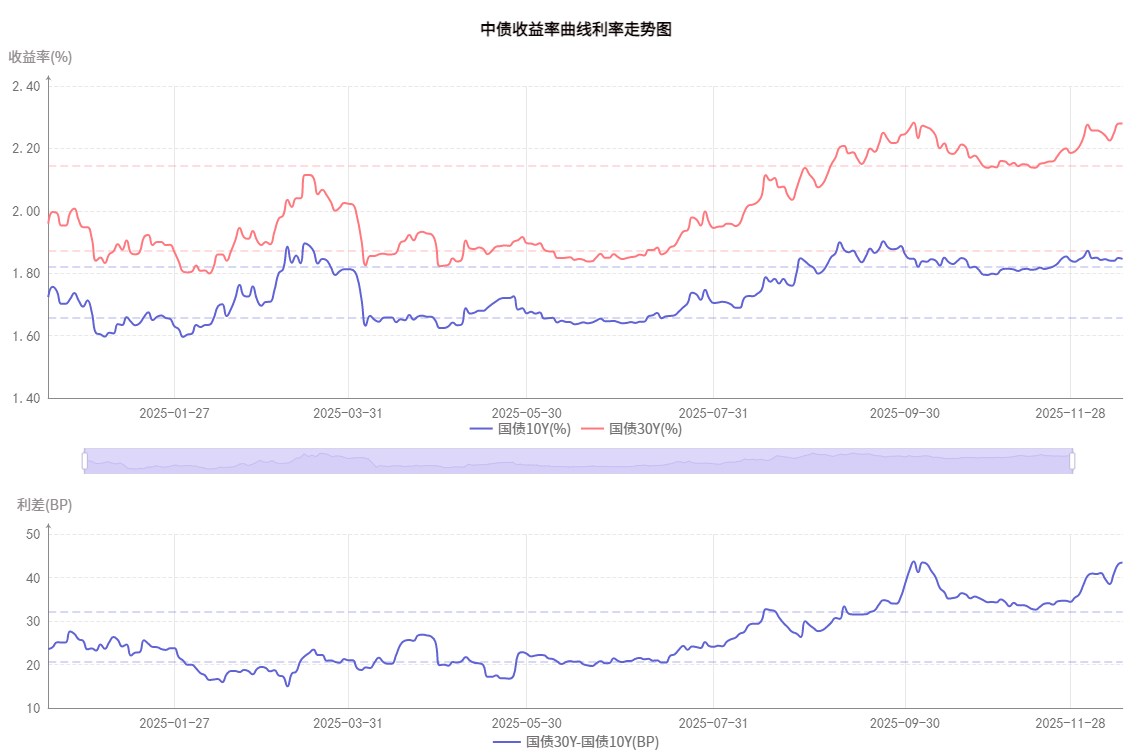
Core Viewpoint - The bond market has experienced significant volatility, particularly in ultra-long government bonds, with the 30-year government bond becoming a focal point for institutional trading and analysis as the year-end policy negotiation period approaches [1][3]. Group 1: Market Dynamics - The yield on the 10-year government bond has risen from 1.81% in mid-November to approximately 1.85%, with a peak of 1.87%, while the 30-year government bond yield increased from 2.14% to 2.28%, reaching a yearly high [1]. - The yield curve has steepened, with the spread between the 10-year and 30-year bonds widening from 33 basis points to 43 basis points [1]. Group 2: Institutional Behavior - The rise in the 30-year bond yield is attributed to a divergence in trading behaviors among institutions, particularly between banks, brokerages, and funds, reflecting deeper concerns about the macroeconomic environment and asset pricing [3]. - Brokerages have been significant net sellers, with a total net sell of 65.9 billion yuan in bonds over the period from November 20 to December 15, while funds also sold off 45.8 billion yuan during the same timeframe [3]. Group 3: Supply and Demand Factors - The supply pressure for ultra-long bonds has increased, with over 1 trillion yuan of 30-year bonds issued since 2025, a 30% increase compared to the total issuance in 2024 [4]. - The lack of sufficient buying power from banks and insurance companies has led to a "liquidation" phenomenon, where the marginal pricing power has shifted back to insurance and other institutional investors [4]. Group 4: Future Outlook - The market is focused on whether the supply-demand structure for ultra-long bonds can improve and if institutional buying capacity will increase [5]. - There is potential for a short-term stabilization in the 30-year bond risk after recent adjustments, although the overall trend remains weak [5]. - If supply pressures ease and institutional buying gradually increases, ultra-long bonds may return to stability, improving the investment environment for wealth management products [8].

2026超长债之供需格局
HUAXI Securities· 2025-12-16 08:12
Supply and Demand Dynamics - The total supply of long-term government bonds in 2026 is projected to be between 6.5 trillion and 7.2 trillion yuan, slightly higher than the 6.4 trillion yuan in 2025[2][4]. - The issuance of long-term government bonds has increased significantly since 2019, with the proportion of bonds with a maturity of over 10 years rising from less than 5% before 2019 to around 25% in recent years[2]. Market Behavior and Trends - From November 20 to December 15, 2025, net sales of bonds with maturities over 10 years totaled 659 billion yuan by brokerages, with funds also selling 458 billion yuan during the same period due to relative ranking pressures[1]. - The yield on 10-year government bonds rose from 1.81% to 1.87%, while the yield on 30-year bonds increased from 2.14% to 2.28%, leading to a widening yield spread of 43 basis points[1]. Issuance Patterns - In 2025, the issuance of special government bonds accounted for 1.3 trillion yuan, while ordinary long-term bonds totaled 211 billion yuan, indicating a shift towards longer maturities[3]. - The issuance of long-term local government bonds peaked in the first quarter of 2025, with significant amounts issued in subsequent months, reflecting a balanced issuance rhythm throughout the year[5][6]. Institutional Demand and Capacity - Major banks have been net sellers of long-term government bonds, with cumulative net sales of 3.58 trillion yuan for large banks and 2.79 trillion yuan for joint-stock banks in 2025[8]. - Insurance companies have emerged as significant buyers of long-term bonds, with net purchases of 2.36 trillion yuan in long-term government bonds and 1.88 trillion yuan in local bonds in 2025[9]. Future Outlook - The demand for long-term government bonds in 2026 may be constrained by potential declines in insurance premium growth and regulatory pressures on asset management products, which could limit their capacity to absorb new issuances[10][11]. - The market's ability to improve the supply-demand structure will be crucial for the performance of long-term bonds, with potential adjustments in bank capacity and central bank interventions being key factors to watch[12].