板块效应

Search documents
康达新材股价上涨4.13%,受板块情绪及业绩扭亏等多因素驱动
Jing Ji Guan Cha Wang· 2026-02-24 02:36
Core Viewpoint - Kangda New Materials (002669.SZ) experienced a stock price increase of 4.13% to 14.87 yuan, driven by sector performance, positive earnings forecasts, and technical indicators [1][2][3]. Sector Performance - The basic chemical sector rose by 2.22%, while the new materials sector increased by 2.08%, indicating a recovery in industry sentiment and a broad-based rally among leading stocks due to supply-side contraction and anti-involution policies [1]. Recent Performance - The company announced an earnings forecast on January 20, 2026, predicting a net profit of 125 to 135 million yuan for 2025, marking a turnaround from a loss of 246 million yuan in 2024, representing a growth of 150.78% to 154.84% [2]. Financial and Technical Analysis - The stock price broke through the 60-day moving average of 14.42 yuan, with a narrowing MACD histogram at -0.062 and a KDJ J-line rising to 90.255, indicating increased short-term buying momentum. Additionally, there was a net inflow of 1.4044 million yuan from main funds, reflecting institutional interest [3]. Company Valuation - Despite the anticipated profit increase for 2025, the current price-to-earnings ratio (TTM) is negative, while the price-to-book ratio stands at 1.66, below the industry average, suggesting potential for valuation recovery. Institutions forecast a net profit growth rate of 46.35% and a revenue growth rate of 12.12% for 2025, indicating improving fundamentals [4]. Future Development - The recent stock price increase is attributed to a combination of sector sentiment, earnings growth, technical breakthroughs, and valuation recovery. Investors should monitor the 2025 annual report, expected to be released in March 2026, for final confirmation of performance and the ongoing impact of wind power demand on core business [5].

玻纤,我拿住了
猛兽派选股· 2026-02-11 02:30
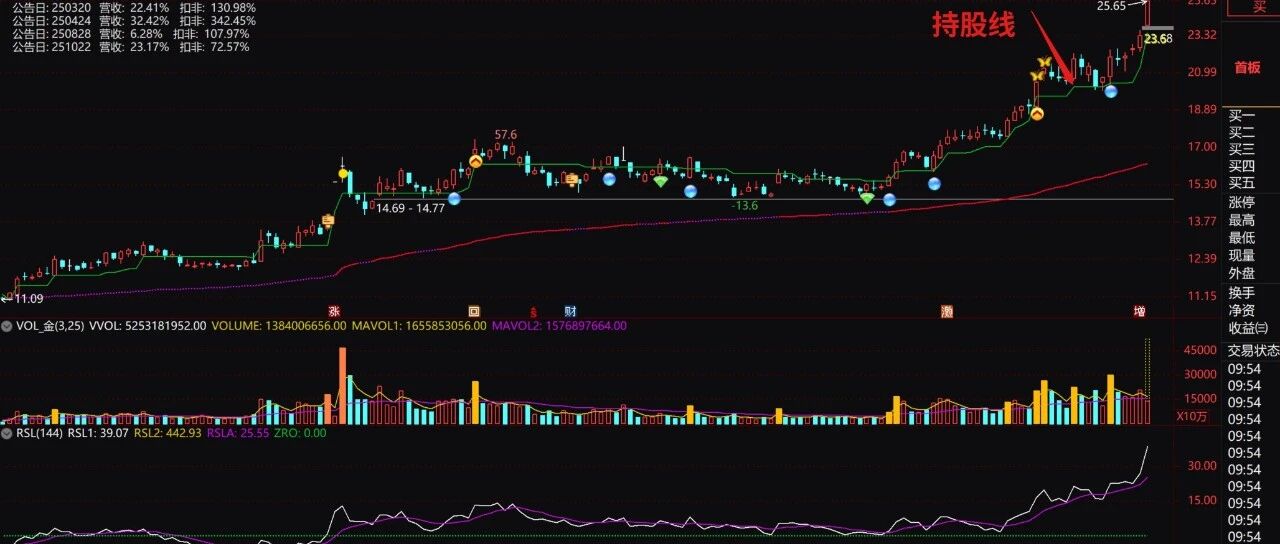
Group 1 - The article discusses the investment potential in the fiberglass sector, highlighting companies like Jushi, Honghe, and Fucai as easier to hold based on TR holding lines [1] - China National Materials (中材) is noted for its slow growth and has breached holding lines twice, making it challenging to maintain positions, although there are reasons to hold based on sector linkage and fundamentals [3] - The article suggests that when a stock breaches its holding line, investors might consider switching to stronger stocks like Jushi and Honghe, emphasizing the importance of sector performance and fundamental logic [4] Group 2 - The article mentions other companies in the copper-clad laminate sector, such as Shengyi Technology, Nanya New Materials, Huazheng New Materials, and Jin'an Guoji, indicating that despite Shengyi being a leading player, it has underperformed recently [4] - The performance metrics of Nanya New Materials and Huazheng New Materials are highlighted, with specific percentage changes noted, indicating their market positions [5] - The article concludes with a note on the unpredictability of future performance, suggesting that current conditions are the only controllable factors [7]


抓涨停不是靠运气,而是靠这套量价+逻辑双重验证模型
Sou Hu Cai Jing· 2025-10-05 02:44
Core Insights - The article discusses the dynamics of stock trading in the A-share market, particularly focusing on military and AI concept stocks, highlighting the importance of understanding the underlying patterns that drive stock price movements [1][3]. Group 1: Stock Trading Dynamics - A military stock reached its daily limit within 15 minutes of opening, with a buy order volume of 500,000 hands, indicating strong buying interest from major players [1][3]. - In contrast, an AI concept stock saw a 60% decrease in trading volume on its second day of hitting the limit, suggesting a lack of sustained interest from investors [1][3]. Group 2: Key Evidence for Stock Selection - The strength of a stock's limit-up performance is crucial; strong stocks typically hit their limit within the first 30 minutes and maintain that position without opening again [3][5]. - Volume changes are significant; a classic pattern is "first limit-up with high volume, second limit-up with reduced volume," indicating that initial buyers are not selling [3][5]. - The price movement before hitting the limit should show a steep upward trend with substantial large orders, reflecting urgent buying activity [5][7]. Group 3: Logical Framework for Stock Selection - Stocks should align with current market trends; those in rising sectors with positive news are more likely to sustain their gains [5][7]. - A clean shareholding structure is preferable; stocks with a market cap between 2 billion and 5 billion are easier to manipulate without institutional interference [5][7]. Group 4: Execution Strategy - A streamlined process for identifying potential stocks involves filtering for early limit-ups, checking order volumes, and verifying volume patterns [7][9]. - Quick validation of the stock's sector performance and institutional ownership is essential to ensure alignment with market trends [7][9]. Group 5: Common Pitfalls - Relying solely on a single indicator can lead to false signals; for instance, a stock may appear to hit its limit but lacks supporting volume [9][10]. - Ignoring the relevance of market trends can result in missed opportunities; stocks in outdated sectors may not perform well despite favorable volume patterns [10][11]. - A lack of stop-loss discipline can lead to significant losses; immediate action is necessary if a stock breaches the stop-loss threshold [10][11]. Group 6: Market Environment Adaptation - The strategy should be adjusted based on market conditions; for example, in a bull market, a higher tolerance for price drops may be acceptable [11][12]. - Stocks that meet the criteria of early limit-ups and sector alignment have a higher success rate compared to isolated stocks [11][12].