死亡互联网理论

Search documents
「死亡互联网理论」刷屏硅谷
投资界· 2025-10-26 08:32
Core Viewpoint - The article discusses the concept of the "Death of the Internet," which suggests that the internet is increasingly dominated by AI-generated content, leading to a loss of authenticity and real human interaction [2][4][9]. Group 1: The Impact of AI on Internet Authenticity - Alexis Ohanian, co-founder of Reddit, claims that the internet is largely "dead" due to the overwhelming presence of AI-generated content [2][4]. - The proliferation of AI-generated content is eroding the authenticity of the internet, with many posts and interactions potentially being driven by algorithms rather than real people [5][6]. - Users are increasingly encountering AI-generated tweets and posts, which often contain telltale signs of artificiality, such as abrupt transitions and overused metaphors [7][8]. Group 2: The Evolution of the "Death of the Internet" Theory - The "Death of the Internet Theory" (DIT) posits that the internet's vitality is tied to its authenticity, and a loss of this authenticity equates to its "death" [9][10]. - The rise of generative AI has provided more "real-world" support for the DIT, as AI-generated content becomes more prevalent and sophisticated [10][11]. - The theory has gained traction since its mention in 2021, reflecting a growing concern over the authenticity of online interactions [9][10]. Group 3: The Rise of Automated Traffic and AI Content - According to Cloudflare, bot traffic accounts for approximately 31% of overall application traffic, with automated traffic projected to reach 51% by 2024 [12][14]. - The increase in AI-generated articles is expected to surpass human-written articles by November 2024, indicating a significant shift in content creation [14][16]. - The recursive training of AI models on generated data may lead to a decline in content quality, resulting in a phenomenon known as "model collapse," where models lose diversity and produce increasingly homogeneous outputs [16][17]. Group 4: The Need for Authenticity in AI-Generated Content - Google CEO Sundar Pichai suggests that AI-generated content will fundamentally transform search engines, necessitating a collaborative interaction between AI and human content [18][21]. - There is a growing consensus among industry leaders, including Sam Altman and Elon Musk, on the importance of distinguishing between AI-generated and human-generated content to enhance trust [21][22]. - Regulatory measures are being implemented to address the challenges posed by AI-generated content, including the U.S. "TAKE IT DOWN Act" and the EU's AI Act, which emphasize the need for transparency and authenticity [23][24].


「死亡互联网理论」刷屏硅谷,Reddit创始人预警,奥特曼公开发声
3 6 Ke· 2025-10-21 02:26
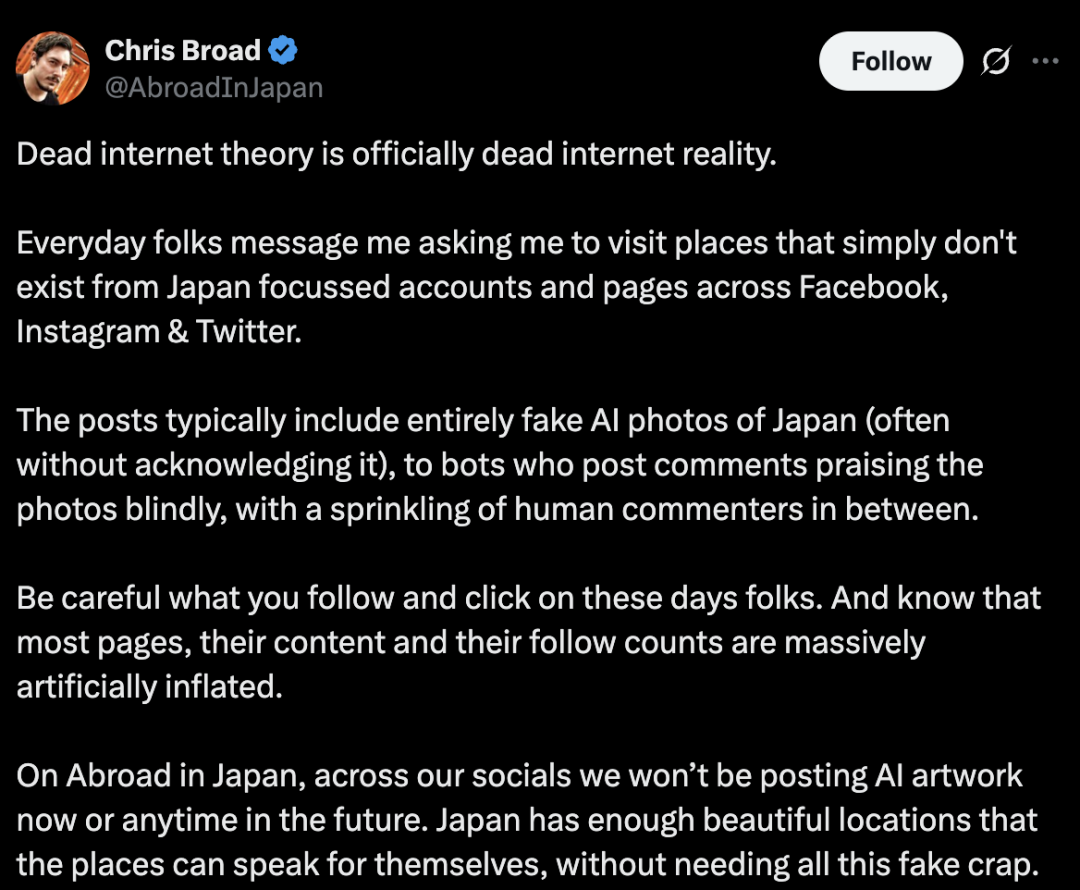
Core Viewpoint - The "Dead Internet Theory" suggests that the internet has lost its authenticity due to the overwhelming presence of AI-generated content, leading to a decline in genuine human interaction and trust in online platforms [8][10][27]. Group 1: The Impact of AI on Internet Authenticity - Alexis Ohanian, co-founder of Reddit, argues that the internet is being inundated with AI-generated content, which diminishes its vitality and authenticity [3][4]. - Chris Broad, a travel influencer, highlights the prevalence of fake locations and AI-generated images on social media, warning users to be cautious about the content they engage with [4][11]. - The rise of AI-generated content has led to a significant increase in automated traffic, with reports indicating that bot traffic accounts for approximately 31% of overall application traffic [11][12]. Group 2: The Evolution of Content Creation - Since the launch of ChatGPT in November 2022, the number of AI-generated articles has surged, with predictions that by November 2024, AI-generated articles will surpass those written by humans [14][16]. - The quality of AI-generated content is improving, making it a more viable source of information, which could further alter the structure of information sources on the internet [16][18]. - The concept of "Model Collapse" is introduced, where AI models may lose diversity and quality over time due to reliance on AI-generated data for training, leading to a potential crisis in content authenticity [17][18]. Group 3: The Need for Trust and Verification - Sam Altman emphasizes the importance of verifying the sources of content to enhance trust, as AI can confidently produce misleading information [24][25]. - Regulatory measures are being implemented to address the challenges posed by AI-generated content, including the U.S. government's "TAKE IT DOWN Act" and the EU's AI Act, which mandates transparency in synthetic content [25][26]. - The focus should shift from distinguishing between AI and human-generated content to ensuring that AI serves to enhance human authenticity and trust [28][29].

“死亡互联网理论”刷屏硅谷
虎嗅APP· 2025-10-20 09:57
Core Viewpoint - The article discusses the "Death of the Internet Theory," which suggests that the internet is losing its authenticity due to the overwhelming presence of AI-generated content, leading to a decline in genuine human interaction and creativity [3][14][20]. Group 1: The Rise of AI-Generated Content - Alexis Ohanian, co-founder of Reddit, claims that the internet is being inundated with AI-generated content, which diminishes its vitality and authenticity [3][4]. - The proliferation of AI-generated content is eroding the internet's truthfulness, as many online interactions may not involve real humans but rather algorithms and AI [6][5]. - Chris Broad, a travel influencer, notes that many messages he receives are about non-existent places, often based on AI-generated images and exaggerated social media accounts [7]. Group 2: The Impact of AI on Internet Authenticity - The "Death of the Internet Theory" posits that the loss of authenticity equates to the internet's demise, as the early organic, user-driven nature of the internet is being replaced by computer-generated content [17][18]. - The rise of generative AI has provided more "real-world support" for this theory, as AI is increasingly used to amplify social media interactions [19][20]. - Data from Cloudflare indicates that bot traffic accounts for approximately 31% of overall application traffic, with malicious bots making up 37% of automated traffic by 2024 [22]. Group 3: The Future of AI and Internet Content - By November 2024, AI-generated articles are expected to surpass those written by humans, indicating a significant shift in content creation dynamics [25]. - The quality of AI-generated content has improved, leading to a stable increase in its production, which may reshape the internet's authenticity baseline [27]. - The phenomenon of "model collapse" is highlighted, where AI models may lose diversity and quality due to reliance on AI-generated data for training [31][33]. Group 4: Addressing the Challenges of AI Content - Google CEO Sundar Pichai suggests that AI-generated content will fundamentally transform search engines, necessitating a collaborative interaction between AI and human content [35]. - There is a growing need to distinguish between AI-generated and human-generated content to maintain trust and authenticity in digital interactions [36][40]. - Regulatory measures are being implemented to address the challenges posed by AI-generated content, including laws against the malicious use of AI [42].

“死亡互联网理论”刷屏硅谷
Hu Xiu· 2025-10-19 23:26
Core Viewpoint - The internet is increasingly dominated by AI-generated content, leading to a decline in authentic human-created content, which some are referring to as the "death of the internet" [2][3][6]. Group 1: The "Death of the Internet" Theory - The "Death of the Internet" theory posits that the loss of authenticity equates to the internet's demise, as it becomes overrun by fake content [13][14]. - This theory gained traction in 2021, highlighting the growing perception that much of the internet is becoming artificial [15][17]. - The rise of generative AI has provided more support for this theory, as AI-generated content increasingly mimics human behavior on social media [19][20]. Group 2: The Impact of AI on Internet Content - According to Cloudflare, bot traffic accounts for approximately 31% of overall application traffic, with some regions experiencing even higher levels [24]. - Imperva's 2025 report indicates that automated traffic will reach 51% by 2024, with malicious bots making up 37% of that traffic [25][26]. - By November 2024, AI-generated articles are expected to surpass those written by humans, marking a significant shift in content creation [29][32]. Group 3: The Crisis of Model Collapse - The concept of model collapse arises from the recursive training of AI models on AI-generated data, leading to a loss of diversity and quality in content [36][38]. - As AI-generated content becomes more prevalent, the risk of producing lower-quality AI outputs increases, potentially resulting in a downward spiral of content quality [40][41]. Group 4: The Need for Authenticity and Trust - Google and Nvidia executives emphasize the importance of integrating AI-generated content with human input to maintain authenticity [42][43]. - There is a growing challenge in distinguishing between AI-generated and human-generated content, as many AI outputs are guided by human input [45][48]. - Sam Altman advocates for verifiable sources and governance tools to enhance trust in content, stressing that authenticity is paramount [49][50]. Group 5: Regulatory Responses - Recent legislative efforts, such as the U.S. "TAKE IT DOWN Act" and the EU's AI Act, aim to regulate AI-generated content and ensure transparency [55][56]. - These regulations highlight the necessity of identifying AI content to mitigate risks associated with misinformation and maintain the integrity of digital interactions [57][58].
腾讯研究院AI速递 20251020
腾讯研究院· 2025-10-19 16:01
Group 1: Nvidia and TSMC Collaboration - Nvidia and TSMC unveiled the first Blackwell chip wafer produced in the U.S., marking a significant milestone in domestic chip manufacturing [1] - The TSMC Arizona factory has a total investment of $165 billion and will produce advanced chips using 2nm, 3nm, and 4nm processes [1] - The Blackwell chip features 208 billion transistors and achieves a connection speed of 10TB/s between its two sub-chips through NV-HBI [1] Group 2: Anthropic's Agent Skills - Anthropic launched the Agent Skills feature, allowing users to load prompts and code packages as needed, enhancing the capabilities of AI [2] - Skills can be used across Claude apps, Claude Code, and API platforms, with a focus on minimal necessary information loading [2] - The official presets include nine skills for various document formats, and users can upload custom skills [2] Group 3: New 3D World Model by Fei-Fei Li - Fei-Fei Li's World Labs introduced a real-time generative world model, RTFM, which can render persistent 3D worlds using a single H100 GPU [3] - RTFM employs a self-regressive diffusion Transformer architecture to learn from large-scale video data without explicit 3D representations [3] - The model maintains spatial memory for persistent world geometry through pose-aware frames and context scheduling technology [3] Group 4: Manus 1.5 Update - Manus released version 1.5, introducing a built-in browser that allows AI to interact with web pages, test functions, and fix bugs [4] - A new Library file management system enables collaborative editing within the same Agent session, reducing average task completion time significantly [4] - The system allows for no-code music web application construction through natural language, supporting real-time updates [4] Group 5: Windows 11 Major Update - Windows 11's major update features "Hey Copilot" for voice activation and Copilot Vision for screen understanding, enhancing user interaction [5][6] - Copilot Actions can perform operations on local files, while Copilot Connectors integrate with OneDrive, Outlook, and Google services [5][6] - Manus AI operations are integrated into the file explorer, allowing for automatic website generation and video editing functionalities [6] Group 6: Baidu's PaddleOCR-VL Model - Baidu open-sourced the PaddleOCR-VL model, achieving a score of 92.6 on the OmniDocBench V1.5 leaderboard with only 0.9 billion parameters [7] - The model supports 109 languages and excels in text recognition, formula recognition, table understanding, and reading order prediction [7] - It utilizes a two-stage architecture combining dynamic resolution visual encoding and a language model, achieving high inference speed on A100 [7] Group 7: AI in Fusion Energy Development - Google DeepMind collaborates with CFS to accelerate the development of the SPARC fusion device using AI [8] - The partnership focuses on creating precise plasma simulation systems and optimizing fusion energy output [8] - The TORAX simulator is a key tool for CFS, enabling extensive virtual experiments and real-time control strategy exploration [8] Group 8: Harvard Study on AI's Impact on Employment - A Harvard study tracking 62 million workers found a significant decline in entry-level positions in companies using AI, primarily through slowed hiring [9] - The impact of AI is most pronounced among graduates from mid-tier universities, while top-tier and bottom-tier institutions are less affected [9] - The wholesale and retail sectors face the highest risk for entry-level jobs, with a trend towards skill polarization [9] Group 9: Concerns Over AI-Generated Content - Reddit co-founder Ohanian warned that much of the internet is "dead," overwhelmed by AI-generated content [10] - Reports indicate that automated traffic could reach 51% by 2024, with AI-generated articles surpassing human-written ones [10] - Research suggests that training models on AI-generated data may lead to a decline in model performance [10] Group 10: Andrej Karpathy on AGI Development - AI expert Andrej Karpathy expressed skepticism about the current state of AI agents, predicting that AGI is still a decade away [11] - He criticized the noise in reinforcement learning and the limitations of pre-training methods [11] - Karpathy anticipates that AGI will contribute modestly to GDP growth, emphasizing the importance of education in the AI era [11]




「死亡互联网理论」刷屏硅谷!Reddit创始人预警,奥特曼公开发声
创业邦· 2025-10-19 03:25
Core Viewpoint - The article discusses the "Death of the Internet" theory, which posits that the internet is losing its authenticity due to the overwhelming presence of AI-generated content, leading to a decline in genuine human interaction and creativity [5][7][8]. Group 1: The Impact of AI on Internet Authenticity - Alexis Ohanian, co-founder of Reddit, claims that the internet is being overwhelmed by AI-generated content, resulting in a loss of its original vitality [5]. - Travel influencer Chris Broad highlights the prevalence of fake locations and AI-generated images on social media, warning users to be cautious about the content they engage with [6]. - The rise of AI-generated content has led to a significant increase in bot traffic, which accounted for approximately 31% of overall application traffic, with projections indicating that automated traffic could reach 51% by 2024 [10]. Group 2: The Evolution of the "Death of the Internet" Theory - The "Death of the Internet" theory originated from a forum post in 2021, suggesting that the internet is becoming increasingly artificial and disconnected from real human experiences [7]. - The theory has gained traction as generative AI technologies have advanced, leading to a proliferation of content that mimics human interaction but lacks authenticity [8][12]. - A study from Oxford University indicates that the recursive training of AI models on generated data could lead to a phenomenon known as "model collapse," where the quality and diversity of AI-generated content deteriorate over time [14]. Group 3: The Future of AI and Human Interaction - Google CEO Sundar Pichai suggests that AI-generated content will fundamentally transform search engines, leading to a new paradigm of interaction between AI and human-generated content [16]. - There is a growing consensus among industry leaders, including Sam Altman and Elon Musk, on the necessity of developing tools to identify and verify AI-generated content to maintain trust and authenticity in digital interactions [19][20]. - The European Union's AI Act mandates that synthetic content must be labeled, emphasizing the importance of transparency and authenticity in the age of AI [21].