
水资源费改税

Search documents
中国经济社会绿色转型加快
Ren Min Ri Bao Hai Wai Ban· 2026-02-10 02:01
Core Viewpoint - China's economic and social green transformation is accelerating, driven by structural optimization in industries, energy, and transportation, along with effective tax policies promoting emission reduction and water conservation [2][3]. Industry Structure - The proportion of "dual high" industries is continuously decreasing, while green and low-carbon industries are developing well. During the 14th Five-Year Plan period, key green product manufacturing sectors such as new energy vehicles, photovoltaic equipment, lithium-ion batteries, and solar appliances are expected to see annual sales growth rates exceeding 30% [2]. - Sales revenue in green technology service industries, including new energy, energy-saving, and environmental protection, is projected to grow annually by 51.1%, 28.5%, and 18.2% respectively, while ecological protection and environmental governance industries are expected to grow by 13.2% annually [2]. Energy Structure - The share of clean energy is steadily increasing, with high-energy-consuming manufacturing industries optimizing their energy use. By 2025, sales revenue from clean energy generation, including wind, solar, hydro, and nuclear power, is expected to account for 42.6% of total power generation revenue, an increase of 7.2 percentage points from the end of the 13th Five-Year Plan [2]. - Sales revenue from wind and solar power generation is projected to grow at an annual rate of 25.4% during the 14th Five-Year Plan period [2]. Transportation Structure - The new energy vehicle industry is experiencing strong growth, with an increase in the proportion of railway and waterway freight. By 2025, domestic sales of new energy vehicles are expected to grow by 25.9% year-on-year [2]. Pollution Reduction and Water Conservation - The environmental protection tax policy has released tax reduction benefits, with cumulative tax reductions amounting to 111.06 billion yuan since its implementation in 2018. This includes 59.945 billion yuan for promoting centralized treatment and improving pollution control efficiency, 24.37 billion yuan for promoting clean production, and 26.134 billion yuan for enhancing governance efficiency [3]. - The number of urban and rural sewage and solid waste treatment plants benefiting from environmental tax incentives is expected to increase from 5,589 in 2021 to 6,415 by 2025 [3]. - By 2025, the environmental tax revenue from key air pollutants such as sulfur dioxide and nitrogen oxides is projected to decrease by 33.8% and 34.03% respectively compared to 2020 [3]. - The pilot program for converting water resource fees to taxes is expected to yield positive results, with a projected 7.1% decrease in underground water extraction in new pilot areas by 2025, totaling 5.47 billion tons [3].
2025年水资源费改税新试点地区节水成效明显
Zhong Guo Jing Ying Bao· 2026-02-09 16:06
Core Insights - The pilot program for water resource fee reform into tax will be implemented nationwide starting December 1, 2024 [1] - In 2025, taxpayers in the new pilot regions are expected to extract 5.47 billion tons of groundwater, a decrease of 7.1% compared to 2024, with over 4,500 self-owned wells shut down [1] - Special water usage sectors such as golf courses, ski resorts, car washes, and bathhouses have seen a significant reduction in water usage by 34.3% compared to 2024 [1] Tax Incentives and Environmental Impact - The tax authorities have reduced tax payments by 61.197 million yuan for 381 taxpayers who meet the water-saving preferential policy conditions [1] - This initiative effectively promotes the conservation, intensive, and circular utilization of water resources, as well as ecological environmental protection [1]
21省水资源费改税收入年增两位数
第一财经· 2025-12-09 03:12
Core Viewpoint - The article discusses the implementation and impact of the water resource tax reform in China, highlighting its role in increasing local government revenue and promoting water conservation efforts. Group 1: Water Resource Tax Reform - The water resource tax reform was implemented nationwide starting December 1, 2024, leading to a significant increase in local government revenue, with tax income reaching 18.5 billion yuan, a growth of 18.5% compared to the same period in 2024 [3][5]. - The number of taxpayers under the water resource tax has increased to 94,000, marking a 26.9% rise from the previous year [3]. - The reform aims to address the previous chaotic management of water resource fees and enhance the effectiveness of water conservation measures [3][4]. Group 2: Local Government Financial Impact - The Ministry of Finance has decided that all water resource tax revenues will be retained by local governments, contrasting with the previous 1:9 revenue sharing model with the central government [4]. - The incremental revenue from the water resource tax reform for the 21 provinces is approximately 2.96 billion yuan, which is considered relatively small [5]. - Local public budget revenues for the first ten months of the year reached 10.5 trillion yuan, reflecting a year-on-year growth of 2.1% [8]. Group 3: Water Conservation and Corporate Response - The tax reform has led to a notable decrease in groundwater extraction, with a reported 13% reduction in groundwater usage in the first three quarters of 2025 compared to 2024 [5]. - There has been a significant drop in special water usage by 49.7%, indicating improved awareness and action towards water conservation among enterprises [5]. - A total of 369 enterprises have qualified for tax reductions under the new water resource tax policy, resulting in a tax relief of 4.395 million yuan [5]. Group 4: Broader Fiscal Reforms - The government is also planning to shift some consumption tax collection responsibilities to local governments to further enhance local fiscal autonomy, with the current consumption tax revenue being approximately 1.7 trillion yuan annually [6]. - Recent amendments to the environmental protection tax law will include volatile organic compounds in the tax scope, potentially increasing local government revenues from environmental taxes [7]. - The ongoing fiscal reforms aim to optimize the sharing ratio of various taxes to bolster local financial capabilities [7].


21省水资源费改税收入年增两位数
Di Yi Cai Jing· 2025-12-09 02:52
Core Insights - The implementation of the water resource tax reform has led to a significant increase in local government revenue, with an estimated additional fiscal income of approximately 3 billion yuan [1][3] - The number of taxpayers under the water resource tax has risen to 94,000, marking a 26.9% increase compared to the previous year [1] - Water resource tax revenue reached 18.96 billion yuan, reflecting an 18.5% increase year-on-year [1] Group 1: Water Resource Tax Reform - The water resource tax reform aims to enhance local fiscal autonomy and expand local tax sources by retaining all tax revenue at the local level [2] - The reform has introduced a "differentiated taxation" mechanism, encouraging water conservation by imposing higher taxes on excessive water usage while providing tax incentives for water-saving practices [2] - In the first three quarters of 2025, the water extraction volume for underground water in newly piloted regions decreased by 13%, and special water usage dropped by 49.7% compared to the previous year, indicating the effectiveness of the tax in promoting water resource protection [2] Group 2: Broader Fiscal Context - Local fiscal revenue growth has been sluggish, prompting the need for reforms to increase local financial autonomy, with the water resource tax reform being a key initiative [3] - The government plans to accelerate the transition of certain consumption tax collection responsibilities to local authorities to further enhance local fiscal capacity [3] - The Ministry of Finance has indicated that the reform of consumption tax collection is still in the planning stages, aiming to address the imbalance in fiscal revenue distribution between central and local governments [3] Group 3: Expert Insights on Tax Reforms - Experts emphasize the importance of manageable tax administration when considering which consumption tax items to shift to local collection, as this could complicate tax enforcement [4] - The potential impact of tax reforms on various industries and consumer behavior is a critical factor in the decision-making process [4] - Recent legislative changes, including the inclusion of volatile organic compounds in the environmental protection tax, are expected to provide additional fiscal revenue for local governments [4] Group 4: Local Budget Performance - In the first ten months of this year, local general public budget revenue was approximately 1.05 trillion yuan, reflecting a year-on-year growth of 2.1% [5] - Local government fund budget revenue saw a decline of 3.3%, while expenditures increased by 7.3%, indicating a growing fiscal pressure on local governments [5]
一组组税收数据勾勒中国经济高质量发展“画卷” 多领域“亮点”不断涌现
Yang Shi Wang· 2025-12-08 09:54
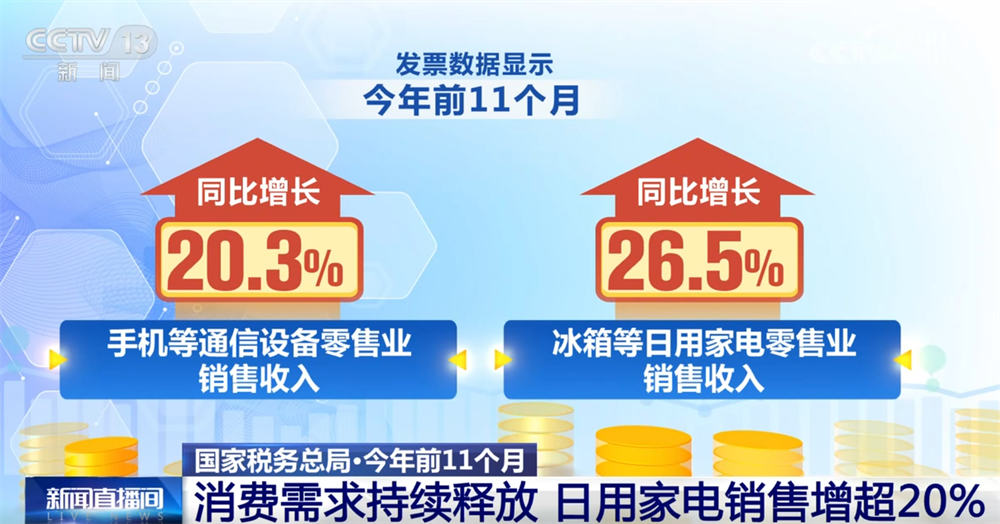
Group 1: Consumer Demand and Sales Growth - Consumer demand has been continuously released this year, driven by policies such as the trade-in program for consumer goods [1] - Sales of home appliances and new energy vehicles have maintained rapid growth, with retail sales of communication devices and daily household appliances increasing by 20.3% and 26.5% year-on-year, respectively [1] - The sales revenue of new energy passenger vehicles has also shown a positive trend, with a year-on-year increase of 19.1% [1] Group 2: Cultural and Tourism Sector Growth - The cultural and tourism market has seen the emergence of new business formats and scenarios, enhancing consumer vitality [3] - Sales revenue from artistic creation and performance, as well as film screenings, increased by 15.6% and 19.1% year-on-year, respectively [5] - The integration of tourism with cultural activities has led to a surge in immersive and scenario-based tourism consumption [5] Group 3: Sports and Health Sector Performance - The sports and health sectors have exhibited high consumer enthusiasm, with sports exhibition services and retail sales of sports goods increasing by 29.7% and 6.6% year-on-year, respectively [5] - Health-related consumption has become a new hotspot, with retail sales of health auxiliary treatment equipment and health consulting services maintaining double-digit growth [5] Group 4: Elderly Care Services Demand - The consumption demand from the elderly population has increased, driving diversified growth in essential elderly care services [7] - Sales in elderly care, social assistance, and nursing home services have increased by 33.6%, 9.6%, and 14.6% year-on-year, respectively [7] Group 5: Tax Refunds and Cross-Border Trade - The sales volume and tax refunds for tax refund goods have increased by 98.8% year-on-year, reflecting the optimization of the tax refund policy and services [8] - The number of tax refund stores has reached 12,252 nationwide, with over 7,000 stores offering "buy and refund" services [8][10] - The variety of goods eligible for tax refunds has expanded significantly, with 329 categories available, an increase of 84 categories year-on-year [10] Group 6: Water Resource Tax Reform - The implementation of the water resource tax reform has shown significant results, with a 26.9% increase in the number of tax filers and an 18.5% increase in tax revenue [11] - The tax reform has led to a notable decrease in groundwater and special water usage, with a 13% and 49.7% reduction, respectively [13] Group 7: Inter-Provincial Trade Growth - The proportion of inter-provincial trade sales in the national sales revenue has increased to 41.1%, up 0.8 percentage points year-on-year [16] - The number of provinces experiencing growth in inter-provincial trade has risen from 19 to 27, indicating deepening trade connections [16] - The average processing time for cross-regional tax-related business has been reduced by 5 to 10 days, enhancing efficiency [18]
水资源费改税成效显著,新扩围省份地下水和特种取用水量明显下降
Sou Hu Cai Jing· 2025-12-08 04:16
Core Insights - The implementation of the water resource tax reform pilot across 21 newly included provinces has led to a significant decrease in groundwater and special water usage, demonstrating the effectiveness of tax regulation [1] Tax Revenue and Compliance - The number of taxpayers for water resource tax in the newly expanded provinces reached 94,000, marking a 26.9% increase compared to the number of water resource fee payers in 2024 [1] - Water resource tax revenue amounted to 18.96 billion yuan, reflecting an 18.5% increase compared to the same period in 2024 [1] Tax Mechanism and Incentives - The reform has established a mechanism where excessive water consumption incurs higher taxes, while water-saving practices enjoy tax benefits, further highlighting the effectiveness of tax regulation [1] - There is an increased awareness and proactive approach among enterprises towards water conservation, with 369 companies meeting the national water usage quota standards and qualifying for tax incentives, resulting in a tax reduction of 4.395 million yuan [1]
巩固深化水资源费改税成效
Jing Ji Ri Bao· 2025-06-29 22:03
Group 1 - The core viewpoint of the article highlights the initial positive effects of the water resource tax reform, with a total revenue of 10.4 billion yuan in the first quarter, indicating a smooth operation of the new tax system [1] - The reform has led to a significant reduction in water usage in key sectors, with groundwater and special industry water usage decreasing by 15.4% and 41.5% respectively compared to the previous year [1] - Urban public water supply enterprises have seen a reasonable tax burden reduction of 8.7% compared to the previous year, due to adjustments in tax calculations that account for reasonable losses [1] Group 2 - The success of the reform is attributed to collaborative efforts among various departments, including tax and water administration, which have established mechanisms for data sharing and automated tax calculations [2] - Local authorities have been granted expanded powers to implement tax incentives, simplify tax standards, and adjust specific tax rates, promoting a cycle of water conservation, tax reduction, efficiency increase, and emission reduction [2] - The comprehensive implementation of the water resource tax reform is seen as a crucial measure to leverage tax incentives, enhance societal awareness of water conservation, and encourage enterprises to improve water efficiency for high-quality development [2] Group 3 - The importance of the water resource tax reform is emphasized, with a call for continued collaboration to create favorable conditions for its deepening, including the introduction of more intelligent services and optimization of technical measures [3] - Taxpayers are urged to fulfill their legal obligations regarding tax payments and ensure accurate water measurement data, contributing to the green development of the economy and society [3]
水资源费改税试点全面实施 首季征期整体运行平稳
news flash· 2025-05-26 11:48
Core Viewpoint - The nationwide implementation of the water resource tax reform has shown initial positive effects, with stable operations during the first quarter of 2025 and increased revenue compared to the previous year [1] Group 1: Tax Revenue and Growth - In the first quarter of 2025, the total water resource tax revenue reached 10.4 billion yuan, with 4.35 billion yuan generated from 21 new pilot provinces [1] - Excluding seasonal factors from hydropower and annual reporting for agricultural water use, the average revenue from water resource fees increased by 16.4% compared to 2024 [1] Group 2: Taxpayer Engagement - The number of taxpayers in the new pilot regions reached 87,000, an increase of 13,000 compared to the previous year [1] - Among these, 3,500 previously unlicensed water users completed their tax declarations, with 2,700 of them proactively applying for water extraction permits [1] Group 3: Public Response and Awareness - The reform has not significantly increased the burden of water costs on residents and businesses, while enhancing awareness of water conservation among the public [1]
一季度水资源税收入超百亿,城镇公共供水企业税负还降了
Di Yi Cai Jing· 2025-05-26 09:07
Core Viewpoint - The implementation of the water resource tax reform has led to a significant increase in tax revenue, compelling market participants to conserve water while reducing the tax burden on urban public water supply enterprises [1][2][3]. Summary by Sections Tax Revenue Growth - Since the nationwide promotion of the water resource tax reform at the end of last year, there has been a notable increase in water resource tax revenue. In the first quarter of 2025, the total revenue reached 10.4 billion yuan, with 4.35 billion yuan coming from 21 newly piloted provinces, marking a 16.4% increase compared to the average quarterly revenue from the water resource fee in 2024 [2][3]. Taxpayer Participation - The number of taxpayers in the newly piloted regions has risen to 87,000, an increase of 13,000 or 18% compared to the previous year [2]. Resource Tax Composition - Water resource tax accounted for approximately 14% of the total resource tax revenue of 72.4 billion yuan in the first quarter of this year [3]. Conservation Measures - The reform emphasizes the principles of "paying for resource use" and "polluters pay." It includes higher tax rates for regions facing severe water shortages and for industries with high water consumption, such as golf courses and car washes, with some tax rates increasing by over 15 times compared to before the reform [3][4]. Water Usage Reduction - In the first quarter of 2025, the water usage in key regulated sectors, including groundwater and special industries, decreased by 15.4% and 41.5%, respectively, compared to the average in the previous year [3]. Impact on Urban Public Water Supply - The tax reform has not increased the water burden on residents. Urban public water supply enterprises, which are essential for public welfare, saw an 8.7% reduction in tax burden compared to the previous year [4]. Future Collaboration - The tax authority plans to enhance collaboration with the finance and water resources departments to improve taxpayer convenience and ensure the effective implementation of the reform, promoting the sustainable and efficient use of water resources [5].