汽车数据安全

Search documents
中国汽车市场一周行业信息快报——2026年2月第2期
Zhong Guo Zhi Liang Xin Wen Wang· 2026-02-09 08:34
Policy Developments - The Ministry of Industry and Information Technology, along with seven other departments, issued the "Automotive Data Export Security Guidelines (2026 Edition)" to enhance data security in the automotive sector [1][9] - A mandatory national standard for automotive door handles, "Safety Technical Requirements for Automotive Door Handles (GB 48001-2026)," was approved and will be implemented starting January 1, 2027 [2] Company Announcements - BYD launched a new automotive brand named "Linghui," targeting the B-end market for government and fleet vehicle procurement [3][5] - BMW Group unveiled its 2026 strategic plan, emphasizing a year of delivery and product expansion in the Chinese market, with plans to introduce approximately 20 new or updated models across its brands [10][12] Collaborative Initiatives - Quanzhou City signed a cooperation agreement with CATL to establish a smart zero-carbon battery factory, focusing on advanced green manufacturing technologies [6][8]





汽车数据出境中国方案落地
Mei Ri Jing Ji Xin Wen· 2026-02-03 12:05
Core Viewpoint - The article discusses the release of the "Automotive Data Export Security Guidelines (2026 Edition)" by the Ministry of Industry and Information Technology and other departments, which aims to regulate the management of automotive data export activities and enhance data security protection levels in the automotive industry [1][3]. Group 1: Data Generation and Market Trends - Intelligent connected vehicles generate approximately 10TB of data daily, which is 5 to 10 times more than traditional fuel vehicles [1]. - By November 2025, the cumulative sales of passenger cars equipped with urban NOA (Navigation On Autopilot) functions in China are expected to reach 3.129 million units, accounting for 15.1% of the total insured passenger vehicles [1]. Group 2: Guidelines Overview - The "Safety Guidelines" consist of four parts, detailing the identification rules for important data related to various automotive industry scenarios, including automated driving and software upgrades [2]. - The guidelines specify that automotive data processors must classify data based on type and description before determining its level of importance [2]. Group 3: Data Export Process - The guidelines outline requirements for identifying and managing important data export activities, conducting security assessments, and establishing standard contracts for personal information exports [2][3]. - Certain important data related to security vulnerabilities and OTA software updates are exempt from declaration for security assessments, facilitating a quicker data export process [3]. Group 4: Industry Context and Historical Background - The release of the "Safety Guidelines" marks a significant revision compared to previous regulations, addressing industry feedback and incorporating new risk considerations due to technological advancements [4]. - China's automotive industry is increasingly globalized, with projected exports of 7.098 million vehicles in 2025, a year-on-year increase of 21.1%, and 2.615 million new energy vehicles, a 103.7% increase [4][5]. Group 5: Data Security Importance - Data security is critical for the sustainable development of the automotive industry, as highlighted by recent data breach incidents, such as the one affecting Toyota, which compromised data for over 2.15 million users [5]. - Most domestic automakers have established mature data security management systems and teams to ensure compliance with the new guidelines [5].
聚焦三类汽车数据出境行为,八部门联合发布安全指引
证券时报· 2026-02-03 10:06
Core Viewpoint - The release of the "Automotive Data Export Security Guidelines (2026 Edition)" aims to establish an efficient, convenient, and secure mechanism for the cross-border flow of automotive data in China [1][2]. Group 1: Overview of the Guidelines - The guidelines target various scenarios including automotive R&D, manufacturing, automated driving, software upgrades, and connected operations, detailing important data identification rules and methods for conducting security assessments for data exports [1][2]. - The guidelines are applicable to automotive data processors providing data from China to overseas entities, covering three main categories of data handling [2][3]. Group 2: Categories of Data Handling - The first category involves transferring data collected and generated during domestic operations to overseas locations [3]. - The second category pertains to data that, while stored domestically, can be accessed, queried, or exported by foreign organizations or individuals [3]. - The third category includes activities related to processing personal information of domestic individuals overseas, in compliance with the Personal Information Protection Law of the People's Republic of China [3]. Group 3: Importance and Impact - The guidelines introduce a clear identification rule for "important data," listing 27 categories and 51 items of important data along with corresponding identification rules [3]. - The introduction of these guidelines is closely linked to the international expansion of China's automotive industry, which is expected to facilitate automotive companies' overseas operations and international business strategies [3].

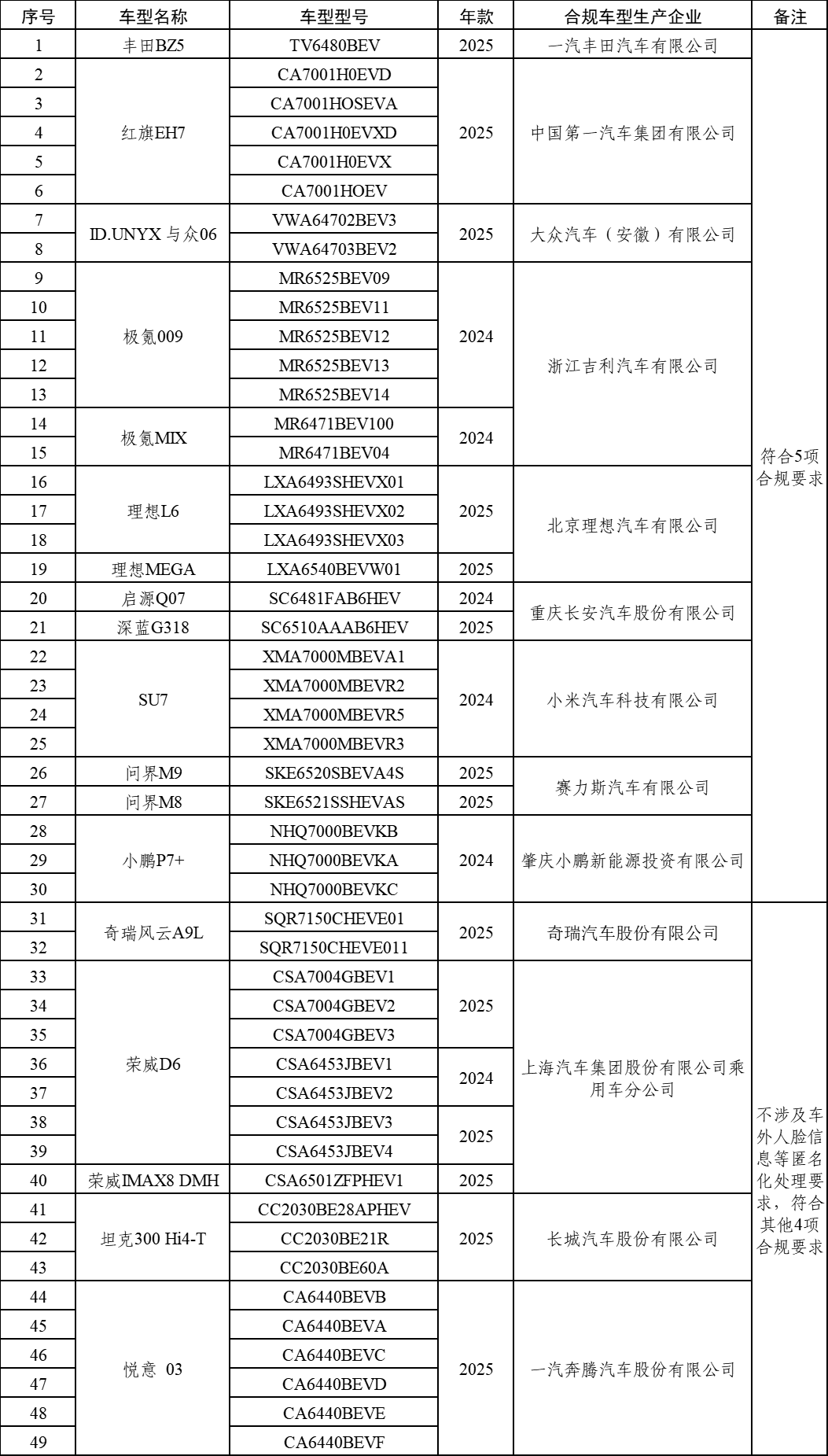
新华社权威快报|瞄准高效便利安全 新版汽车数据出境安全指引发布
Xin Hua She· 2026-02-03 08:48
Core Viewpoint - The Ministry of Industry and Information Technology, along with eight other departments, has released the "Automotive Data Export Security Guidelines (2026 Edition)" to promote efficient, convenient, and secure cross-border flow of automotive data [2][3]. Group 1: Guidelines Overview - The guidelines establish management methods and applicable conditions for automotive data export activities [5]. - Nine categories of exemptions are proposed, targeting various business scenarios such as research and development, manufacturing, automated driving, software upgrades, and connected operations [5]. - Important data determination rules are detailed, along with protective requirements to guide automotive data processors in conducting data export activities [5].
哪吒汽车破产重整新进展:已选定经营管理受托方;菜鸟入股九识智能,拟整合无人车业务丨汽车交通日报
创业邦· 2025-12-19 14:57
Group 1 - Nezha Auto has selected a management trustee for its bankruptcy restructuring, with two institutions submitting applications and one being chosen to assist in the management process [2] - The China Automotive Industry Association has published compliance results for five data security requirements, with nine manufacturers, including BYD and Changan, having 43 models meeting these standards [2] - Cainiao Group is in talks to invest in Jiushi Intelligent, aiming to integrate its unmanned vehicle business, with plans to launch a low-cost L4 autonomous delivery vehicle [2] - Toyota plans to sell three models manufactured in the U.S. in Japan starting in 2026, aiming to improve trade relations between Japan and the U.S. [2] Group 2 - Geely's autonomous driving integration faces personnel changes, with the chief scientist of Qianli Zhijia leaving, indicating potential shifts in the company's strategic direction [3]

关于汽车数据处理5项安全要求检测情况的通报(第三批)
Cai Jing Wang· 2025-08-18 11:50
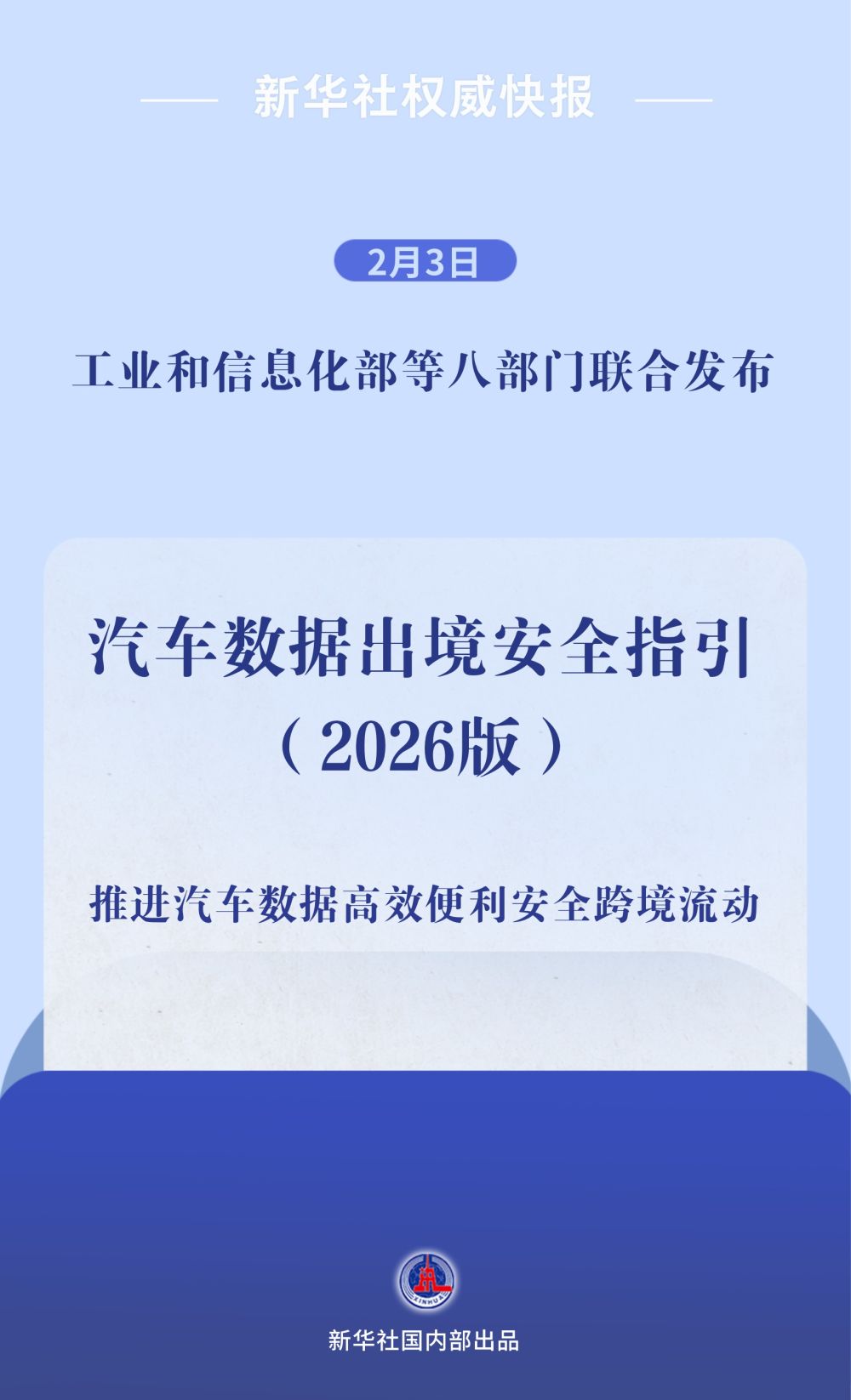
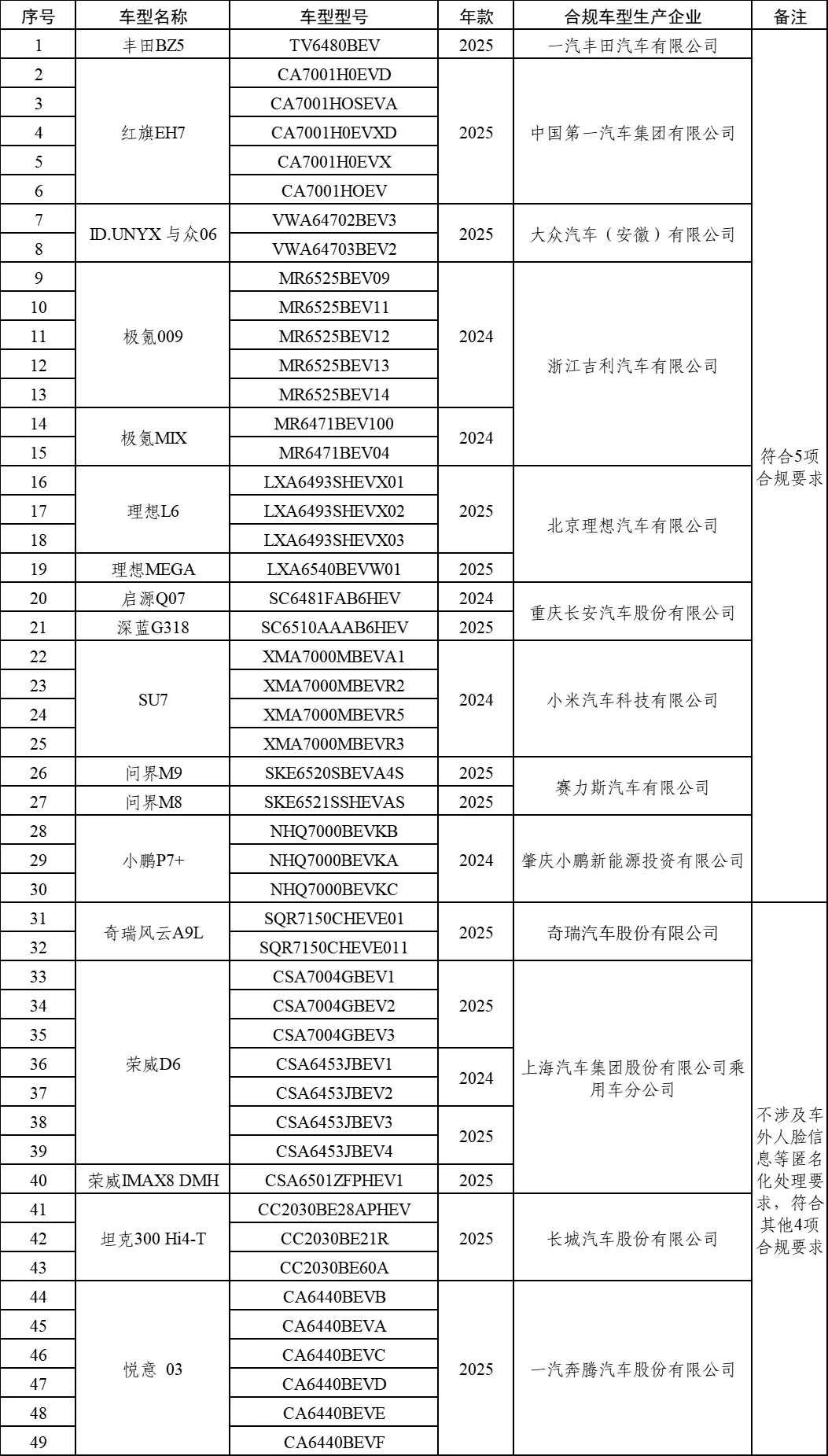
Core Viewpoint - The article discusses the implementation of automotive data security compliance measures in China, aimed at protecting user rights and promoting a secure automotive industry environment starting from April 2025 [1]. Group 1: Regulatory Framework - The initiative is based on several regulations, including the "Automotive Data Security Management Regulations (Trial)" and GB/T 41871-2022 and GB/T 44464-2024 standards [1]. - The compliance checks will cover five key requirements, including anonymization of external facial information and handling of cabin data [1]. Group 2: Compliance Results - A total of 13 manufacturers, including FAW Toyota, Volkswagen, and Geely, have 49 vehicle models that meet the five compliance requirements [1]. - Specific models listed include the Toyota BZ5, Hongqi EH7, and Ideal L6, among others, with production years ranging from 2024 to 2025 [1]. Group 3: Data Security Issues - Some models were found to have data security issues, such as low anonymization detection rates for facial images and inadequate consent settings for sensitive personal information [2]. - Feedback has been provided to the relevant companies for necessary rectifications [2].
中汽协:13家企业的49款车型符合汽车数据安全5项合规要求
Di Yi Cai Jing· 2025-08-18 08:26
Group 1 - The article discusses the implementation of data security compliance testing for automotive manufacturers in China, starting from April 2025, based on several regulatory standards [1] - A total of 13 companies, including major players like FAW Toyota, Volkswagen, and Geely, have 49 vehicle models that meet the five compliance requirements related to automotive data security [1] - The compliance requirements include aspects such as anonymization of external facial information, internal cockpit data processing, and significant notification regarding personal information handling [1]





第三批汽车数据处理5项安全要求检测情况公布
Xin Lang Cai Jing· 2025-08-18 08:18
Core Insights - The China Automotive Industry Association, in collaboration with several national organizations, has released a report on the compliance of automotive data processing safety requirements, highlighting the importance of data security in the automotive sector [1][2]. Group 1: Regulatory Framework - The report is based on the "Automotive Data Security Management Regulations (Trial)" and relevant standards such as GB/T 41871-2022 and GB/T 44464-2024, which outline the safety requirements for automotive data processing [2]. - Starting from April 2025, manufacturers will be required to undergo compliance checks for five key data safety requirements, including anonymization of external facial data and proper handling of personal information [2]. Group 2: Compliance Results - A total of 13 manufacturers, including FAW Toyota, FAW Group, Volkswagen, and others, have had 49 vehicle models that meet the five compliance requirements for automotive data safety [2][3]. - Specific models listed include the Toyota BZ5, Hongqi EH7, and several models from Geely, Li Auto, and others, indicating a broad compliance across major automotive brands [2][3]. Group 3: Identified Issues - The report also identified data security issues in some models, such as low anonymization rates for facial data and inadequate consent settings for processing sensitive personal information [3]. - Feedback has been provided to the relevant companies for necessary rectifications, emphasizing the ongoing need for improvement in data handling practices [3].

中国汽车工业协会:13家企业的49款车型符合汽车数据安全5项合规要求
Xin Lang Cai Jing· 2025-08-18 08:07
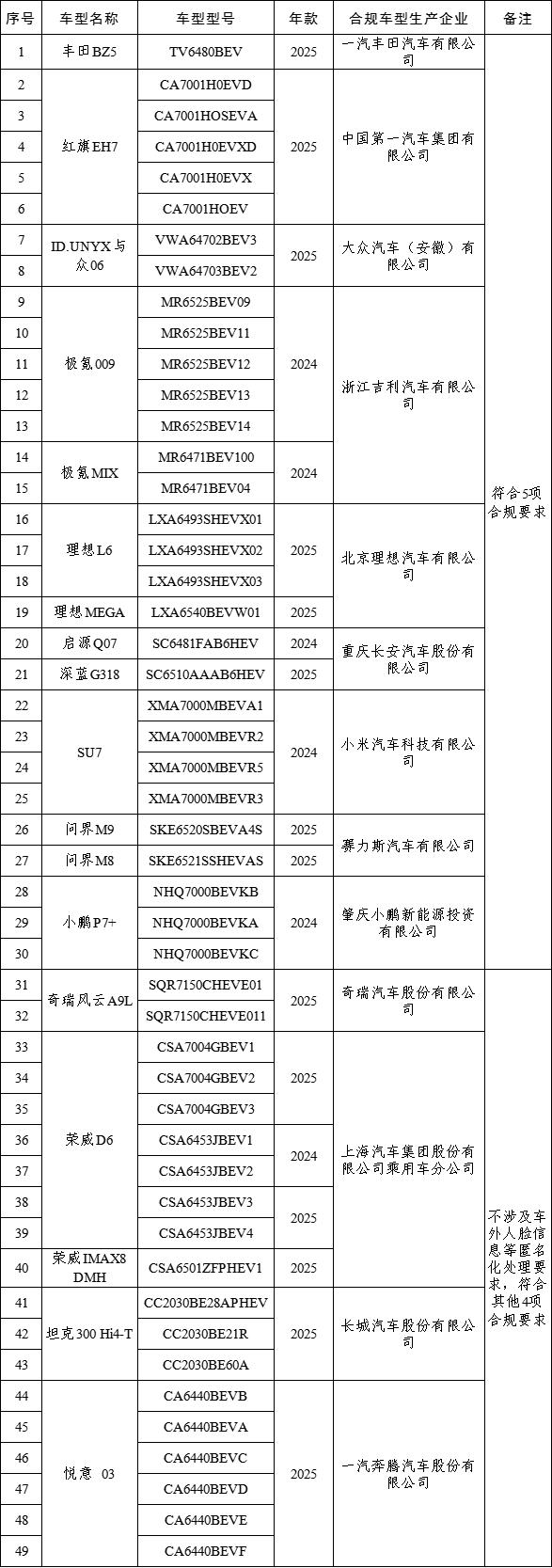
Core Points - The China Automotive Industry Association announced that starting from April 2025, it will conduct inspections on the data security compliance of automotive manufacturers' products, with 13 companies and 49 models already meeting five compliance requirements [1] - Some models were found to have data security issues, including low anonymization rates for facial recognition in video images, indefinite consent periods for sensitive personal information, and lack of privacy policies for applications on in-car systems [1] Group 1 - 13 companies including FAW Toyota, FAW Group, Volkswagen, Geely, Li Auto, Changan, Xiaomi, Seres, Xiaopeng, Chery, SAIC, Great Wall, and FAW Bestune have models that comply with data security requirements [1] - The compliance checks revealed that some models did not meet the anonymization requirement for facial data, with detection rates below 90% [1] - Companies have been notified to rectify the identified data security issues [1] Group 2 - A detailed list of compliant models includes the Toyota BZ5, Hongqi EH7, Volkswagen ID.UNYX, Zeekr 009, Li Auto L6, Xiaomi SU7, and others, with production years ranging from 2024 to 2025 [2][3] - The compliance requirements focus on five key areas, with some models not involving external facial information anonymization [2][3] - The inspection aims to enhance data security standards within the automotive industry, reflecting a growing emphasis on consumer privacy and data protection [1]