
泰国4.0战略

Search documents
3.8万亿泰铢投资涌入,2700万中产崛起,泰国还有机会吗?
吴晓波频道· 2026-01-05 00:30
Core Insights - China has maintained its position as Thailand's largest trading partner for the 12th consecutive year, with direct investment in Thailand increasing by 42% year-on-year in the first half of 2025, significantly contributing to foreign investment growth in Thailand [2][3] - Thailand is transforming from a tourism-centric economy to a hub for electric vehicles, digital economy, modern logistics, and high-end manufacturing, driven by Chinese capital, supply chains, and business models [3][4] Trade and Investment Landscape - In 2024, Thailand's industrial value added reached approximately $169.1 billion, with manufacturing value added at $128 billion, reflecting a structural shift towards high-value manufacturing [4] - The "Thailand 4.0" strategy, launched in 2016, aims to enhance high-value industries, with the Eastern Economic Corridor (EEC) attracting over 3.8 trillion Thai Baht (approximately 760 billion RMB) in global investment, of which Chinese investment accounts for 32% [4][5] Industry Opportunities - Thailand has strong foundations in traditional automotive, electronics assembly, and agricultural processing, but lacks in high-end sectors like electric vehicle batteries and semiconductors, which aligns with China's supply chain advantages [6] - The production of pure electric vehicles (BEVs) in Thailand exceeded 105,000 units in the first nine months of 2025, marking a 38.5% year-on-year increase, with major Chinese companies establishing manufacturing bases in the EEC [11][12] Consumer Market Dynamics - Thailand's middle class has reached approximately 27 million people, accounting for 38% of the total population, and is expected to surpass 40% by 2025, with a shift in consumption patterns towards experience and quality [19][20] - The e-commerce market in Thailand is growing at over 25% annually, with a projected market size of $28 billion by 2025, driven by a young, digitally-savvy population [24][25] Infrastructure Development - Thailand ranks 34th globally in the World Bank's Logistics Performance Index, with significant investments in infrastructure reducing logistics costs by 20%-30% compared to other regions [27][30] - The government has invested approximately 1.5 trillion Thai Baht in infrastructure, enhancing the country's position as a transportation hub within ASEAN [30][29] Cultural and Operational Challenges - Despite attractive foreign investment policies, operational challenges exist, including lengthy approval processes and strict compliance requirements, necessitating strong local partnerships and compliance teams [35][42] - Cultural factors, such as the influence of Buddhism on business practices, require companies to adopt a more patient and respectful approach to management and marketing strategies [37][39] Competitive Landscape - Japanese companies dominate the automotive and home appliance sectors in Thailand, while South Korean firms focus on mid-to-high-end markets with smart technology [40][41] - Chinese enterprises face significant competition in traditional manufacturing sectors, requiring a deep understanding of local ecosystems and consumer habits to succeed [42][43]


中资企业出海高峰论坛在曼谷举办
Zhong Guo Xin Wen Wang· 2025-12-23 02:16
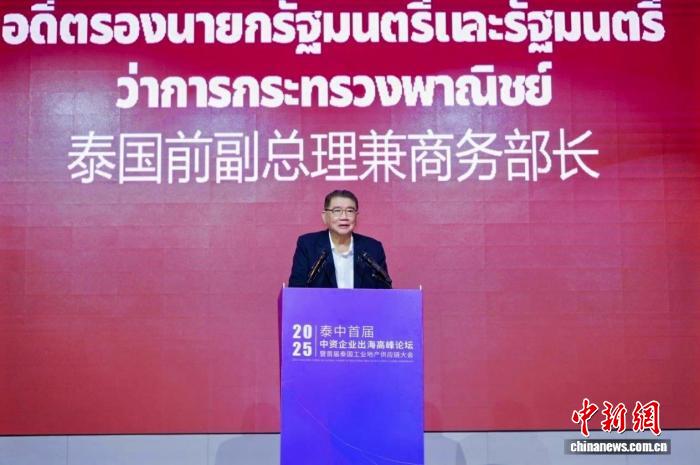
Group 1 - The forum focused on the integration of industries under the backdrop of global supply chain restructuring, aiming to enhance cooperation between China and Thailand in line with the Belt and Road Initiative and Thailand's 4.0 strategy [1][3] - Over 400 representatives from political, business, and academic sectors of both countries attended the forum, highlighting the deepening economic ties and fruitful cooperation between China and Thailand since the establishment of diplomatic relations [3][5] - Thailand is becoming an attractive destination for Chinese investment due to its strategic location, well-developed infrastructure, and favorable business environment [3][5] Group 2 - The former Thai Deputy Prime Minister emphasized that 2025 will be a significant milestone for Sino-Thai relations, with China being the largest source of investment in Thailand for several consecutive years [5] - The forum addressed the shift of Chinese enterprises from single projects to collaborative layouts in industrial and supply chains, indicating a profound transformation in outbound investment strategies [5][7] - Discussions included the development blueprint of Thailand's 4.0 strategy and the Eastern Economic Corridor (EEC), with a focus on the complementarity of China's advanced capabilities in sectors like electric vehicles and digital economy with Thailand's innovation goals [7]
“为‘泰中一家亲’谱写新篇章”
Ren Min Ri Bao· 2025-11-13 22:10
Group 1 - The visit of Thailand's King Vajiralongkorn to China marks the first state visit by a Thai monarch since the establishment of diplomatic relations, highlighting the deep-rooted friendship between the two nations [1] - Thailand's Deputy Prime Minister Prawit Wongsuwan emphasized the significant role of the Thai royal family in fostering Thailand-China relations, noting that Princess Sirindhorn has visited China over 50 times [1] - The historical ties between Thailand and China, spanning over a thousand years, have established a solid foundation for mutual respect and cooperation, making them a model for collaboration between countries with different social systems [1] Group 2 - The Thai government is aligning its "Thailand 4.0" strategy with China's "15th Five-Year Plan," focusing on renewable energy, digital infrastructure, and artificial intelligence to promote high-quality economic development [2] - Prawit Wongsuwan praised China's unique approach to modernization, particularly its focus on "common prosperity" and ensuring no one is left behind, which serves as a valuable reference for Asian countries [2] - There is a strong endorsement of China's global governance initiatives, with hopes for enhanced communication and collaboration between Thailand and China in multilateral areas to promote a more balanced and sustainable world [2] Group 3 - The Thai Deputy Prime Minister has actively promoted youth exchanges and cultural cooperation between Thailand and China, with over 20,000 Thai students studying in China and around 30,000 Chinese students in Thailand [3] - Prawit expressed a deep appreciation for Chinese culture, citing his fondness for classic Chinese literature and television dramas, which reflects the cultural ties between the two nations [3] - He extended a warm invitation for Chinese friends to visit Thailand, highlighting the country's beautiful architecture, stunning landscapes, and friendly people [3]
“为‘泰中一家亲’谱写新篇章”——访泰国副总理波汶萨
Ren Min Ri Bao· 2025-11-13 22:04
Core Viewpoint - The visit of Thailand's King Vajiralongkorn to China marks a significant milestone in the diplomatic relations between the two countries, emphasizing their long-standing friendship and cooperation [1]. Group 1: Thailand-China Relations - The Thai royal family has played a crucial role in fostering Thailand-China relations, with Princess Sirindhorn having visited China over 50 times and actively engaging in cultural exchanges [1]. - The relationship between Thailand and China has been characterized by mutual respect and cooperation over the past 50 years, serving as a model for collaboration between countries with different social systems [1]. Group 2: Economic Cooperation - Thailand's Deputy Prime Minister, Prawit Wongsuwan, highlighted the alignment between China's "14th Five-Year Plan" and Thailand's "Thailand 4.0" strategy, particularly in areas such as renewable energy and digital economy [2]. - There is an expectation for deepened cooperation in emerging fields like renewable energy, digital infrastructure, and artificial intelligence to promote high-quality economic development [2]. Group 3: Cultural and Educational Exchange - The number of Thai students studying in China exceeds 20,000, while around 30,000 Chinese students are studying in Thailand, showcasing the fruitful educational cooperation between the two nations [3]. - The cultural exchange is further enriched by the interest of Thai officials in Chinese literature and media, indicating a strong cultural connection [3].