
海外供给扰动

Search documents
煤炭行业周报:美以伊冲突持续,印尼1月煤炭产量如期大降-20260308
East Money Securities· 2026-03-08 13:09
Investment Rating - The report maintains an "Outperform" rating for the coal industry, indicating a projected performance that exceeds the broader market index by over 10% [2][11]. Core Insights - The ongoing conflict between the U.S. and Iran, along with a significant decline in Indonesia's coal production (down nearly 30% year-on-year in January 2026), is expected to tighten global coal supply and support prices [4][6]. - As of March 6, 2026, coal prices at Qinhuangdao port were reported at 745 RMB/ton, showing a year-on-year increase of 8.6% [4]. - The average daily coal consumption in power plants across 25 provinces was 5.33 million tons, reflecting a year-on-year decrease of 3.6% [4]. - The report suggests that despite entering the off-peak season, coal prices may remain stable due to ongoing overseas supply disruptions and domestic regulatory measures [4][6]. Summary by Sections Supply and Demand Dynamics - Indonesia's coal production in January 2026 was 46 million tons, the lowest since January 2022, significantly impacted by export restrictions [4]. - The average coal inventory in power plants was 117.03 million tons, up 7.4% year-on-year, indicating a potential oversupply situation [4]. Price Trends - The report notes that coal prices may experience limited declines due to persistent overseas disruptions and high import coal prices [4][6]. - The first round of price reductions for coke post-holiday was noted, with prices dropping by 50-55 RMB/ton [5]. Company Recommendations - The report recommends focusing on companies with high profit elasticity in the coal sector, such as Yancoal Australia, Yanzhou Coal Mining, and China Shenhua Energy, among others [6]. - Companies benefiting from coal capacity reserve policies and safety improvements are also highlighted as potential investment opportunities [6].
海外供给扰动叠加库存低位,煤炭ETF(515220)大涨超3%
Sou Hu Cai Jing· 2026-02-27 06:09
Core Viewpoint - The coal sector is at a pivotal point driven by multiple resonating logics, with overseas supply disturbances, particularly from Indonesia, playing a crucial role in price dynamics and domestic demand improvement [3][4]. Group 1: Overseas Supply Disturbances - Indonesia's policy changes regarding coal export approvals and production quotas have led to tighter supply, significantly impacting international coal prices and reducing the competitiveness of imported coal [4]. - The supply contraction from Indonesia has exceeded market expectations, becoming a primary driver for the recent rise in international coal prices [4]. - The linkage of global energy prices, influenced by geopolitical factors, has created upward price expectations for thermal coal, shifting market focus towards overseas supply rather than domestic demand fluctuations [4]. Group 2: Domestic Supply Constraints - Domestic coal supply is facing increasing constraints, with a notable reduction in production capacity due to seasonal factors and regulatory measures aimed at safety and environmental standards [5]. - The capacity utilization rate in key production areas has decreased, with a reported drop of 3.12 percentage points to 84.43% as of February 11, attributed to pre-holiday shutdowns of private mines [5]. - The coal industry is transitioning towards high-quality development, with major state-owned enterprises planning to increase their stakes in listed companies, reflecting confidence in the sector's stability and growth potential [5]. Group 3: Inventory and Price Dynamics - Port inventories are at historically low levels, with significant declines reported in both northern and southern ports, indicating a clear supply contraction effect [7]. - As of February 14, northern port inventories were at 2,415.9 million tons, down 46.3 million tons week-on-week, while southern ports reported a decrease of 168.9 million tons [7]. - Coal prices have shown stability with upward adjustments, with Qinhuangdao's thermal coal price reaching 718 yuan/ton, reflecting a week-on-week increase of 23 yuan/ton [8]. Group 4: Demand Resilience - Post-holiday resumption of work is driving steady growth in iron and steel production, with daily average iron output reported at 230.56 million tons, up 1.92 million tons week-on-week [9]. - Despite a seasonal decline in electricity consumption, heating demand remains robust, supporting overall coal demand [9]. - The coking coal market shows resilience, with stable prices and a focus on monitoring iron production and domestic coal mine resumption [9]. Group 5: Investment Opportunities - The coal ETF (515220) presents a dual logic for investment, combining high dividend yields with price elasticity driven by overseas supply disturbances [10]. - Leading coal companies maintain high dividend rates and stable cash flows, positioning them as attractive investments in a declining interest rate environment [10]. - The ETF encompasses major players in thermal coal, coking coal, and coal power, offering both defensive attributes and potential for price recovery amid low inventories and stable prices [10].

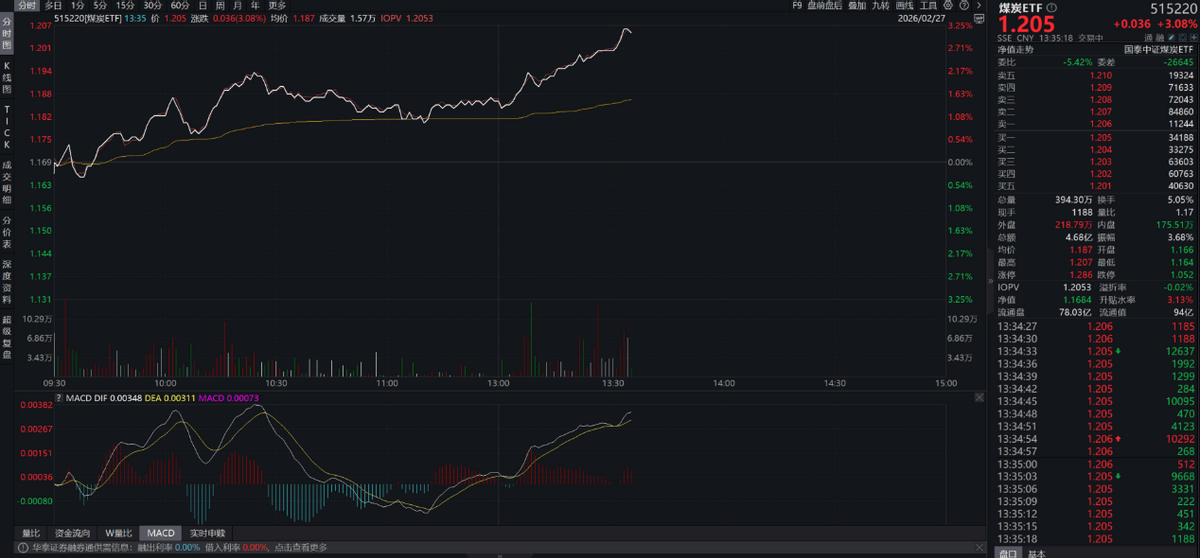
海外供给扰动叠加库存低位,煤炭板块迎来结构性修复窗口,煤炭ETF(515220)盘中涨超3.2%
Mei Ri Jing Ji Xin Wen· 2026-02-24 04:29
Group 1 - The core catalyst for the current coal market is the overseas supply disruptions, particularly from Indonesia, which significantly impacts global coal trade dynamics [2] - The coal sector is experiencing a structural repair window due to low inventory levels and supply constraints, leading to a notable increase in coal ETF (515220) prices [1][3] - The domestic coal supply is tightening due to seasonal reductions in production and ongoing maintenance at state-owned mines, resulting in a decrease in port inventories [3] Group 2 - The coal sector is supported by dual logic: high dividend yields providing a safety margin and overseas supply disruptions creating price elasticity [4] - The market is shifting focus from domestic demand fluctuations to overseas supply elasticity, which is becoming a critical variable for price assessments [2] - The coal industry is transitioning from a phase of rapid expansion to one of high-quality development, with increased industry concentration enhancing the profitability stability of leading companies [3]