海陆空全空间无人体系

Search documents
从海陆空到居家服务 22类新场景政策打通科技与产业转化堵点
Xin Jing Bao· 2025-11-08 14:59
Core Viewpoint - The State Council's recent implementation opinion emphasizes the importance of cultivating and opening new application scenarios to drive the large-scale application of new technologies and products, thereby supporting high-quality economic and social development during the 14th Five-Year Plan period [1][2]. Group 1: Implementation and Objectives - The opinion aims to create a pathway for "technological breakthroughs - scenario validation - industrial application - system upgrade," which is crucial for fostering new productive forces and enhancing the modern industrial system [1][6]. - It aligns with the 14th Five-Year Plan's focus on improving the industrial ecosystem and promoting large-scale applications of new technologies and products [2][7]. Group 2: Key Areas of Focus - The opinion identifies five major areas for developing new application scenarios, including new fields and tracks, industry transformation, social governance, and enhancing livelihood services, covering 22 specific fields such as digital economy and artificial intelligence [3][4]. - Notably, the inclusion of marine development as a new sector highlights the expansion of development opportunities beyond traditional areas [3]. Group 3: Technological Integration and Employment - The emphasis on a "full-space unmanned system" indicates a shift towards a systematic approach to integrating various unmanned technologies, which is expected to enhance efficiency and reduce barriers across different sectors [4][6]. - The opinion also addresses the need to balance technological advancement with job creation, suggesting that while automation may reduce traditional roles, it will also create new technical positions [8]. Group 4: Policy Recommendations - Recommendations include focusing on intelligent device integration, service model restructuring, and data empowerment to enhance the effectiveness of new application scenarios [5][6]. - The opinion stresses the importance of avoiding redundant construction and market segmentation while ensuring high-quality employment opportunities are created alongside technological advancements [7][8].
从海陆空到居家服务,22类新场景政策打通科技与产业转化堵点
Bei Ke Cai Jing· 2025-11-08 14:38
Core Viewpoint - The State Council's recent implementation opinion aims to accelerate the cultivation and large-scale application of new scenarios, serving as a bridge between technology and industry, and promoting the integration of technological innovation and industrial development [1][2]. Group 1: Policy Framework - The opinion aligns with the "14th Five-Year Plan" and emphasizes the importance of large-scale application of new technologies and products, aiming to enhance the modern industrial system and strengthen the real economy [1][2]. - It highlights the need for a systematic approach to cultivate new scenarios, creating a pathway from technological breakthroughs to industrial applications and system upgrades [1][6]. Group 2: Key Areas of Focus - The opinion identifies 22 key areas for scenario cultivation and opening, including digital economy, artificial intelligence, unmanned systems, marine development, and elderly care [3][4]. - It emphasizes the integration of new fields such as marine development and the enhancement of immersive experience scenarios in digital economy and artificial intelligence [3][4]. Group 3: Employment and Economic Impact - The opinion addresses the urgent need to overcome the "technology without scenarios" dilemma faced by enterprises, linking the cultivation of scenarios to the creation of high-quality employment opportunities [6][8]. - It proposes a balanced approach to managing the relationship between technological replacement and job creation, suggesting that intelligent manufacturing can lead to new job types while optimizing traditional roles [8]. Group 4: Implementation Strategies - The opinion calls for a coordinated layout to avoid redundant construction and market segmentation, ensuring effective allocation of application scenarios [7]. - It suggests focusing on four key directions for scenario development, including home care, institutional settings, community services, and special needs scenarios [5][6].
先行先试 多地探索全空间无人体系建设
Zhong Guo Fa Zhan Wang· 2025-05-08 03:12
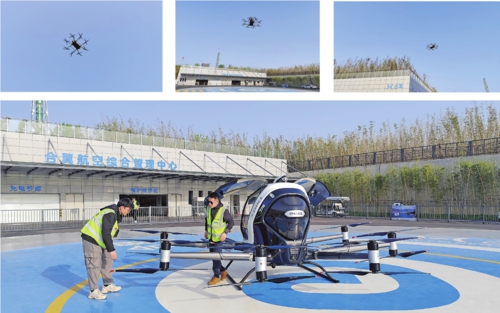
Group 1 - The first "four-in-one" low-altitude manned flying vehicle has successfully completed a test flight in Hefei, marking a significant milestone in the development of unmanned aerial vehicles (UAVs) in China [2][3] - The "EH216-S," produced by EHang Intelligent Technology Co., is the world's first low-altitude manned flying vehicle to obtain all four necessary certifications: Type Certificate (TC), Standard Airworthiness Certificate (AC), Production Certificate (PC), and Operational Certificate (OC) [3][12] - The issuance of the first operational certificates for manned UAVs signifies the official launch of large-scale commercial applications in low-altitude flying [3][12] Group 2 - The National Development and Reform Commission (NDRC) has released the "Market Access Negative List (2025 Edition)," reducing the number of items from 117 to 106, which aims to optimize the market access environment for new industries and technologies [2] - Hefei has established over 30 temporary takeoff and landing points for various flying vehicles and UAVs, and has become home to the world's first unmanned boat super factory, indicating a robust infrastructure for the UAV industry [5][6] - The International Advanced Technology Application Promotion Center in Hefei is focused on integrating innovation chains and industrial chains, promoting the development of a comprehensive unmanned system that includes air, land, and sea applications [4][5] Group 3 - The city of Guangzhou has been proactive in the development of autonomous driving technology, with the establishment of the first operational licenses for autonomous taxis and the launch of the seventh-generation autonomous driving system, which is based on automotive-grade chips [10][11] - The market for urban air mobility is projected to reach $1.5 trillion by 2035, with China expected to account for over 30% of this market, highlighting the significant growth potential in the UAV sector [12] - The low-altitude economy in China is anticipated to reach a trillion-dollar scale by 2030, driven by advancements in UAV technology and infrastructure [12]