淮河生态经济带

Search documents
连宿、连淮高速今日正式开通
Yang Zi Wan Bao Wang· 2025-12-26 10:32
Core Viewpoint - The opening of the Lianyungang section of the Liansu Expressway Phase I and the Lianhuai Expressway expansion is significant for regional economic development and integration into national initiatives like the Belt and Road Initiative [1][3]. Group 1: Infrastructure Development - The Liansu Expressway Phase I is a crucial part of Jiangsu Province's highway network, spanning 40.65 kilometers, built to a dual four-lane standard with a design speed of 120 km/h [3]. - The construction utilized advanced 3D paving technology, incorporating measurement robots and automated control systems to enhance construction precision and quality [3]. - The Lianhuai Expressway section in Lianyungang will expand from a dual four-lane to a dual eight-lane configuration, significantly increasing traffic capacity [3]. Group 2: Economic Impact - The completion of these expressways is expected to improve regional road networks, enhance traffic conditions, and stimulate local economic growth [3]. - The projects align with national strategies, particularly the Belt and Road Initiative and the Huai River Ecological Economic Belt, indicating their broader significance beyond local infrastructure [3].

五河至蒙城高速公路正式通车
Xin Lang Cai Jing· 2025-12-21 16:36
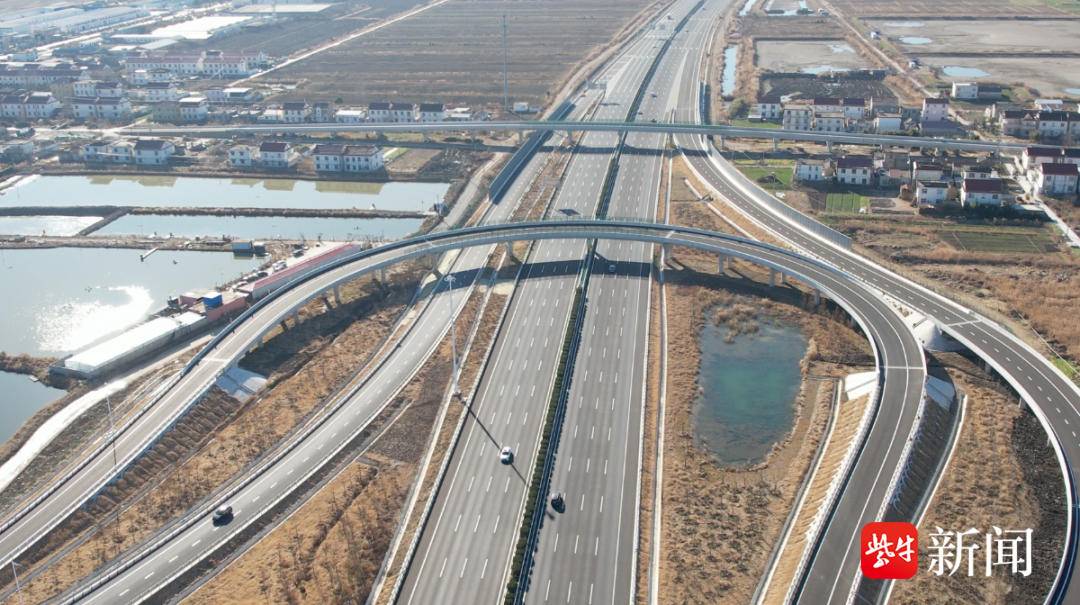
Core Viewpoint - The Wuhua to Mengcheng Expressway has officially opened, marking it as the largest and longest expressway project in northern Anhui, fully invested, constructed, and operated by Bengbu City [1] Group 1: Project Overview - The expressway spans 119.5 kilometers, starting from Shuangzhongmiao Town in Wuhua County and connecting to the under-construction Sihong to Bengbu Expressway [1] - The project will form a "golden triangle" with Ningluo and Xuming expressways, effectively alleviating traffic pressure and reinforcing Bengbu's status as a national comprehensive transportation hub [1] Group 2: Economic and Social Impact - The expressway connects industrial parks and agricultural production areas along its route, contributing to the revitalization of county-level industries [1] - It will facilitate rapid development among the provinces of Henan, Anhui, and Jiangsu, supporting national strategies such as the "Huaihe Ecological Economic Belt" and "Yangtze River Delta Integration" [1] - Service areas along the expressway incorporate local cultural elements and feature specialty agricultural product exhibition areas, promoting the integration of transportation and tourism [1] Group 3: Construction Innovations - The project utilized a "minute-level construction organization" model for the construction of box girders over the Beijing-Shanghai Railway, and pioneered underwater soil extraction techniques, reducing land occupation by 1,285.9 acres [1] - Advanced technologies such as BIM and 3D intelligent paving were applied, resulting in 25 patents for inventions and utility models [1] - The extension line of the Sihong-Bengbu Expressway's main bridge construction has been completed, with an expected completion date of the entire project by the end of 2026 [1]
皖北地区里程最长高速公路通车
Xin Lang Cai Jing· 2025-12-20 11:53
Core Viewpoint - The Wimong Expressway, the longest highway project in northern Anhui, officially opened on December 20, 2023, enhancing regional transportation and economic development [1] Group 1: Project Overview - The Wimong Expressway has a total length of 119.5 kilometers, starting from Shuangzhongmiao Town in Wuhe County and connecting to the under-construction Sibang Expressway, passing through Guzhen County and Huaiyuan County, and ending at Banjiaojizhen in Mengcheng County [1] - This project is the largest investment and longest highway in northern Anhui, and it is the first highway in Bengbu City to be fully self-invested, constructed, and operated [1] Group 2: Economic and Strategic Impact - The opening of the Wimong Expressway further densifies the highway network in northern Anhui, forming a "Golden Triangle" transportation pattern with the Ningluo Expressway and the Xuming Expressway [1] - It serves as a secondary line for the Ningluo Expressway, effectively diverting through traffic and alleviating regional transportation pressure [1] - The highway establishes a rapid passage for collaborative development among the provinces of Henan, Anhui, and Jiangsu, supporting the implementation of national strategies such as the "Huai River Ecological Economic Belt" and "Yangtze River Delta Integration" [1] Group 3: Investment and Development Context - During the 14th Five-Year Plan period, Anhui Province completed approximately 700 billion RMB in fixed asset investment in transportation, with the total length of highways ranking first in the Yangtze River Delta [1] - The highway network in northern Anhui has achieved significant breakthroughs, contributing to regional resource optimization and economic collaboration [1]
全长119.5公里!皖北这条高速今日正式通车
Xin Lang Cai Jing· 2025-12-20 01:35
Core Viewpoint - The Wuhou to Mengcheng Expressway, the first fully self-invested, constructed, and operated highway in Bengbu City, will officially open on December 20, enhancing regional transportation and economic development [1] Group 1: Project Overview - The Wuhou to Mengcheng Expressway is the largest and longest highway project in northern Anhui, with a total length of 119.5 kilometers, starting from Shuangzhongmiao Town in Wuhou County and connecting to the ongoing Sihong to Bengbu Expressway [1] - The expressway will form a "golden triangle" with Ningluo and Xuming highways, effectively alleviating traffic pressure and solidifying Bengbu's status as a national comprehensive transportation hub [1] Group 2: Economic and Social Impact - The project connects industrial parks and agricultural production areas along the route, supporting county-level industrial revitalization and establishing a rapid development corridor for the collaboration of Henan, Anhui, and Jiangsu provinces [1] - It serves national strategies such as the "Huaihe Ecological Economic Belt" and "Yangtze River Delta Integration," promoting the integration of transportation and tourism, and benefiting local livelihoods [1] Group 3: Construction Innovations - The project utilized a "minute-level construction organization" model for the construction of the box girder over the Beijing-Shanghai Railway and pioneered underwater soil extraction technology, reducing land occupation by 1,285.9 acres [2] - Advanced construction techniques such as BIM technology and 3D intelligent paving were applied, resulting in 25 patents for inventions and utility models [2] - Green construction measures included optimizing the route, building 34 kilometers of sound barriers, and employing special processes to protect the Tuo Lake ecology, achieving a win-win for ecological protection and engineering construction [2] Group 4: Future Developments - The extension line of the Sihong to Bengbu Expressway has completed all main bridge works, with an expected completion date by the end of 2026 [3]
苏北地区国家级园区发展及园区城投企业转型情况:城投企业转型进程呈现分化,园区发展情况影响个体转型成效
Lian He Zi Xin· 2025-12-17 11:35
Group 1: Economic Development and Strategic Positioning - The economic gap between Northern Jiangsu and Southern Jiangsu is significant, with Northern Jiangsu's GDP at 3.22 trillion yuan in 2024, growing at 7.03%, compared to Southern Jiangsu's GDP of 7.78 trillion yuan with a growth rate of 6.77%[4][6] - Northern Jiangsu is undergoing a dual task of "catching up" and "transformation," influenced by national strategies like the Yangtze River Delta integration and the Huai River ecological economic belt[3][6] - The development of national-level parks in Northern Jiangsu is crucial for industrial agglomeration and economic growth, with a focus on quality improvement and innovation-driven development during the 14th Five-Year Plan[9][10] Group 2: Transformation of Urban Investment Enterprises - Urban investment enterprises in Northern Jiangsu have shown some success in transformation, with a 2.69% increase in equity fund investments and a 6.29% increase in self-operated project investments by 2024 compared to 2016[39] - The average proportion of urban construction assets decreased by 8.75% from 2016 to 2024, indicating a shift towards more market-oriented operations[39] - Despite improvements in asset and income diversification, profit contributions from operational activities remain weak, with government subsidies still comprising a significant portion of net profits[37][40]
濉溪2025爆发元年!土地供应蓝图曝光,热门地块即将改写城市格局?
Sou Hu Cai Jing· 2025-04-28 06:12
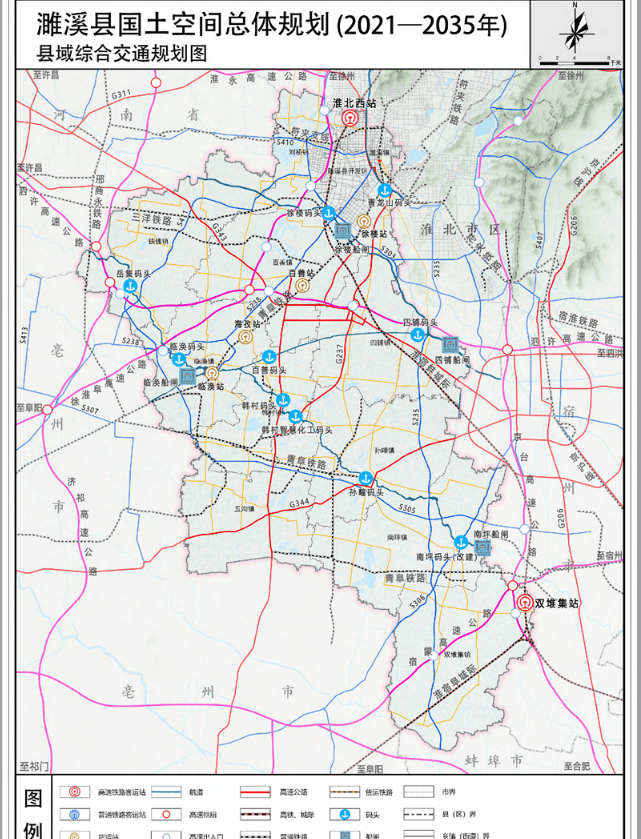
Group 1: Future Development Positioning and Goals - Suixi is positioned as a key node in the Yangtze River Delta integration and the core area of the Huai River Ecological Economic Belt, with three major roles: "National Important New Comprehensive Energy Base," "Canal Cultural City," and "Growth Pole in Northern Anhui" [1] - The planning blueprint emphasizes a "space revolution" in response to national strategies, aiming to create a comprehensive development framework [1] Group 2: Spatial Structure - The urban framework is restructured into "One Main, Two Belts, Three Zones, and Four Channels," focusing on ecological and cultural integration [2] - The "One Main" refers to the central urban area, which will develop into a "Waterfront Garden City" with ecological resources [2] - The "Two Belts" include a central town development belt and a southern industrial linkage belt, promoting urban-rural integration [2] - The "Three Zones" consist of a northern suburban agricultural area, a central grain and livestock area, and a southern grain production area, safeguarding agricultural land [2] - The "Four Channels" integrate ecological protection with cultural heritage along major waterways [2] Group 3: Transportation Network - A comprehensive transportation network is being established, including railways, highways, and waterways, enhancing connectivity to major urban centers [3] - Key projects include the Huai-Su-Beng Intercity Railway and upgrades to local waterways, facilitating multi-modal transport [3] Group 4: Key Development Areas - The central urban area is undergoing revitalization, focusing on cultural heritage and modern commercial developments [5][6] - The West River New District aims to integrate industry and urban living, with significant residential and commercial land planned [7] - The southern sub-center is positioned as a new growth pole, leveraging red tourism and port economy [8][9] - The Suixi Economic Development Zone is set to become a powerhouse for traditional industry upgrades and new energy projects [10][11] Group 5: Land Supply Plans - A detailed land supply plan for 2025 includes various residential and commercial plots, with a total of 380.79 acres planned for the first quarter [13] - Subsequent quarters will see additional land supplies, totaling 532.19 acres in the second quarter and 586 acres in the third quarter [15][16] - Key land parcels include the Q8 plot near Qianlong Lake, which is expected to become a new landmark for ecological and cultural tourism [17]