港股市场反弹

Search documents
港股通央企红利ETF南方(520660.SH)涨1.48%,中国石油化工股份涨3.01%
Jin Rong Jie· 2026-01-22 06:20
Core Viewpoint - The Hong Kong stock market is experiencing fluctuations, with resource sectors such as oil, petrochemicals, and coal showing significant gains, driven by external capital inflows and improved profit expectations [2]. Group 1: Market Performance - As of January 22, the Hong Kong stock market showed volatility, with the Hong Kong Stock Connect Central State-Owned Enterprises Dividend ETF (520660.SH) rising by 1.48% and China Petroleum & Chemical Corporation increasing by 3.01% [1]. - Recent data indicates a net inflow of foreign capital into the Hong Kong stock market amounting to $2.82 billion, with active foreign capital turning into a net inflow of $160 million, marking the largest single-week net inflow since September 2024 [2]. Group 2: Sector Analysis - The oil and petrochemical sectors are benefiting from strong international oil prices, supported by geopolitical factors such as instability in Iran and ongoing concerns regarding supply risks due to the Russia-Ukraine conflict and OPEC+ production pauses [2]. - In the coal sector, production has resumed in some coal mines post-New Year, but supply is expected to contract due to the upcoming Spring Festival and capacity reductions, while demand may increase due to a cold wave expected later in the month [2]. Group 3: Investment Insights - The Central State-Owned Enterprises Dividend ETF focuses on sectors like oil, petrochemicals, and coal, which account for approximately 45% of its index weight, reflecting their role as a stabilizing force in the national economy [2]. - The ETF's index limits the proportion of financial and real estate sectors, emphasizing leading entities in the real economy, which differentiates it from other similar indices and highlights its investment value [2].

港股开盘 | 恒指高开0.62% 科网股走强 贵金属板块回调
智通财经网· 2026-01-22 01:38
Market Overview - The Hang Seng Index opened up by 0.62% and the Hang Seng Tech Index rose by 0.85%, with tech stocks like Baidu Group increasing by over 3% [1] - Precious metals sector experienced a pullback [1] Future Outlook for Hong Kong Stocks - Huaxia Fund believes that the Hong Kong stock market is highly sensitive to corporate earnings and macroeconomic data. If upcoming monthly and quarterly economic data consistently exceed expectations, market forecasts could be significantly revised, potentially igniting both A-shares and Hong Kong stocks, with the latter having greater rebound elasticity due to previous declines and low expectations [1] - JPMorgan anticipates that the earnings season for Hong Kong real estate stocks will commence at the end of January. While most companies are expected to continue experiencing declining earnings, improvements in the Hong Kong residential market will have limited impact on the fiscal year 2025 reports. However, the upcoming earnings announcements may represent a low point for many companies, with a high likelihood of earnings rebound in the next fiscal year [1] - CICC suggests that due to the recent increase in real estate policy frequency, while demand remains weak, there are signs of positive changes on the supply side. The firm recommends a short-term increase in focus on the real estate sector, adjusting dynamically based on changes in natural inventory and the progress of existing housing storage policies [1]

港股站稳26000点 多板块助力市场企稳回升
Zhong Guo Xin Wen Wang· 2026-01-09 14:57
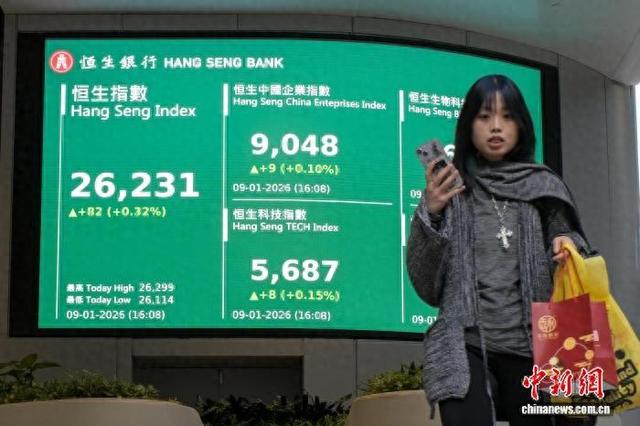
Market Performance - The Hong Kong stock market saw all three major indices rise on January 9, with the Hang Seng Index increasing by 0.32% to close at 26,231.79 points [1][3] - The Hang Seng Technology Index rose by 0.15% to 5,687.14 points, while the National Enterprises Index increased by 0.1% to 9,048.53 points [1][3] Sector Performance - Internet healthcare stocks performed well, with Alibaba Health leading the gains at 4.72%, and Ping An Good Doctor and JD Health both rising over 2.9% [3] - Gold stocks collectively surged, with Shandong Gold rising by 6.12%, and Zhaojin Mining and Lingbao Gold also seeing increases [3] - Non-ferrous metal stocks also moved upward, with Luoyang Molybdenum rising by 4.74%, and China Aluminum and Jiangxi Copper both increasing by over 2% [3] - Apple concept stocks were all in the green, with Lens Technology soaring by 9.01%, and Sunny Optical Technology experiencing slight gains [3] Weekly Market Trends - The Hong Kong stock market exhibited a pattern of "opening strong followed by fluctuations" during the week, with the Hang Seng Index reaching a peak of 26,858.13 points on January 6, marking the highest level since November 14 of the previous year [3] - The Hang Seng Technology Index mirrored this trend, hitting a daily high of 5,875.32 points, also the highest since November 14, 2025 [3] Economic Indicators - Market analysts provided positive interpretations of the rebound in the Hong Kong stock market on January 9, attributing it to favorable economic data from mainland China [3] - The latest Consumer Price Index (CPI) showed a year-on-year increase of 0.8%, meeting expectations, while the Producer Price Index (PPI) also showed improvement, contributing to the market's slight rebound [3]

一场资金与中国资产的“正向循环”
Shang Hai Zheng Quan Bao· 2025-08-11 18:18
Group 1: A-Share Market Activity - The A-share market has seen increased trading activity, with the Shanghai Composite Index surpassing 3600 points, indicating a positive market cycle driven by profit effects [3][4] - Since July, there has been a significant inflow of funds into industry-themed ETFs, with active equity fund issuance showing a notable recovery [3][4] - Institutional positions have been continuously increasing, becoming a crucial support for the market rally [3][7] Group 2: ETF Inflows - Industry-themed ETFs have attracted substantial capital, particularly in three main areas: dividend-themed ETFs, AI sector ETFs, and ETFs related to policies aimed at reducing competition [4][5][6] - Notable inflows include 39.45 billion RMB into the Southern S&P China A-Share Large Cap Dividend Low Volatility ETF and 30.54 billion RMB into the Huatai-PB CSI Dividend Low Volatility ETF since July [4] - The surge in industry-themed ETF sizes often correlates with improved market activity and the formation of consensus on market themes [4][5] Group 3: Active Equity Funds - Active equity funds have experienced a resurgence, with an average annual return exceeding 14% and several products doubling in net value [6][7] - Seven active equity funds launched since July have raised over 1 billion RMB each, with the largest being the Dacheng Insight Advantage Mixed Fund at 2.461 billion RMB [6] - The second batch of floating management fee funds is also being launched, potentially driving further growth in the active equity fund market [6] Group 4: Institutional Investment Sentiment - Institutions have been increasing their positions, with average stock fund positions reaching approximately 90.55% as of August 8, reflecting a bullish outlook [7][8] - Major public funds, such as Southern Fund, have committed over 230 million RMB to their own equity funds, indicating confidence in the long-term stability of the capital market [8] - Analysts believe that the A-share market is currently in a favorable position for long-term investment, with expectations of continued inflows of capital [8][9] Group 5: Hong Kong Market Dynamics - There is a significant shift in global asset allocation, with a notable influx of capital into the Hong Kong market, which has become a favored destination for global investors [10][11] - As of August 11, net inflows from southbound funds into Hong Kong exceeded 800 billion RMB, surpassing the total for the entire year of 2024 [11] - The Hong Kong market is seen as a bridge for investing in China, with many private equity firms increasing their allocations to Hong Kong stocks while reducing exposure to U.S. equities [10][13] Group 6: Investment Opportunities in Hong Kong - The technology sector remains a key focus for institutional investors, with major stocks like Tencent and Alibaba seeing high trading volumes [17][18] - High-dividend stocks and new consumption sectors are also attracting attention, with significant net purchases in financials and consumer discretionary sectors [18] - The emergence of new core assets in China, driven by economic transformation, is expected to attract more global capital into the Hong Kong market [18]