盈利预期上修

Search documents
科技+周期耗材主线回撤而非反转
HTSC· 2026-02-01 11:27
Core Viewpoints - The recent market pullback is seen as a technical correction rather than a reversal, primarily driven by the rapid rise in stock prices and the hawkish stance of the newly nominated Federal Reserve Chair [2] - The current market sentiment has shifted to an optimistic zone, with the emotional index reaching 62.1, indicating a potential for continued volatility in the short term [5][49] - The three driving factors for market space in the first quarter remain intact: improved liquidity, resonance in the funding environment, and upward revisions in profit expectations [2] Fundamental Analysis - Non-financial profit expectations have been revised upward by 0.4% over the past four weeks, while revenue expectations have been slightly adjusted downward by 0.1% [3] - The sectors with the most significant upward revisions in profit expectations include non-ferrous metals (7.7%), military industry (4.0%), and new energy (1.8%) [3] - The official manufacturing PMI for January stands at 49.3, reflecting demand-side pressures, although there are positive signals in price recovery [3] Funding Environment - Foreign capital continues to flow into the Hong Kong stock market, with net inflows reaching $2.8 billion, up from $1.95 billion the previous week [4] - Active foreign capital has seen a continuous inflow for three weeks, with a record weekly inflow of $640 million, while passive foreign capital remains at a high level [4] - The nomination of Kevin Warsh as the next Federal Reserve Chair has led to short-term volatility, but the medium-term liquidity outlook remains relatively loose [4] Market Sentiment - The market sentiment has quickly transitioned into an optimistic zone, with the emotional index indicating a potential accumulation of short-term volatility risks [5][49] - The sentiment indicators, including net inflows from southbound funds and the AH premium score, remain high, suggesting strong market participation [5] Investment Recommendations - Emphasis on companies with earnings certainty as a core holding, with a focus on the technology and cyclical materials sectors for potential incremental investments [6] - Short-term attention should be given to leading companies' earnings reports and industry developments, particularly in the AI supply chain [6] - Mid-term strategies should continue to overweight resource stocks, insurance, and local Hong Kong stocks after stabilization [6]
港股通央企红利ETF南方(520660.SH)涨1.48%,中国石油化工股份涨3.01%
Jin Rong Jie· 2026-01-22 06:20
Core Viewpoint - The Hong Kong stock market is experiencing fluctuations, with resource sectors such as oil, petrochemicals, and coal showing significant gains, driven by external capital inflows and improved profit expectations [2]. Group 1: Market Performance - As of January 22, the Hong Kong stock market showed volatility, with the Hong Kong Stock Connect Central State-Owned Enterprises Dividend ETF (520660.SH) rising by 1.48% and China Petroleum & Chemical Corporation increasing by 3.01% [1]. - Recent data indicates a net inflow of foreign capital into the Hong Kong stock market amounting to $2.82 billion, with active foreign capital turning into a net inflow of $160 million, marking the largest single-week net inflow since September 2024 [2]. Group 2: Sector Analysis - The oil and petrochemical sectors are benefiting from strong international oil prices, supported by geopolitical factors such as instability in Iran and ongoing concerns regarding supply risks due to the Russia-Ukraine conflict and OPEC+ production pauses [2]. - In the coal sector, production has resumed in some coal mines post-New Year, but supply is expected to contract due to the upcoming Spring Festival and capacity reductions, while demand may increase due to a cold wave expected later in the month [2]. Group 3: Investment Insights - The Central State-Owned Enterprises Dividend ETF focuses on sectors like oil, petrochemicals, and coal, which account for approximately 45% of its index weight, reflecting their role as a stabilizing force in the national economy [2]. - The ETF's index limits the proportion of financial and real estate sectors, emphasizing leading entities in the real economy, which differentiates it from other similar indices and highlights its investment value [2].

海外流动性宽松预期+资金面流入+盈利预期上修三重因素共振,港股“硬科技”标的港股通科技ETF(159262)盘中涨超2%
Xin Lang Cai Jing· 2026-01-14 06:16
Group 1 - The Hang Seng Technology Index rose over 1% on January 14, 2026, with notable gains from Alibaba Health (up over 10%), Hua Hong Semiconductor, and Kuaishou (both up over 5%) [1] - Citigroup raised the target for the Hong Kong stock market benchmark index, expecting export growth and government support to improve corporate profit outlook, adjusting the Hang Seng Index year-end target from 28,800 points to 30,000 points [1] - The listings of Zhipu and MiniMax on the Hong Kong Stock Exchange signify a revaluation of AI companies, potentially shifting the industry focus from "parameter competition" to profitability and commercialization efficiency [1] Group 2 - The AI industry is experiencing continuous catalysis, with significant commercial development potential, particularly in generative search (GEO) applications [2] - Southbound capital has been increasing in the Hong Kong stock market, with a net inflow of 41.296 billion HKD since the beginning of 2026, driven by expectations of overseas liquidity easing and improved profit forecasts [2] - The Hong Kong technology sector is expected to recover, influenced by a rebound in risk appetite due to factors like the Federal Reserve's easing pressure [2] Group 3 - As of January 14, 2026, the Hong Kong Stock Connect Technology ETF (159262) rose by 2.31%, with the top ten weighted stocks accounting for 78.45% of the ETF [3] - The latest scale of the Hong Kong Stock Connect Technology ETF reached 10.502 billion HKD, a record high since its inception, with a significant increase in shares over the past week [3] - The ETF closely tracks the Hang Seng Stock Connect Technology Index, focusing on TMT industries and excluding sectors like pharmaceuticals and automobiles, with major weights in leading AI companies [3]

2026年以来南向资金持续流入,机构人士:港股有望震荡上行
Xin Lang Cai Jing· 2026-01-13 23:31
Core Viewpoint - In 2025, southbound capital recorded a net inflow of 14,048.44 million HKD, and this trend continued into 2026 with a cumulative net inflow of 412.96 million HKD as of January 13, 2026, indicating strong investor interest in the Hong Kong stock market [1] Group 1 - The Hong Kong stock market has shown impressive performance, with the Hang Seng Index rising over 4% and the Hang Seng Tech Index increasing over 6% since the beginning of 2026 [1] - More than 60% of the stocks in the Hang Seng Index, with a total market capitalization exceeding 1 trillion HKD, have experienced price increases, with an average gain of over 3% [1] Group 2 - Analysts attribute the positive market outlook to three converging factors: an increase in expectations for overseas liquidity easing, accelerated capital inflows, and upward revisions in profit expectations [1]
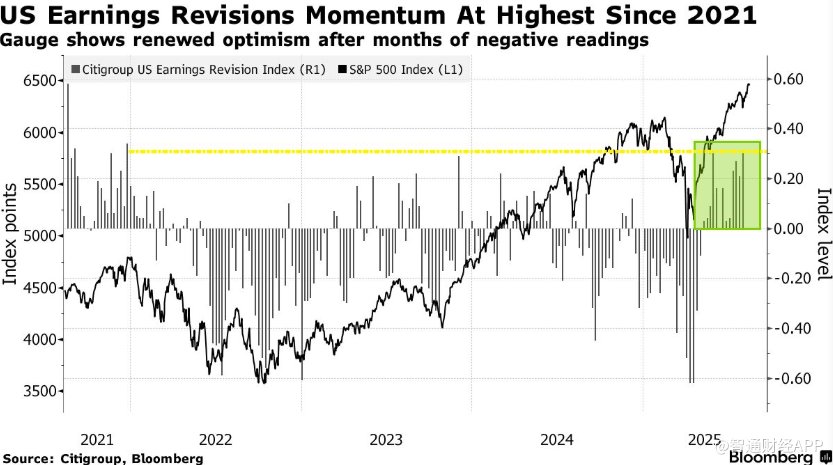
美股屡创新高背后:盈利预期正以四年最快速度上修
智通财经网· 2025-08-18 11:31
Group 1 - Analysts are raising earnings expectations for the current quarter at the fastest pace in nearly four years, contributing to the S&P 500 index reaching new highs [1] - A tracking index by Citigroup shows the highest level of upward revisions to earnings expectations since December 2021, indicating a strong trend among companies providing guidance [1] - The forward guidance indicator comparing corporate guidance to Wall Street consensus is at its second-highest level in four years, reflecting a more optimistic outlook compared to earlier in the year [1] Group 2 - Despite the upward revisions, the overall earnings growth forecast for 2025 has decreased to 9.2%, down from nearly 13% at the beginning of the year, with expected earnings per share for S&P 500 companies at $269, lower than previous estimates [3] - The trend of upward earnings revisions may not be sustainable, as analysts and companies could lower forecasts in the coming months, similar to patterns observed during Trump's first term [3][4] - Current earnings guidance from companies is strong, with only 25% of S&P 500 companies providing quarterly performance guidance, primarily from technology and consumer discretionary sectors [4] Group 3 - The earnings momentum observed in the current reporting season is the strongest since the second quarter of 2021, with significant attention on upcoming earnings reports from major retailers like Walmart and Target [5] - Companies have shown resilience in performance despite challenges such as rising inflation and high interest rates, with investors hoping for a reduction or elimination of tariffs before profit margins are impacted [5] - There are concerns about increasing cost pressures in the second half of 2025, which could pose risks to actual income growth, as companies are still depleting inventories accumulated before tariffs took effect [5]