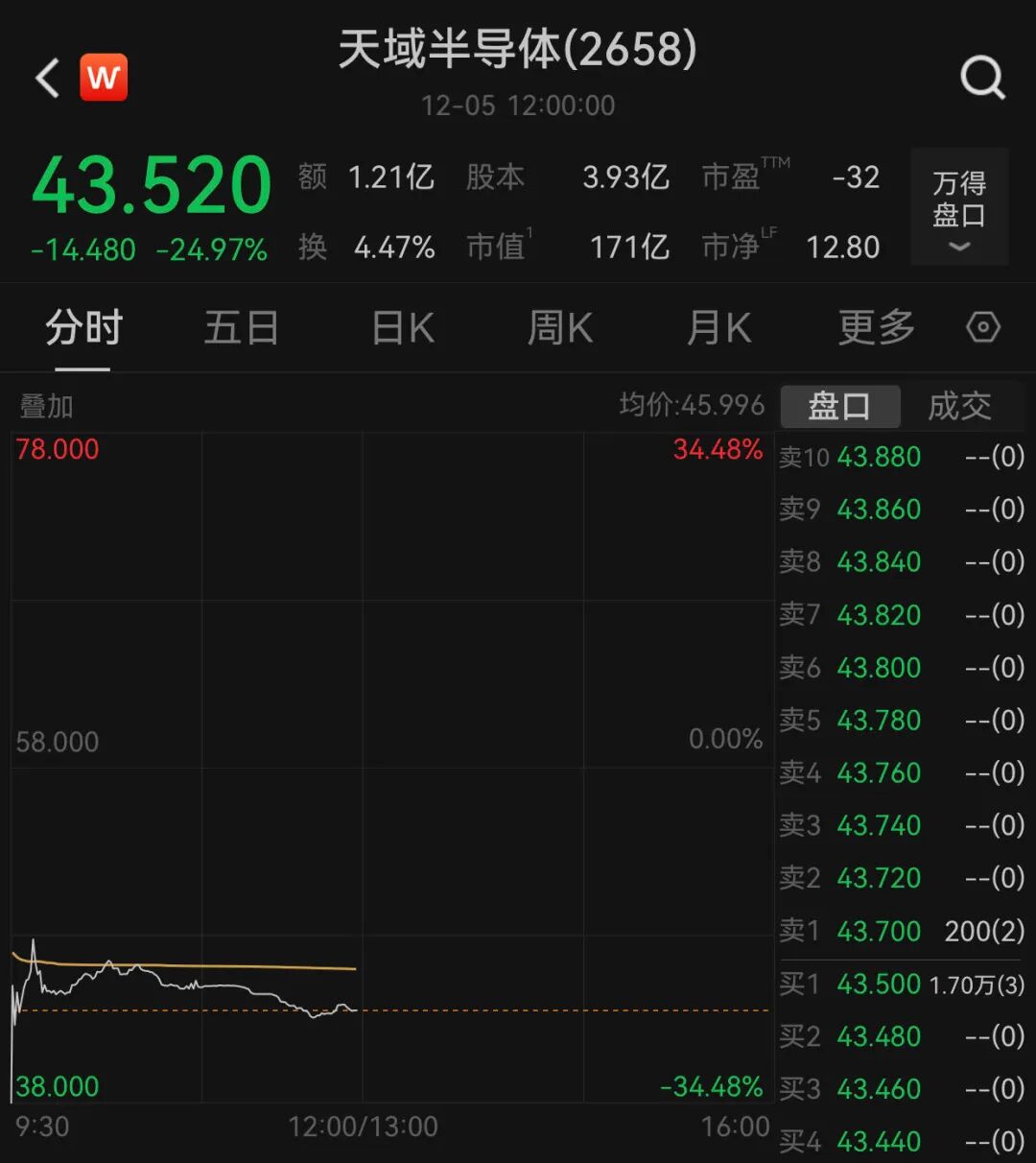
港股新股破发

Search documents
首日暴跌近50%!铜师傅,上市破发!
证券时报· 2026-03-31 12:45
Core Viewpoint - The recent IPO market for Hong Kong stocks is experiencing a downturn, with an increase in the rate of new stocks breaking below their issue prices, influenced by geopolitical conflicts, tightening liquidity, and cautious market sentiment [2][10]. Group 1: IPO Performance - The IPO of Tong Shifu, dubbed the "Bubble Mart for middle-aged people," saw its stock price drop nearly 50% on its first day of trading, opening at HKD 35.42, down 40.97% from the issue price of HKD 60, and closing at HKD 30.50, a decline of 49.17% [4][6]. - In March, 15 new stocks were listed on the Hong Kong stock market, with 4 of them breaking below their issue prices, resulting in a break rate exceeding 20% [2][10]. Group 2: Company Overview - Tong Shifu specializes in developing copper cultural and creative products by combining traditional craftsmanship with modern design, holding a 35% market share in China's copper cultural product market [7]. - The company's revenue for 2022 to 2024 is projected to be approximately HKD 5.03 billion, HKD 5.06 billion, and HKD 5.71 billion, with net profits of HKD 569.38 million, HKD 441.31 million, and HKD 789.82 million respectively [7]. - In the first three quarters of 2025, the company reported a revenue increase of 11.26% to HKD 4.48 billion, but net profit decreased by 21.99% to HKD 415.53 million, indicating a "growth without profit" scenario [7]. Group 3: Market Dynamics - The increase in IPO break rates is attributed to market adjustments, with some new stocks being overvalued compared to A-share anchors, leading to price corrections post-listing [11]. - The market environment has been affected by geopolitical tensions and energy crises, which have pressured risk assets and caused significant index pullbacks [10]. Group 4: Investment Strategies - Investors are advised to focus on stocks with strong cornerstone investors, green shoe options, or "quick entry" mechanisms, particularly in leading industries such as AI and high-end manufacturing, while avoiding overvalued stocks with weak fundamentals [14].


财富观 | 港股打新亏钱!4只新股上市首日集体破发
Sou Hu Cai Jing· 2025-12-23 11:08
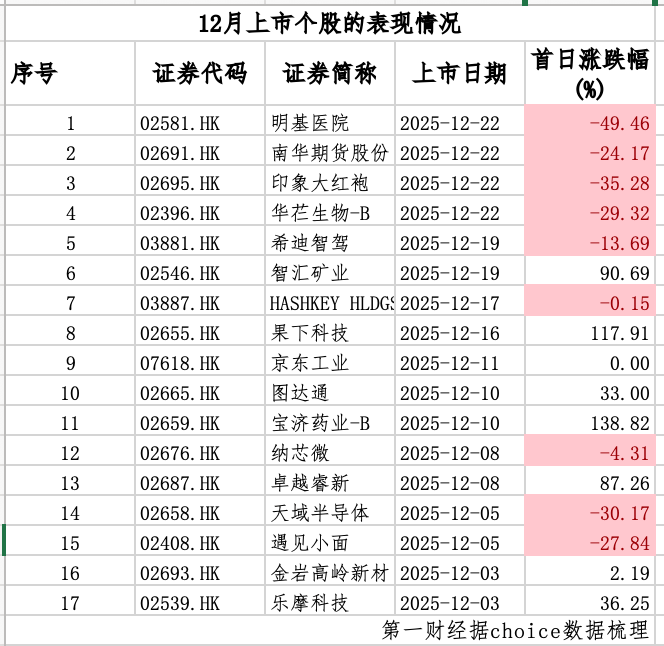
Core Viewpoint - The Hong Kong IPO market experienced a rare event where four new stocks collectively fell below their issue prices on their first trading day, indicating a significant shift in market sentiment and performance [2][3]. Group 1: IPO Performance - Four new stocks listed on December 22, 2025, including Mingji Hospital, Impression Dahongpao, Huazai Biotechnology, and Nanhua Futures, saw declines of 49.46%, 35.28%, 29.32%, and 24.17% respectively, with Mingji Hospital's drop marking the largest first-day decline for a new stock since 2025 [2][4]. - In December 2025, out of 17 newly listed stocks, 9 experienced first-day declines, representing over 50% of the total, contrasting sharply with the strong performance of new stocks earlier in the year [3]. Group 2: Market Conditions - The overall liquidity environment in the Hong Kong market has tightened, with daily trading volumes on the Hong Kong Stock Exchange falling below 2 billion HKD, and net inflows from southbound funds significantly decreasing to 219.12 billion RMB in December [5][6]. - The Hang Seng Index, Hang Seng Tech Index, and Hang Seng China Enterprises Index all experienced declines of 1.10%, 2.82%, and 1.96% respectively during the week of December 15-19, 2025 [5]. Group 3: Factors Influencing Performance - The recent decline in new stock performance is attributed to multiple factors, including tightening liquidity, high valuations relative to fundamental performance, and regulatory changes affecting public fund holdings in Hong Kong stocks [7][8]. - Mingji Hospital's high price-to-earnings (P/E) ratio of approximately 29.8 times compared to the average P/E of 17 times for the private hospital sector in Hong Kong indicates a mismatch between valuation and fundamental performance [8][9]. Group 4: Regulatory Changes - The introduction of "Mechanism B" for IPOs allows issuers to set a lower limit on the proportion of shares available for public subscription, which can reduce the risk of mispricing but may also limit the ability of companies with high valuations to attract sufficient demand [9][10]. - Mingji Hospital utilized Mechanism B for its IPO, issuing 67 million shares with only 10% allocated for public sale, resulting in a limited float of approximately 394 million HKD [10].
港股4只新股全部暴跌,明基医院更是闪崩近50%,发生了什么?
Xin Lang Cai Jing· 2025-12-22 23:59
Core Insights - The Hong Kong stock market has seen a significant influx of new listings in 2023, with 108 stocks listed and a total fundraising amount reaching 277.2 billion, positioning it as a potential global fundraising champion for 2025 [1][8] - Despite the high number of new listings, the market has shifted from a previous state of exuberance to a decline, with recent new stocks experiencing substantial drops, including one stock plummeting nearly 50% [1][8] Group 1: Market Trends - The scarcity of new stocks in the Hong Kong market has diminished, leading to a decline in market enthusiasm compared to earlier in the year [2][10] - The Hong Kong market has been in a downward trend since late September, resulting in liquidity issues and a lack of investor interest in new stocks [3][10] Group 2: Specific Stock Performance - Recent new listings have shown poor performance, with four new stocks listed on a particular day all experiencing declines of over 20%, and one stock, Ming Kee Hospital, dropping by 49.46% [2][9] - Ming Kee Hospital, which operates two private hospitals, has a very low market share of 1% in the East China region, and its subscription rate was only 5.28 times, indicating weak investor interest [3][10] Group 3: Investor Sentiment - The concentration of shareholding in new listings can lead to volatility, as seen with the significant drop in shares of a cornerstone investor, He Fu China, which fell nearly 9%, causing panic among investors [4][11] - The overall sentiment in the market has shifted towards caution, with investors wary of the potential for further declines in stock prices due to the lack of demand and liquidity [3][10]

港股打新亏钱!4只新股集体破发,明基医院跌近50%创纪录
Di Yi Cai Jing· 2025-12-22 13:01
Core Viewpoint - The recent performance of new stocks in the Hong Kong market has been notably poor, with four new listings experiencing significant declines on their first trading day, marking a rare occurrence of collective price drops among new stocks [1][2]. Group 1: New Stock Performance - Four new stocks listed on December 22, 2025, saw substantial declines: Ming Kee Hospital down 49.46%, Impression Da Hong Pao down 35.28%, Huazai Biotechnology down 29.32%, and Nanhua Futures down 24.17% [1][3]. - This trend of new stocks underperforming is not isolated; over half of the 17 new stocks listed in December 2025 have experienced price drops on their first day [2]. Group 2: Market Conditions - The overall liquidity environment in the Hong Kong market has tightened, with daily trading volumes falling below HKD 2 trillion, and southbound capital inflows significantly reduced [1][4]. - Southbound capital net inflows for December 2025 were only HKD 21.91 billion, a stark contrast to previous months where inflows often exceeded HKD 100 billion [5][6]. Group 3: Factors Influencing Performance - The decline in new stock performance is attributed to multiple factors, including tightening liquidity and high valuations not aligning with fundamental performance [1][7]. - Specific to Ming Kee Hospital, its price-to-earnings (PE) ratio was approximately 29.8 times, significantly higher than the average PE of 17 times for the private hospital sector in Hong Kong [8][10]. - The company's revenue for the first half of 2025 was reported at HKD 1.312 billion, a decline of 1.34% year-on-year, with net profit also decreasing by 23.18% [8]. Group 4: IPO Mechanisms - The introduction of "Mechanism B" for IPOs allows issuers to set a lower limit on the public offering portion, which can lead to smaller trading volumes and potentially lower the risk of price drops [9][10]. - However, this mechanism can also backfire for companies with high valuations and weak demand, as it lacks a mechanism to adjust allocations to retail investors [10].
天域半导体、遇见小面双双破发!11月港股IPO近半数破发
Zheng Quan Shi Bao· 2025-12-05 04:52
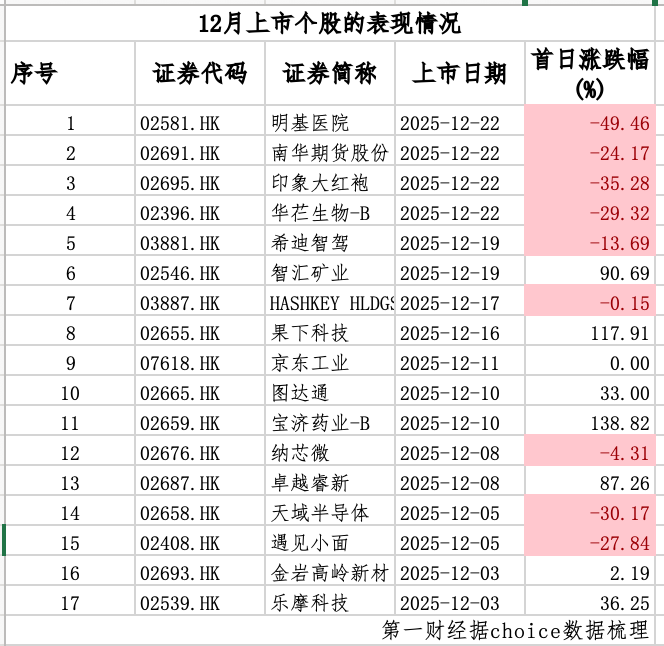
Core Viewpoint - Both newly listed stocks, Tianyu Semiconductor and Yujian Xiaomian, experienced significant declines on their debut, indicating a lack of investor enthusiasm despite their unique market positions [3][7]. Group 1: Stock Performance - Tianyu Semiconductor (2658) closed down 24.97% on its first day, with a market capitalization of 17.1 billion HKD and a price-to-earnings ratio of -32 [1]. - Yujian Xiaomian (2408) fell by 27.27%, with a market capitalization of 3.6 billion HKD and a price-to-earnings ratio of 42.6 [2]. - Both stocks had poor performance in the dark market prior to their official listing, with declines exceeding 14% [2]. Group 2: Subscription and Demand - Yujian Xiaomian had an oversubscription rate of 425.97 times, while Tianyu Semiconductor's rate was only 60.63 times, indicating a disparity in investor interest [3][4]. - In the international placement, Tianyu Semiconductor had an oversubscription of 2.47 times, while Yujian Xiaomian's was 4.99 times [5]. Group 3: Company Background - Yujian Xiaomian is positioned as the "first stock of Chinese noodle restaurants," focusing on Chongqing-style noodles, while Tianyu Semiconductor is the first specialized supplier of silicon carbide epitaxial wafers in China, backed by major investors like Huawei and BYD [3][6]. - Both companies have a limited allocation of shares to retail investors, with only 10% of shares available, which theoretically supports stock price stability [6]. Group 4: Recent Market Trends - The trend of newly listed stocks in the Hong Kong market shows a rising incidence of first-day declines, with 7 out of 15 new stocks since November experiencing a drop, indicating a concerning trend for new listings [7].