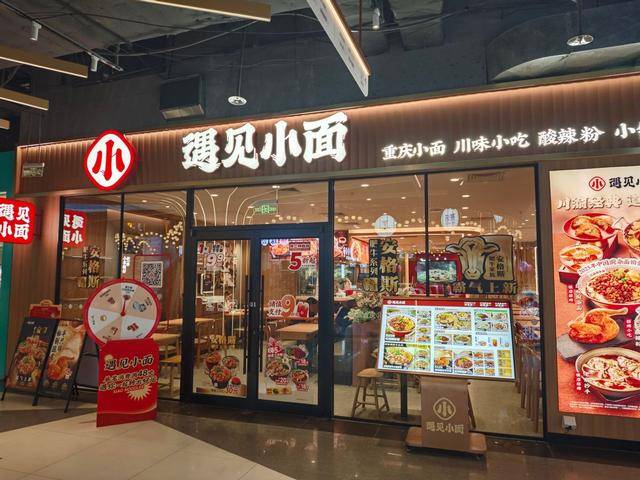
中式面馆

Search documents
国信证券晨会纪要-20260225
Guoxin Securities· 2026-02-25 01:07
Core Insights - The report highlights the anticipated upward trend in convertible bonds following the Spring Festival, with a significant probability of price increases due to favorable market conditions and investor sentiment [9][10]. - The insurance industry is expected to see an increase in equity investments, with the proportion of equity assets reaching a four-year high, indicating a shift towards riskier assets amid a stable regulatory environment [12][13]. - The company "遇见小面" (Meet Noodle) is positioned as a leader in the standardized operation of Chinese noodle restaurants, with ambitious expansion plans and a projected revenue growth of 44.2% in 2024 [14][15]. Market Overview - The report provides a snapshot of major market indices, showing a mixed performance across different regions, with the Shanghai Composite Index closing at 4117.40 points, up by 0.86% [2]. - The fixed income market is experiencing a stable environment, with the 10-year government bond yield at 1.79%, reflecting a slight decrease, indicating a favorable climate for bond investments [8]. Company and Industry Analysis - "遇见小面" aims to expand its store count to 503 by 2025, representing a 39.7% increase, with a focus on both direct and franchise models [14][15]. - The Chinese noodle restaurant market is projected to grow to 326 billion yuan by 2025, with a compound annual growth rate (CAGR) of approximately 11.0%, highlighting the sector's growth potential [15]. - The insurance sector's total investment income is expected to improve, driven by a higher allocation to equity assets, with the overall investment return rate anticipated to remain favorable [12][13]. Investment Strategy - The report suggests that investors should focus on sectors such as battery production and semiconductor equipment, which are expected to benefit from increased production and demand in the coming months [9]. - The company "遇见小面" is projected to achieve adjusted net profits of approximately 1.25 to 1.4 billion yuan in 2025, reflecting a significant increase compared to previous years [14][15].
【遇见小面(2408.HK)】川渝风味面馆龙头,加速全国布局——投资价值分析报告(陈彦彤/汪航宇/聂博雅)
光大证券研究· 2026-02-09 23:06
Core Viewpoint - The article highlights the growth and expansion strategy of "Yujian Xiaomian," a leading brand in the Sichuan-Chongqing style noodle restaurant sector in China, which operates through a combination of direct sales and franchising. The company aims to become the largest in its category by 2024 and plans to go public in Hong Kong by 2025 [4]. Group 1: Company Overview - "Yujian Xiaomian" was founded in 2014 and has adopted a dual model of direct sales and franchising, positioning itself as the leading Sichuan-Chongqing noodle restaurant in China [4]. - The management team is experienced, and the company has achieved continuous revenue growth and profitability through price reductions and effective raw material cost control [4]. - Despite challenges such as high debt and rental pressures, the company is expected to optimize operations and further enhance profitability due to its mature team and scale advantages [4]. Group 2: Industry Landscape - The Chinese noodle restaurant industry is steadily expanding, with Sichuan-Chongqing style noodles gaining popularity and a clear trend towards chain operations, particularly in lower-tier markets [5]. - The industry is highly fragmented, with the top five companies holding only 2.9% market share in 2024, and "Yujian Xiaomian" ranks fourth overall and first in the Sichuan-Chongqing segment, showing the fastest growth [5]. - Following a period of industry consolidation, brands are now restarting expansion efforts, utilizing strategies such as franchise openings and price reductions to gain market share [5]. Group 3: Growth Strategies - "Yujian Xiaomian" employs a strategy of diversification, digital empowerment, and capital support to drive growth [6]. - The company targets a wide demographic with a diverse product range (30-40 SKUs) and operates 24-hour stores to cater to various customer needs [6]. - The number of stores increased from 170 in 2022 to 417 in the first half of 2025, supported by a self-developed system that enhances operational efficiency through real-time data [6]. Group 4: Market Expansion - The company is expanding into lower-tier markets, increasing its stores in these areas from 30 to 76 between 2022 and the first half of 2025, while lowering the average price of main dishes to 21 yuan to compete with local low-cost noodle shops [7]. - The franchise model is characterized by "slow expansion and strong control," with franchise stores growing from 59 to 86 during the same period, ensuring quality through a unified supply chain [7]. - Internationally, the company is testing the market in Hong Kong, where seven stores are achieving daily sales of 42,000 yuan, nearly four times that of its stores in first-tier and new first-tier cities, indicating strong market adaptability [8].


遇见小面(02408):投资价值分析报告:川渝风味面馆龙头,加速全国布局
EBSCN· 2026-02-09 09:38
Investment Rating - The report assigns an "Accumulate" rating for the company, marking its first coverage [5]. Core Insights - The company, "Yujian Xiaomian," is the leading brand in the Sichuan-Chongqing flavor noodle restaurant sector in China, employing a dual model of direct operation and franchising. It was founded in 2014 and is projected to become the largest Sichuan-Chongqing flavor noodle restaurant by 2024, with plans for an IPO in 2025 [1][21]. - The company has experienced continuous revenue growth and has turned profitable through price reductions and effective raw material cost control, despite facing challenges such as high debt and rental pressures from store expansions [1][3]. - The Sichuan-Chongqing flavor noodle market is witnessing a resurgence in expansion following industry consolidation, with a notable increase in popularity and a clear trend towards chain operations, particularly in lower-tier markets [1][2]. Summary by Sections 1. Company Overview - Yujian Xiaomian is recognized as the top Sichuan-Chongqing flavor noodle restaurant in China, utilizing a combination of direct operation and franchising [1]. - The company has expanded its menu to include a variety of noodle dishes, rice, snacks, and beverages, catering to a wide demographic and operating in various locations [21]. 2. Market Dynamics - The Chinese noodle restaurant industry is steadily growing, with Sichuan-Chongqing flavors gaining popularity. The market is highly fragmented, with the top five companies holding only 2.9% market share [1][2]. - The company is positioned as the fourth largest in the Chinese noodle restaurant sector and the fastest-growing in the Sichuan-Chongqing category [1]. 3. Growth Strategy - The company is focusing on market penetration in lower-tier cities, with the number of stores in these areas increasing from 30 to 76 between 2022 and 2025 [3]. - The franchise model is being implemented with a strategy of "slow expansion, strong control," ensuring quality through a unified supply chain [3]. 4. Financial Projections - Revenue is expected to grow significantly, with forecasts of 1.15 billion CNY in 2024 and 1.66 billion CNY in 2025, reflecting growth rates of 44.2% and 43.8% respectively [4]. - The company anticipates net profits of 105 million CNY in 2025, with an EPS of 0.15 CNY, and a corresponding P/E ratio of 32X [4][13]. 5. Operational Efficiency - The company has implemented a digital system to enhance operational efficiency across all business segments, leveraging real-time data to improve performance [2]. - Despite rapid expansion, the company faces challenges in maintaining store efficiency, with average daily sales per store showing a declining trend [41]. 6. Competitive Advantages - Yujian Xiaomian's competitive edge lies in its diversified offerings, standardized management practices, and strong capital backing from notable investors [2][3]. - The company has successfully reduced raw material costs from 38.3% in 2022 to 31.4% in 2025, showcasing effective cost management strategies [49].
门店增近四成的遇见小面,挺近亿元利润俱乐部
Hua Er Jie Jian Wen· 2026-01-30 10:13
Core Viewpoint - The first Chinese noodle restaurant listed in Hong Kong, "Yujian Xiaomian," has released its first earnings forecast post-IPO, projecting a net profit of 100 to 115 million yuan for 2025, representing a year-on-year growth of 64.7% to 89.5% [1] Group 1: Financial Performance - The adjusted net profit is expected to reach 125 to 140 million yuan, with a year-on-year increase of 95.6% to 119.1% [1] - The average order value at Yujian Xiaomian restaurants has decreased from 36.1 yuan to 32 yuan between 2022 and 2024, indicating a downward trend in daily sales per store [3] Group 2: Growth Strategy - The company plans to expand its restaurant count to 503 by the end of 2025, a nearly 40% increase from 360 at the end of the previous year, averaging over one new store opening every three days [2] - Yujian Xiaomian aims to open an additional 520 to 610 new restaurants from 2026 to 2028, potentially doubling its store count from the current 500 [5][6] Group 3: Market Position and Efficiency - The company is shifting its restaurant locations from high-rent central areas to lower-cost surrounding regions, which is expected to enhance profit margins [4] - The operating profit margin for direct restaurants in first and new first-tier cities is 14.1%, while it is 19.8% in second-tier cities and 21.8% in Hong Kong, showing a significant margin difference of over 5 percentage points [4] - The Chinese noodle restaurant market remains highly fragmented, with the top five companies accounting for only about 3% of total transaction value, indicating substantial consolidation potential for leading brands [4]
料理包里的“养生”高价面?和府捞面陷信任危机
Xi Niu Cai Jing· 2026-01-10 02:17
Core Viewpoint - The company, He Fu Lao Mian, faces consumer backlash for selling high-priced, industrially produced noodles, which many customers perceive as pre-packaged meals rather than freshly made dishes [2][3] Group 1: Consumer Reactions - Multiple consumers have expressed disappointment over the perceived quality of He Fu Lao Mian's offerings, comparing them to high-end instant noodles due to the use of pre-packaged ingredients [2] - Social media reactions highlight a significant disconnect between the brand's marketed image of "health-focused noodles" and the reality of their food preparation process [2] Group 2: Company Response - He Fu Lao Mian's official response clarifies that all dishes are prepared in a central kitchen and delivered to stores on the same day, asserting that their products do not fall under the category of "pre-packaged meals" as defined by national regulations [2] - The company's attempt to differentiate its products from the sensitive "pre-packaged meal" label may not align with consumer perceptions, as the visible preparation process raises concerns about authenticity [2] Group 3: Brand Trust Issues - The brand has previously faced scrutiny for using absolute terms in advertising, such as "the number one brand of Chinese noodle restaurants," which led to regulatory penalties [2] - A series of incidents, including misleading marketing and pricing inconsistencies, are eroding consumer trust in this once-celebrated brand [3]
中式面馆第一股上市首月遇冷:破发困境下遇见小面陷多重隐忧
Sou Hu Cai Jing· 2026-01-07 12:12
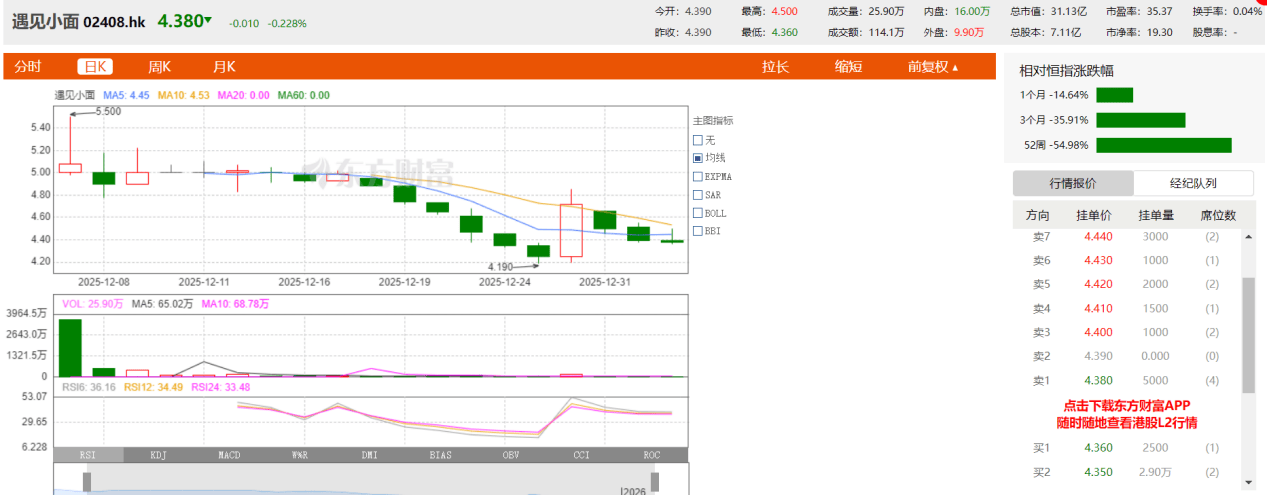
Core Viewpoint - The initial public offering (IPO) of "Yujian Xiaomian" faced significant challenges, with its stock price declining sharply after a highly anticipated launch, reflecting a disconnect between market enthusiasm and the company's operational fundamentals [1][2][4]. Financial Performance - The company issued 97.36 million H-shares at an initial price of HKD 7.04, raising approximately HKD 685 million, but the stock opened at HKD 5.00, a drop of nearly 29% on the first day, closing at HKD 5.08, a total decline of 27.84% [1]. - By December 29, 2025, the stock price had further decreased to HKD 4.25, representing a drop of over 39% from the IPO price, and the market capitalization fell to approximately HKD 31.13 billion [2]. - The company's financial structure shows high leverage, with asset-liability ratios of 95.77%, 93.62%, and 89.86% from 2022 to 2024, indicating persistent financial risk [9][10]. Business Model and Growth Strategy - "Yujian Xiaomian" plans to expand its restaurant network significantly, aiming to add 520 to 610 new locations over the next three years, despite current declines in average sales per store [5][12]. - The average order value has decreased from RMB 36.2 in 2022 to RMB 31.8 in 2025, and the average daily sales per store have also declined, indicating challenges in maintaining profitability amid aggressive expansion [5][7]. Market Position and Competition - The company ranks fourth in the Chinese noodle restaurant market with a transaction volume of RMB 13.48 billion, capturing only 0.5% of the market share, highlighting a fragmented industry with limited brand dominance [12]. - The competitive landscape shows that "Yujian Xiaomian" lacks distinct advantages in expansion quality, brand establishment, and profitability compared to peers like "Hefulao" [12]. Consumer Concerns - Food safety issues have emerged as a significant concern, with numerous complaints regarding food quality, including reports of foreign objects in food and health-related incidents [11]. - Regulatory scrutiny has increased, with the company facing penalties for failing to meet food safety standards, further impacting its reputation [11]. Future Outlook - The company must address the balance between rapid expansion and operational quality, as well as the need for sustainable profitability, to navigate its growth challenges effectively [13].
遇见小面上市首日股价大跌27%,单店指标明显下滑
Xin Lang Cai Jing· 2025-12-25 12:41
Core Viewpoint - The company "Yujian Xiaomian" (02408.HK) has officially listed on the Hong Kong Stock Exchange, becoming the first stock of a Chinese noodle restaurant, but its stock price fell by 27.84% on the first day of trading, closing at HKD 5.08 per share, with a total market capitalization of approximately HKD 3.61 billion [1][4][10]. Company Overview - Founded in 2014, Yujian Xiaomian has received investments from various firms including Jiumaojiu Group, Baifu Holdings, Country Garden Ventures, and Xijia De, and has expanded its presence in cities like Beijing, Shanghai, Guangzhou, Shenzhen, and Hong Kong [1][10]. - The company raised approximately HKD 685 million through the issuance of 97.36 million H-shares at an issue price of HKD 7.04 per share, with cornerstone investors subscribing to USD 22 million worth of shares, accounting for about 25% of the total fundraising [4][12]. Market Performance - On its first trading day, Yujian Xiaomian's stock price opened nearly 29% lower and closed down 27.84% from its issue price, reflecting market skepticism about its business model and future prospects [4][12]. - The company achieved a significant oversubscription of 425.97 times for its public offering, indicating initial strong interest from investors [4][12]. Business Challenges - Analysts have identified three major "singularization" challenges facing Yujian Xiaomian: 1. Geographic concentration, with stores heavily concentrated in Guangdong Province and insufficient expansion outside this region 2. Limited product range, primarily focused on Chongqing noodles, lacking diversification to support risk resilience 3. A singular operational model that restricts efficiency in cross-regional expansion [5][13]. Expansion Strategy - Yujian Xiaomian is in a phase of accelerated expansion, having opened its 200th store in Shanghai in July 2023 and planning to reach 400 stores by April 2025 [7][15]. - As of November 18, 2025, the company operates 465 restaurants, with 331 being directly operated and 86 franchised, and plans to add 520 to 610 new stores from 2026 to 2028, focusing on lower-tier cities and overseas markets [7][15]. Financial Performance - The company's revenue increased from CNY 418 million in 2022 to CNY 1.154 billion in 2024, with a turnaround from a net loss of CNY 35.973 million to a profit of CNY 60.7 million [7][15]. - In the first half of 2025, revenue reached CNY 703 million, a year-on-year growth of 33%, while net profit surged by 95.77% to CNY 41.834 million [7][15]. Operational Efficiency - Despite revenue growth, key operational metrics such as average daily sales per store have declined, with direct-operated restaurants seeing a drop from CNY 12,693 to CNY 11,805, and franchised restaurants from CNY 12,528 to CNY 11,493 [8][16][17]. - The overall turnover rates for direct and franchised stores also decreased, indicating potential inefficiencies in the current business model [8][18]. Future Outlook - The funds raised from the IPO will be used to expand the restaurant network, enhance market penetration, upgrade technology and digital systems, strengthen brand loyalty programs, and pursue strategic investments or acquisitions in the upstream food processing sector [18]. - Analysts suggest that the company should focus on improving operational efficiency and diversifying its product offerings before pursuing aggressive expansion, as the current model may not be sustainable [18].
遇见小面「跑步」上市,股价却“水银泻地”
Sou Hu Cai Jing· 2025-12-24 11:32
Core Viewpoint - The company "遇见小面" (Yujian Xiaomian) faces significant challenges in the competitive Chinese noodle restaurant market, despite its initial public offering (IPO) and reported revenue growth. The disparity between its market performance and consumer foot traffic raises questions about its long-term sustainability and competitive advantage [2][6][20]. Market Performance - Since its IPO, "遇见小面" has experienced a continuous decline in stock price, dropping over 38% from its issuance price of 7.04 HKD per share, reflecting a market sentiment that is not favorable towards the brand [4][6]. - As of December 24, the stock price fell to 4.99 HKD, resulting in a market capitalization decrease from approximately 35.55 billion HKD to 30.91 billion HKD within five trading days [2][4]. Industry Context - The Chinese noodle restaurant market is projected to grow at a compound annual growth rate (CAGR) of 12.72%, reaching approximately 286.6 billion CNY by 2024, with expectations to exceed 300 billion CNY by 2025 [6]. - Despite the overall market growth, the industry is characterized by intense competition, with the top five brands holding less than 10% market share, leading to a fragmented landscape where no single brand dominates [6][20]. Company Strategy and Challenges - "遇见小面" has expanded its store count significantly, from around 100 stores before 2021 to 252 by the end of 2023, with plans for 360 stores in 2024 and over 440 in 2025 [8][20]. - However, the growth in store numbers has not translated into improved operational efficiency, as key performance indicators such as store turnover rates and average customer spending have declined [7][20]. Consumer Experience - The in-store experience at "遇见小面" is designed to be appealing, with a clean and comfortable environment, diverse menu options, and attention to service details [11][12]. - Despite these efforts, customer feedback indicates dissatisfaction with service quality and food taste, which could hinder repeat business and brand loyalty [13][16]. Competitive Landscape - "遇见小面" competes directly with brands like "和府捞面" (Hefulao), which positions itself in the high-end market with a focus on premium dining experiences, making it difficult for "遇见小面" to penetrate that segment [17][18]. - The presence of numerous competitors, including regional brands and those specializing in niche offerings, further complicates "遇见小面"'s market position, as it faces pressure from both high-end and budget-friendly options [19][20].
遇见小面破发,中式面馆梦碎
36氪· 2025-12-17 00:09
Core Viewpoint - The listing of "Yujian Xiaomian" on the Hong Kong Stock Exchange has reignited market interest in the chain noodle restaurant sector, but its high valuation and subsequent stock price drop raise questions about the industry's growth potential and capital market sentiment [5][6][17]. Industry Overview - The Chinese noodle restaurant market is projected to reach a total transaction value of 510 billion yuan by 2029, with a compound annual growth rate of 10.9% from 2025 to 2029 [5]. - The number of noodle restaurant outlets in China is expected to exceed 660,000 by May 2025, indicating significant market competition [5]. Capital Market Sentiment - The enthusiasm for noodle restaurants has waned significantly since 2021, when major brands experienced a surge in financing activity, with 24 financing events and over 4 billion yuan raised [8][12]. - The recent listing of "Yujian Xiaomian" saw its stock price drop nearly 29% on the first day, reflecting a broader skepticism in the capital market regarding high valuations in the noodle restaurant sector [5][17]. Competitive Landscape - The industry can be categorized into three tiers: - The first tier includes "Hefuliao" (577 stores), "Yujian Xiaomian" (465 stores), and "Wuye Banmian" (670 stores), each targeting different market segments [16]. - The second tier consists of brands like "Majiyong" and "Zhanglala," which are facing growth challenges due to market saturation [16]. - The third tier comprises regional brands and individual stores that lack national expansion capabilities [16]. Financial Performance - "Yujian Xiaomian" reported a loss of 35.97 million yuan in 2022, with projected profits of 45.91 million yuan and 60.70 million yuan for 2023 and 2024, respectively, indicating a struggle for profitability [20]. - "Hefuliao" has experienced revenue fluctuations, with figures dropping from 17.32 billion yuan in 2021 to 14.56 billion yuan in 2022, alongside increasing net losses [20]. Strategic Responses - Brands are attempting to counteract growth challenges through price reductions and franchise expansions. "Hefuliao" has successfully lowered prices by 20-30%, resulting in a return to profitability [29]. - The franchise model is being adopted by several brands, including "Yujian Xiaomian," which has seen a compound annual growth rate of 66.2% in franchise revenue from 2022 to 2024 [30]. Market Challenges - The high pricing strategy of many noodle restaurants is misaligned with consumer perceptions, leading to decreased demand. The average consumer spending is around 30 yuan, but many offerings are perceived as not providing value for money [24]. - The industry faces significant challenges from rising consumer price sensitivity, increased competition, and a shift in dining preferences towards more affordable options [24][35].

遇见小面上市首日股价破发,资本集体看淡,中式餐饮上市路不好走
Sou Hu Cai Jing· 2025-12-12 04:05
Core Viewpoint - The recent IPO of "Encounter Small Noodles" on the Hong Kong Stock Exchange, touted as the first stock of Chinese noodle restaurants, has faced a significant decline, dropping nearly 29% on its opening day and currently hovering around 5 HKD, raising concerns about the future of the entire industry [1][3]. Industry Overview - The Chinese noodle restaurant sector experienced a surge in 2021, characterized by a wave of capital investment, with 24 financing events reported that year, leading to significant valuations for brands like "Encounter Small Noodles" [3][5]. - By 2023, the industry has cooled down considerably, with major brands like "Five Ye Mixed Noodles" closing over 600 stores within a year, and "Chen Xianggui" struggling with sales, indicating a shift in market dynamics [5][9]. Market Structure - The industry has formed a clear three-tier structure: - The first tier includes major players like "He Fu Noodles" with 577 stores, "Encounter Small Noodles" with 465 stores, and "Five Ye Mixed Noodles" leading with 670 stores [7]. - The second tier consists of brands like "Ma Ji Yong" and "Zhang La La," which are facing challenges due to market saturation and slowing growth [9]. - The third tier comprises local brands and small shops that struggle to expand beyond their local markets [9]. Financial Performance - "Encounter Small Noodles" is projected to achieve a net profit of 60.7 million RMB in 2024, translating to an average profit of 169,000 RMB per store, which is significantly low compared to industry standards [9][11]. - The high operating costs and low profitability are evident, with "He Fu Noodles" reporting a cumulative loss of nearly 700 million RMB from 2020 to 2022 [9][11]. Pricing and Consumer Perception - The average price point for new Chinese noodle restaurants is around 30 RMB, but many consumers perceive the value as lacking, leading to a disconnect between pricing and customer expectations [11][12]. - Brands are attempting to address these issues through price reductions, with "He Fu Noodles" reducing prices by 20%-30% in late 2023, while "Encounter Small Noodles" has seen a decline in average spending from 36 RMB to around 31 RMB [12][14]. Strategic Responses - In response to market challenges, brands are resorting to price cuts and franchise models to drive growth, with "He Fu Noodles" even exploring franchise options after a decade of avoiding them [12][16]. - However, these strategies are seen as short-term fixes rather than sustainable solutions, as profitability remains a critical concern [14][16]. Industry Outlook - The industry is undergoing a necessary correction, moving away from speculative capital-driven growth towards a focus on sustainable business practices, emphasizing quality, cost management, and customer satisfaction [16].