
生态警务机制

Search documents
江苏“昆仑—2025”专项工作成果发布
Xin Hua Ri Bao· 2025-12-23 23:21
Group 1 - The core focus of Jiangsu's public security efforts is on combating crimes in the food, drug, environmental, and intellectual property sectors, with a significant reduction in reported cases and arrests this year [1] - A total of 2,767 criminal cases related to food, drug, and environmental issues were handled, resulting in the arrest of 6,444 suspects, with reported cases and crime rates decreasing by 22.5% and 22% respectively compared to the previous year [1] - The "Kunlun" special operation has been ongoing for seven years, maintaining a strong crackdown on prominent crimes in the food, drug, and environmental sectors [1] Group 2 - Jiangsu's public security is actively addressing crimes that infringe upon the rights of vulnerable groups, including the elderly, women, and children, with a focus on specific products such as botulinum toxin and cosmetics [2] - The province has established a rapid testing system with three central laboratories and 59 quick testing rooms, enabling comprehensive coverage and coordinated efforts across the province [2] - Regular undercover inspections and follow-up investigations have led to the resolution of 71 cases based on abnormal test results [2]
从先行先试到全国推广,生态警务机制如何更好“联动”?
Zhong Guo Huan Jing Bao· 2025-12-09 23:29
Core Viewpoint - The issuance of the "Opinions on Strengthening the Construction of Ecological Policing Mechanism" by the Ministry of Public Security and nine other departments marks a significant step towards institutionalizing ecological policing at the national level, providing strong mechanisms to combat environmental resource crimes and ensuring the safety of ecological civilization construction [1] Group 1 - The establishment of the ecological policing mechanism is crucial for effectively addressing environmental crimes and has been a long-standing demand, with successful pilot programs in regions like Zhejiang and Jiangsu [1][2] - The implementation of the new Environmental Protection Law in 2015 allowed for the transfer of certain illegal activities to the public security authorities, significantly enhancing the efficiency of environmental law enforcement [1] - The current priority is to adapt the ecological policing mechanism to local conditions across the country, ensuring that it is supported by reliable personnel, funding, and institutional frameworks [2] Group 2 - Successful ecological policing relies on collaboration among various departments, requiring unified goals and effective communication to protect the environment [3] - The ultimate aim of ecological policing is not just to punish environmental crimes but to encourage proactive pollution control and ecological restoration by businesses and individuals [3] - The establishment of a robust ecological policing mechanism is essential for enhancing the overall effectiveness of environmental protection through legal means, contributing to high-quality development and ecological safety [4]
引导金融租赁公司规范开展融资租赁业务|营商环境周报
2 1 Shi Ji Jing Ji Bao Dao· 2025-12-09 04:14
Group 1: Environmental Law Enforcement - The Ministry of Public Security and ten other departments aim to establish an ecological policing mechanism by 2027 to combat environmental resource crimes and ensure safety in ecological development [2][3] - The mechanism will focus on four main tasks: strengthening criminal enforcement, enhancing proactive prevention, promoting comprehensive governance, and facilitating value transformation [3] Group 2: Financial Leasing Regulation - The National Financial Regulatory Administration issued a new management method for financial leasing companies, effective from January 1, 2026, to enhance compliance and focus on core business [4][5] - The method includes 68 articles covering due diligence, risk assessment, contract execution, and internal controls, emphasizing risk prevention and management [4] Group 3: AI in Civil Aviation - The Civil Aviation Administration of China released an implementation opinion to promote the integration of artificial intelligence in civil aviation by 2030, aiming for deep integration across various sectors [6][7] - The opinion outlines key areas for AI application, including safety risk warning, operational optimization, passenger services, logistics efficiency, and regulatory decision-making [8] Group 4: Technology Achievement Registration - Jiangxi Province revised its technology achievement registration rules to expand the scope and shorten the public announcement period to seven days, enhancing the management of technology achievements [10] - The new rules encourage the registration of various types of achievements and aim to improve the efficiency of technology transfer and application [10] Group 5: Technology Transfer Support in Ningxia - Ningxia's new management method for key technology transfer projects offers up to 1 million yuan in support for high-value technology achievements, focusing on innovation in key industries [11][12] - The method categorizes projects into "pre-guidance" and "post-support," promoting collaboration between enterprises and research institutions [11]
十部门发文严打环境资源犯罪
Zhong Guo Jing Ji Wang· 2025-12-02 14:28
Core Viewpoint - The Ministry of Public Security, in collaboration with several other governmental departments, has issued an opinion to strengthen the ecological policing mechanism, aiming to combat environmental resource crimes effectively by 2027 and establish a mature system by 2035 [1][2]. Group 1: Strengthening Criminal Prosecution - The opinion emphasizes a strict approach to law enforcement against environmental pollution, wildlife resource destruction, illegal fishing, illegal mining, and other significant crimes [1]. - It highlights the need for improved mechanisms for case supervision, collective strikes, and collaborative investigations to address the professionalization and cross-regional nature of these crimes [1]. Group 2: Proactive Prevention - The opinion encourages localities to explore mechanisms such as river and lake police chiefs and ecological police chiefs, integrating ecological policing with daily law enforcement and grassroots social governance [2]. - It suggests establishing ecological policing collaborative centers and workstations in areas with heavy ecological protection tasks and frequent environmental crimes [2]. Group 3: Promoting Comprehensive Governance - The opinion advocates for a strategy that combines enforcement with governance, ensuring that identified risks are reported to relevant departments to address management gaps [2]. - It stresses the importance of balancing protection and restoration, guiding offenders to take responsibility for ecological restoration in environmental resource crime cases [2]. Group 4: Supporting Value Transformation - The opinion calls for the integration of crime fighting with ecological governance and green industrial transformation to enhance economic development advantages and the total value of ecological products [2]. - It also emphasizes the need to combat crimes that infringe on legitimate business rights and protect high-quality ecological resources [2]. Group 5: Organizational and Operational Mechanisms - The opinion outlines requirements for improving organizational coordination, practical operations, inter-departmental collaboration, and regional cooperation [2]. - It also highlights the importance of strengthening team building, digital empowerment, legal construction, and foundational support measures [2].
中国推动建立生态警务机制打击环境资源犯罪
Zhong Guo Xin Wen Wang· 2025-12-01 05:15
Core Viewpoint - The Chinese government is establishing an ecological policing mechanism to combat environmental resource crimes, with a goal to have a basic system in place by 2027 and a mature system by 2035 [1][2] Group 1: Ecological Policing Mechanism - The Ministry of Public Security and ten other departments have jointly issued an opinion to promote the establishment of an ecological policing mechanism led by public security agencies [1] - The mechanism aims to enhance collaboration among relevant departments and emphasizes a systematic approach, innovation, and local adaptation [1] Group 2: Goals and Tasks - The opinion outlines a two-step goal for the ecological policing mechanism: basic establishment by 2027 and a fully developed system by 2035 [1] - Four main tasks are identified: strengthening criminal enforcement, enhancing proactive prevention, promoting comprehensive governance, and facilitating value transformation [1][2] Group 3: Criminal Enforcement - The opinion stresses a strict enforcement policy against crimes such as environmental pollution, destruction of wildlife resources, illegal fishing, illegal mining, and unlawful occupation of agricultural land [1] Group 4: Proactive Prevention - Local authorities are encouraged to explore mechanisms like river and lake police chiefs, forest police chiefs, and ecological police chiefs tailored to local conditions [1][2] Group 5: Value Protection - The opinion mandates strict actions against crimes infringing on legitimate business rights, particularly concerning high-quality agricultural products and geographical indication products [2]
十部门推动建立生态警务机制,这些犯罪活动将严打
Ren Min Ri Bao· 2025-12-01 01:53
Core Viewpoint - The Ministry of Public Security, in collaboration with multiple government departments, has issued an opinion to establish an ecological policing mechanism aimed at combating environmental resource crimes and ensuring high-quality development through enhanced safety measures [1]. Group 1: Strengthening Criminal Prosecution - The opinion emphasizes a strict approach to law enforcement against environmental pollution, wildlife resource destruction, illegal fishing, and other significant crimes, addressing the professionalization and organization of such criminal activities [2]. - Mechanisms for case supervision, collective strikes, and collaborative intelligence sharing will be improved to implement precise, in-depth, and large-scale law enforcement actions [2]. Group 2: Enhancing Proactive Prevention - Local governments are encouraged to explore mechanisms such as river and lake police chiefs and ecological police chiefs, integrating ecological policing with daily law enforcement and grassroots social governance [2]. - The establishment of ecological policing joint centers and workstations in areas with heavy ecological protection tasks and frequent environmental crimes is recommended [2]. Group 3: Promoting Comprehensive Governance - The opinion calls for a dual focus on protection and restoration, ensuring that risks and hidden dangers are reported to relevant departments for proactive governance [3]. - It aims to guide offenders to actively undertake ecological restoration responsibilities during environmental crime case handling, achieving a balance of political, legal, and social outcomes [3]. Group 4: Supporting Value Transformation - The opinion seeks to integrate crime fighting with ecological governance and green industrial transformation, enhancing economic advantages and the total value of ecological products [3]. - It stresses the importance of protecting the legitimate rights of enterprises and combating infringement and counterfeiting of high-quality agricultural products and geographical indication products [3]. - Clear requirements for organizational coordination, practical operations, and inter-departmental collaboration are outlined to maximize effectiveness [3].
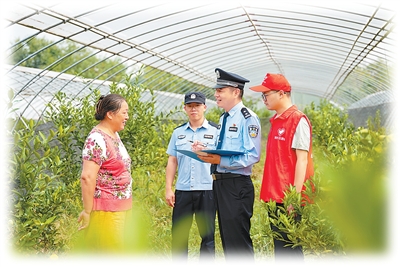
“生态合伙人”守护绿水青山(法治头条)
Ren Min Ri Bao· 2025-08-13 21:50
Core Viewpoint - The article emphasizes the innovative ecological policing model implemented by the Huzhou Public Security Bureau to support green development and ecological civilization construction, aligning with the "Lucid waters and lush mountains are invaluable assets" philosophy [2][5][16]. Group 1: Ecological Policing Mechanism - Since 2020, Huzhou has explored an ecological policing mechanism, covering key ecological resources such as lakes, mining areas, and forests, with 2,185 ecological police patrolling 9,380 kilometers of rivers and 157 reservoirs [3][8]. - The ecological policing model has shifted from passive response to proactive prevention, involving over 20 departments and 150 types of enforcement actions, thus enhancing collaborative governance [5][6]. Group 2: Cross-Departmental Collaboration - The establishment of ecological co-governance centers has improved inter-departmental collaboration, reducing on-site response times by an average of one-third and increasing risk detection rates by 40% since 2020 [6][8]. - The co-governance centers facilitate joint inspections and discussions among various departments, leading to more efficient law enforcement and clearer responsibilities [7][11]. Group 3: Cross-Regional Cooperation - The creation of cross-provincial ecological policing cooperation mechanisms has been initiated, particularly in areas where jurisdictional boundaries complicate enforcement [9][10]. - A joint case involving hazardous waste disposal led to the formation of a collaborative task force between Jiangsu and Zhejiang provinces, resulting in successful law enforcement actions [10][11]. Group 4: Community Engagement - The ecological policing initiative has mobilized local communities to participate actively in environmental protection, expanding the network of ecological police and fostering a culture of vigilance among residents [13][15]. - The "Deep Blue Plan" exemplifies the integration of ecological protection with economic development, showcasing how community involvement can lead to sustainable outcomes [15][16].

公安部:1月至5月,共立案侦办非法占用农用地刑事案件千余起
Xin Jing Bao· 2025-06-25 04:58
Core Viewpoint - The article emphasizes the efforts of public security agencies in China to combat illegal occupation of agricultural land, highlighting the establishment of an ecological policing mechanism and the importance of maintaining national food and ecological security [1][2]. Group 1: Actions Taken - Public security agencies have investigated over 1,000 criminal cases of illegal occupation of agricultural land from January to May this year, resulting in the arrest of more than 2,600 suspects, creating a strong deterrent effect [1]. - Special operations such as "Kunlun" and "Jinfeng" have been organized to target crimes that damage black soil resources, focusing on illegal occupation of farmland and forest land for various unauthorized constructions [1]. - The implementation of a new quality combat power enhancement project has been initiated, utilizing aerial and space remote sensing technology to create a data analysis system and improve the effectiveness of law enforcement [1]. Group 2: Collaborative Efforts - The public security agencies are actively participating in special rectification efforts to address prominent issues related to illegal occupation of agricultural land, enhancing mechanisms for information sharing and case transfer with administrative departments [1]. - The commitment to a high-pressure crackdown on illegal occupation of agricultural land is reinforced through initiatives like "Kunlun-2025," aimed at protecting land resources and ensuring food security [2].