
生猪二次育肥

Search documents
《农产品》日报-20260106
Guang Fa Qi Huo· 2026-01-06 02:28
1. Report Industry Investment Ratings - There is no information about industry investment ratings in the provided reports. 2. Core Views of the Reports Oils and Fats - Palm oil: There is a risk of a downward trend in Malaysian palm oil if it breaks below 4000 ringgit. In China, the futures of Dalian palm oil are expected to be weakly viewed in the short - term due to high port inventories and the potential weakness of Malaysian palm oil. - Soybean oil: CBOT soybean oil may have a narrow - range oscillation in the short - term. In China, the fundamentals of soybean oil are positive as inventories are decreasing, and imports are expected to decline in January [1]. - Rapeseed oil: Attention should be paid to whether COFCO can start pressing on time. After starting, it may relieve the shortage in South China, but there is a risk of further price decline in the futures market [1]. Cotton - ICE US cotton is expected to maintain a volatile trend. In the Chinese market, cotton prices are expected to be volatile and slightly stronger in the short - term due to factors such as faster sales progress, cost solidification, and expected reduction in planting area in 2026 [3]. Sugar - ICE raw sugar is expected to trade in a range of 14.5 - 15.5 cents per pound in the short - term. In the Chinese market, sugar prices are expected to be weak and volatile at a low level due to the expected supply surplus and cautious market sentiment [4]. Jujube - The spot market of jujube has weak trading, but the new - season warehouse receipt cost provides some support to the futures market. Attention should be paid to pre - Spring Festival stocking and inventory reduction progress [6]. Corn and Corn Starch - Corn prices are expected to be volatile in the short - term due to the co - existence of farmers' reluctance to sell and policy - supported supply. However, policy releases and pre - Spring Festival selling pressure may suppress prices [8]. Pork - Spot pork prices are back in a volatile pattern. The futures market is expected to be range - bound in the short - term. Although there is some support from secondary fattening, the overall supply in January is relatively loose [10]. Meal - US soybeans have a technical rebound, but the global supply - demand pattern and South American production expectations still suppress the market. In China, soybean meal is expected to be slightly stronger and volatile in the short - term [13]. Eggs - The supply pressure of eggs may ease as the number of laying hens is expected to decrease. Although the market sentiment is positive due to approaching Spring Festival stocking, considering the relatively loose supply, the main contract is expected to be volatile at a low level [15]. 3. Summary by Catalog Oils and Fats - **Prices**: On January 5, 2026, the spot price of Jiangsu first - grade soybean oil remained unchanged at 8410 yuan/ton, and the futures price of Y2605 decreased by 0.08% to 7856 yuan/ton. The spot price of Guangdong 24 - degree palm oil decreased by 1.16% to 8490 yuan/ton, and the futures price of P2605 decreased by 1.12% to 8488 yuan/ton. The spot price of Jiangsu third - grade rapeseed oil increased by 0.20% to 10050 yuan/ton, and the futures price of OI605 decreased by 0.47% to 9044 yuan/ton [1]. - **Spreads**: The soybean - palm oil spread (2605) increased by 12.47% to - 632 yuan/ton, and the rapeseed - soybean oil spread (2605) decreased by 3.02% to 1188 yuan/ton [1]. Cotton - **Futures Market**: On January 5, 2026, the price of cotton 2605 increased by 0.48% to 14655 yuan/ton, and the price of cotton 2609 increased by 0.58% to 14845 yuan/ton. The price of ICE US cotton increased by 0.98% to 64.64 cents per pound [3]. - **Spot Market**: The Xinjiang arrival price of 3128B cotton increased by 0.32% to 15442 yuan/ton, and the CC Index: 3128B increased by 0.38% to 15615 yuan/ton [3]. Sugar - **Futures Market**: On January 5, 2026, the price of sugar 2605 increased by 0.11% to 5257 yuan/ton, and the price of sugar 2609 increased by 0.06% to 5269 yuan/ton. The price of ICE raw sugar increased by 0.82% to 14.72 cents per pound [4]. - **Spot Market**: The Nanning spot price decreased by 0.37% to 5330 yuan/ton, and the Kunming spot price decreased by 0.19% to 5200 yuan/ton [4]. Jujube - **Futures Market**: On January 5, 2026, the price of jujube 2601 increased by 1.82% to 9250 yuan/ton, and the price of the main contract jujube 2605 decreased by 0.11% to 8955 yuan/ton [6]. - **Spot Market**: The Cangzhou super - grade spot price decreased by 0.63% to 9460 yuan/ton, and the first - grade spot price remained unchanged at 8200 yuan/ton [6]. Corn and Corn Starch - **Corn**: On January 5, 2026, the price of corn 2603 decreased by 0.09% to 2224 yuan/ton, and the Jinzhou Port FAS price decreased by 0.86% to 2310 yuan/ton [8]. - **Corn Starch**: The price of corn starch 2603 decreased by 0.24% to 2509 yuan/ton, and the Changchun spot price remained unchanged at 2570 yuan/ton [8]. Pork - **Futures Market**: On January 5, 2026, the price of the main contract decreased by 25.86% to 1190 yuan/ton, and the price of pork 2605 decreased by 0.45% to 12110 yuan/ton [10]. - **Spot Market**: The Henan spot price decreased by 4.10% to 12850 yuan/ton, and the Shandong spot price decreased by 1.15% to 12900 yuan/ton [10]. Meal - **Soybean Meal**: The spot price in Jiangsu remained unchanged at 3100 yuan/ton, and the futures price of M2605 increased by 0.18% to 2754 yuan/ton [13]. - **Rapeseed Meal**: The spot price in Jiangsu increased by 0.41% to 2440 yuan/ton, and the futures price of RM2605 decreased by 0.17% to 2361 yuan/ton [13]. Eggs - **Futures Market**: On January 5, 2026, the price of the egg 03 contract increased by 1.39% to 2992 yuan per 500KG, and the price of the egg 04 contract increased by 1.15% to 3214 yuan per 500KG [15]. - **Spot Market**: The egg - producing area price increased by 0.23% to 3.02 yuan per catty, and the egg - chick price remained unchanged at 2.80 yuan per chick [15].
高瞻远“猪”:生猪二次育肥行为分析及预测
Sou Hu Cai Jing· 2025-11-24 09:19
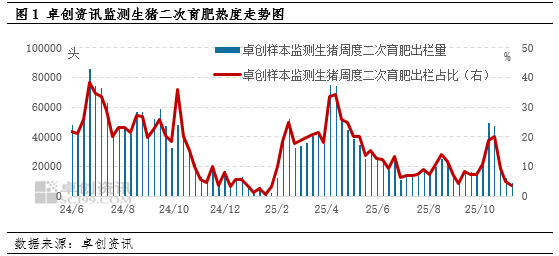
2025年生猪价格低位震荡后震荡下滑。截至11月20日,卓创资讯监测2025年全国瘦肉型生猪均价为 14.04元/公斤,较2024年同期下跌16.72%。理论上,2025年生猪的出栏量是由2024年3月至2025年2月份 的能繁母猪存栏量决定的,彼时养殖端正处于缓慢扩产阶段,能繁母猪存栏量增加,叠加母猪生产效率 提升,对应2025年生猪出栏量增加,利空生猪价格。同时,2025年终端需求支撑欠佳,虽屠宰量同比增 加,但鲜销市场支撑不足,屠宰企业收购生猪积极性较低,难以对猪价形成较强支撑。2025年猪价震荡 下滑,二次育肥养殖户看涨信心降低,补栏行为减少,二次育肥热度下滑。 2025年二次育肥盈利欠佳 养殖户育肥动力不足 高瞻远"猪":生猪二次育肥行为分析及预测 【导语】2025年生猪市场中二次育肥热度明显下降,对猪价的托底效果有所减弱。这一变化背后,既受 市场行情的直接影响,也离不开政策引导与养殖端盈利状况的驱动。未来,二次育肥或因季节性需求与 部分养殖模式选择仍有存在空间,但热度难有明显回升,2026年二次育肥或较难对猪价形成托底作用。 2025年二次育肥热度下降 卓创资讯数据显示,2025年样本企业出栏量流 ...

二育带动猪价反弹,供应压制仍未消除
Guo Xin Qi Huo· 2025-10-25 23:33
Report Summary 1) Report Industry Investment Rating No specific industry investment rating is provided in the report. 2) Core Viewpoints of the Report - From the calculation of piglet birth numbers, the current period to March next year is the stage when the domestic pig slaughter pressure is realized, and the theoretical slaughter volume will generally maintain an increasing pattern in the later period. - The cross - verification of feed production and sales shows that the month - on - month growth rate of fattening feed sales in August and September is good, indicating that the inventory of social pig sources is gradually increasing. - From the perspective of the slaughter rhythm, since September, the average slaughter weight of large - scale farms has increased, while that of small - scale farmers has decreased, but both are higher year - on - year, reflecting that the live inventory is still high. - From the demand side, November to January is the traditional consumption peak season. However, under the situation of insufficient overall consumption confidence, the peak season may not have an unexpected performance, and the final impact on prices still depends on the matching degree of future supply. - Since October, with the increase in the price difference between fat and standard pigs, secondary fattening has increased again. Without effective reduction of the overall live inventory, secondary fattening will increase the supply before the peak season and suppress the performance space of the peak season. - Currently, the futures price is at a premium, which has priced in the peak - season expectation to some extent. In the short term, attention should be paid to the duration of secondary fattening; in the medium term, the time point of reducing live inventory; in the long term, the industry's capacity reduction rhythm under the background of profit compression. - In terms of operation, adopt a short - selling strategy on rebounds for contracts LH2601 and LH2603. Treat the far - month contract LH2609 as a wide - range oscillation and pay attention to the opportunity of low - level band buying [1][23]. 3) Summary by Relevant Catalogs a. Market Review - Since October, the spot market of live pigs has declined significantly. The spot price in Henan, the benchmark area, has approached the 11 - yuan mark, and that in Guangxi has even fallen below 10 yuan. After the National Day holiday, the futures price of live pigs dropped sharply and then rebounded in shock in late October. - The consumption boost during the holiday was ineffective, and large - scale farms accelerated the slaughter rhythm, leading to a sharp decline in the spot price. As the pig price fell, some farmers began to hold back sales, and the price difference between fat and standard pigs widened, indicating a shortage of large pigs in the market and a weakening of the short - term selling impact. - In late October, the large - scale cooling in high - temperature areas in the South was beneficial to consumption. In addition, traditionally, the consumption volume increases significantly month - on - month starting from November. Driven by the expectation of the consumption peak season and the high price difference between fat and standard pigs, the active entry of secondary fattening was the main driving force for the rebound of the pig price in late October [3]. b. Supply and Demand Analysis of Live Pigs - **High Supply of Fattened Pigs in the Later Period Shown by Piglet Data**: The national inventory of breeding sows reached a peak of 40.8 million in November 2024 and then fluctuated downward. By the end of September, it was 40.35 million, a reduction of 1.1% from the peak. In October, due to the decline in pig prices, the slaughter volume of culled sows increased in some areas. The piglet birth numbers from various institutions show that the slaughter pressure will gradually increase until November 2025 and will not significantly decrease until March 2026 [5]. - **Increase in Social Pig Sources Confirmed by Feed Sales**: From June to September 2025, the sales of piglet feed and nursery feed generally increased steadily. The month - on - month growth rate of fattening pig feed sales in August and September 2025 was still high, indicating an overall increase in the inventory of social pig sources, but the marginal increase may be slightly lower than last year [8]. - **Rise in Secondary Fattening with High Price Difference between Fat and Standard Pigs**: The average slaughter weight of small - scale farmers' pigs peaked and declined in September but was still at a high level year - on - year. The average weight of large - scale farms' pigs bottomed out and rebounded in early September, with a small increase overall and also an increase year - on - year. The price difference between fat and standard pigs further soared in September, indicating a tightening supply of fat pigs after the slaughter of large pigs by small - scale farmers. Since August, the utilization rate of secondary fattening pens has continuously declined to a relatively low level but rebounded in October due to the high price difference between fat and standard pigs and the low absolute price [10][12]. - **Significant Increase in Slaughter Volume but Limited Demand**: According to the Ministry of Commerce, the national pig slaughter volume has increased significantly compared with last year, reflecting an increase in domestic pig supply. The fresh - meat sales rate of slaughterhouses has decreased, and the utilization rate of frozen - product storage capacity has continuously increased, reflecting the sluggish terminal consumption and the inability to effectively absorb the increased supply. November and December are traditional consumption peak seasons, with a month - on - month increase of 10% in daily consumption in November and over 15% in December. The strengthening of later - stage consumption may provide some support for the spot price, but the market trend still depends on the comprehensive comparison of supply and demand forces [14]. - **Industry in Loss and Limited Space for Cost Reduction**: Since the second half of September 2025, the pig price has weakened rapidly, and the pig - farming profit has also deteriorated significantly. As the national average price fell below 12 yuan, the profit of the self - breeding and self - fattening model has entered the loss range. Recently, the price of piglets has fallen, and the expected slaughter cost of fattened pigs from purchased piglets has also dropped rapidly. The feed cost has limited room for further decline, and the low pig price will continue to squeeze profits and may gradually stimulate the industry's capacity reduction [20]. c. Conclusion and Market Outlook - The current period to March next year is the stage when the domestic pig slaughter pressure is realized, and the theoretical slaughter volume will generally maintain an increasing pattern. - The cross - verification of feed production and sales shows an increase in the inventory of social pig sources. - The live inventory is still high. The peak season may not have an unexpected performance, and secondary fattening will suppress the performance space of the peak season. - In the short term, pay attention to the duration of secondary fattening; in the medium term, focus on the time point of reducing live inventory; in the long term, watch the industry's capacity reduction rhythm under the background of profit compression. - Adopt a short - selling strategy on rebounds for contracts LH2601 and LH2603. Treat the far - month contract LH2609 as a wide - range oscillation and pay attention to the opportunity of low - level band buying [23].